 Max 10min read
📝Summary
Manufacturers no longer need one loyalty scheme for every dealer, distributor, product, and region. This blog explains how B2B brands design targeted campaigns by location, product, partner type, season, and performance, using examples from paints, pipes, lubricants, and building products. It also shows how LoyaltyXpert manages flexible rules, tiers, bonus schemes, and tracking from one platform.
Most loyalty programs for manufacturers still run a single scheme across the whole channel. A dealer in Pune earns the same points as a distributor in Guwahati. A slow-moving SKU carries the same reward as a bestseller. It looks fair, yet it rarely moves the numbers sales teams chase.
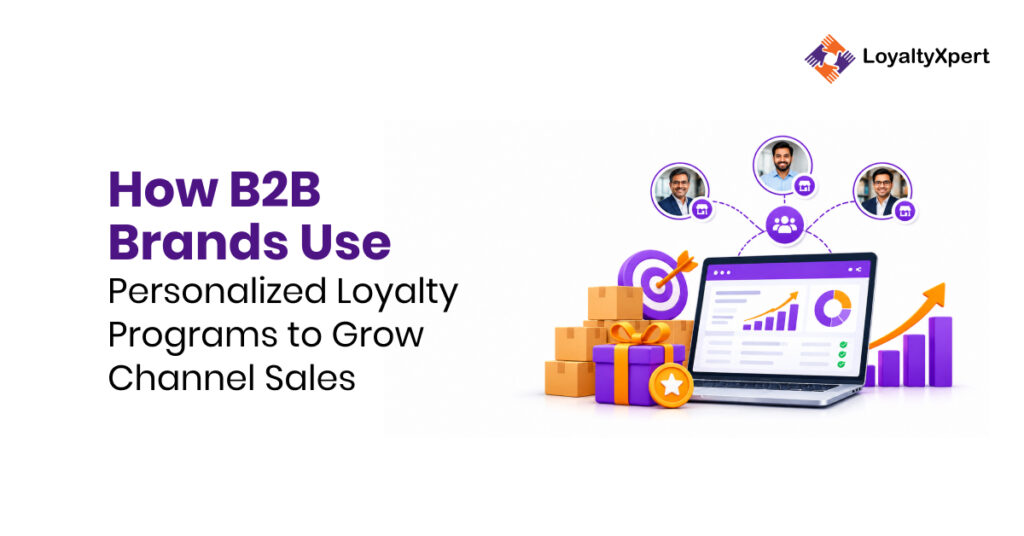
Personalized loyalty programs close that gap. They let a brand shape rewards around real business goals instead of channel-wide averages. With personalized loyalty program software built for B2B networks, one manufacturer can run several targeted campaigns at the same time. Each campaign speaks to a specific partner, product, place, or moment. This guide covers the five campaign types behind effective personalized loyalty programs, with examples from real manufacturing categories.
What Are Personalized Loyalty Programs in B2B?
Personalized loyalty programs are B2B incentive schemes that change rewards based on a partner’s location, product mix, role, season, or performance. Instead of one flat points rule for the whole channel, manufacturers run several targeted campaigns. Each campaign carries its own earning rules, bonus triggers, and goals, all tracked from one platform.
Here is how the two models compare:
| Factor | One-Size-Fits-All Scheme | Personalized Campaign |
|---|---|---|
| Earning Rule | Same points on every invoice | Points vary by SKU, region, or partner tier |
| Sales Target | One national target | Targets set per territory or segment |
| Timing | Runs all year unchanged | Shifts with peak and lean seasons |
| Partner Fit | Treats dealers and electricians alike | Separate rules for each partner type |
| Measurement | Total points issued | Sales lift per campaign |
Customized loyalty programs are not about giving more rewards. They are about aiming rewards better. Teams new to the concept should first see how a channel partner loyalty program works.
Why Do One-Size-Fits-All Loyalty Schemes Fail Manufacturers?
One-size-fits-all loyalty schemes fail because channel partners do not share the same market, margin, or motivation. A flat reward overpays strong regions and underpays weak ones. It also ignores product priorities and seasonal swings. Manufacturers end up spending more on points while channel sales stay flat.

4 Reasons Flat Schemes Lose Channel Partners
- Markets differ sharply. A dealer in a metro faces different competition than one in a tier-3 town.
- Margins differ by product. A flat point rate rewards low-margin volume as generously as premium sales.
- Roles differ across the channel. Distributor loyalty programs need volume and credit rewards, while influencers care about daily earnings.
- Demand differs by month. A scheme that ignores peak seasons pays the same bonus when partners would have ordered anyway.
Most dealer loyalty programs and distributor loyalty programs built on a single rule eventually hit these limits. Customized loyalty programs solve this by tying each reward to a specific business outcome. Personalized loyalty program software then removes the manual work of running several schemes in parallel.
Run every loyalty campaign from one platform.
The wider market is moving the same way. A July 2026 Mordor Intelligence loyalty management study expects B2B loyalty platforms to grow fastest, at a 17.52% CAGR through 2031. The report also notes that manufacturers are shifting from simple rebates toward tiered incentives for distributors. That shift explains why personalized loyalty programs are now a priority for channel teams.
How Do Location-Based Loyalty Campaigns Work?
Location-based loyalty campaigns set different earning rules for dealers and distributors by city, state, or region. A manufacturer can offer higher points where market share is weak and standard points where the brand already leads. This keeps reward spend focused on territories that need growth, not spread evenly across the map.
Take a pipes and fittings manufacturer with uneven share across India. Its regional plan might look like this:
| Region | Market Position | Campaign Design |
|---|---|---|
| Maharashtra | Market leader | Standard points with a retention focus |
| Uttar Pradesh | Low share, high potential | Extra points on first orders from new dealers |
| Kerala | Demand drops in monsoon | Longer scheme window with a stocking bonus |
| Gujarat | Strong rival brand | Conversion bonus for dealers who switch counters |
Distributor loyalty programs gain the most from this approach. A distributor covering three districts can work toward a district-level target instead of a state average. Dealer loyalty programs benefit too, since a counter in a growth market gets a reason to stock more. With the right personalized loyalty program software, these rules apply automatically based on each partner’s registered location.
How Do Product-Based Loyalty Campaigns Drive Focus SKUs?
Product-based loyalty campaigns reward partners for selling selected products, brands, or categories. Manufacturers use them to push new launches, premium ranges, or high-margin SKUs that partners might otherwise ignore. Points or bonuses attach only to the chosen products, so every reward supports a specific portfolio goal.
Picture a paint brand launching a premium exterior emulsion. Dealers know the economy range sells itself, so the new product sits at the back of the store. The brand responds with a 90-day campaign. Painters earn double points on the new range, and dealers earn a stocking bonus on their first order. Economy products keep their standard rate, so the budget goes where the brand needs movement.
Reward the regions that need growth most.
Product-level rewards are among the most practical loyalty programs for manufacturers with wide catalogs. In personalized loyalty program software, the bonus attaches to the SKU code, so nobody has to calculate it by hand.
3 Ways to Structure Product Rewards
- Fixed bonus points on every unit of a focus product.
- A points multiplier on a full category for a set period.
- A combo reward when a partner buys a launch SKU along with a core SKU.
Brands that want extra pull on a launch often add gamification, such as a scratch coupon on each scan.
How Can Manufacturers Personalize Rewards for Each Partner Type?
Partner-specific campaigns give dealers, distributors, retailers, and influencers separate incentives that match their role in the sale. A distributor values volume slabs and credit-linked rewards. An electrician values quick points on every product scan. Segmenting the channel lets each campaign speak to what that partner actually wants.
| Partner Segment | What Drives Them | Reward That Fits |
|---|---|---|
| Distributor | Volume, margin, working capital | Quarterly slab bonuses and tier upgrades |
| Dealer | Counter share and footfall | Points per invoice and display incentives |
| Retailer | Fast stock rotation | Scheme credits on repeat orders |
| Influencer | Daily earnings and recognition | Scan-based points with fast redemption |
This is where customized loyalty programs pay off. Separate dealer loyalty programs and distributor loyalty programs stop the two groups from competing for the same reward pool. Influencers such as electricians, plumbers, and carpenters need their own track as well. A dedicated influencer loyalty program rewards the trade professionals who recommend your brand on site.
Segmented loyalty programs for manufacturers also make reporting cleaner, since each partner group shows its own response.
When Should Manufacturers Run Seasonal Loyalty Campaigns?
Manufacturers should run seasonal loyalty campaigns ahead of festivals, peak construction months, and planned promotional periods. Seasonal campaigns pull partner orders forward when demand is building, then ease off when it cools. They work best with fixed dates, a clear stocking target, and rewards that partners can redeem before the season ends.
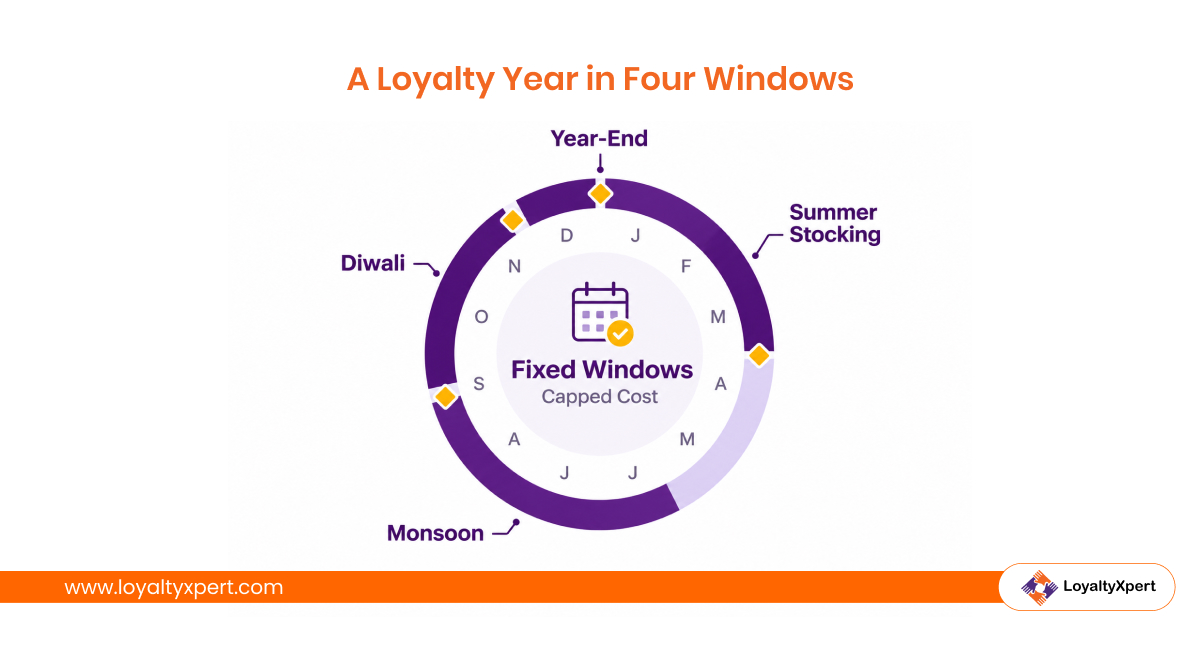
A multi-category building products brand might plan its year around four windows:
- From January to March, a pre-summer stocking drive for pumps and cooling products.
- From June to September, a monsoon scheme for waterproofing and roofing ranges.
- From September to November, a Diwali campaign for paints, laminates, and electricals.
- In December, a year-end push with bonus points on pending target volume.
Because each bonus runs for a fixed window, the cost stays capped. Customized loyalty programs can also run two seasonal schemes in different regions without overlap. Good personalized loyalty program software lets you schedule these campaigns in advance, so they go live and close on time. Seasonal dealer loyalty programs and distributor loyalty programs then stay fresh all year.
How Do Performance-Based Loyalty Campaigns Reward Top Partners?
Performance-based loyalty campaigns reward partners for purchase volume, sales target achievement, and consistency over time. Partners earn more as they sell more, usually through slabs or tiers. This structure links reward spend directly to revenue, so the manufacturer pays the most to the partners who deliver the most.
Here is an illustrative quarterly slab for a lubricant brand’s distributor network:
| Quarterly Target Achieved | Reward |
|---|---|
| Below 80% | Standard points only |
| 80% to 99% | Standard points plus a small bonus |
| 100% to 119% | Larger bonus and Silver tier status |
| 120% and above | Highest bonus and Gold tier status |
A tier-based loyalty program builds on this logic over a longer period. Partners climb from Silver to Gold to Platinum, and each tier unlocks better rewards. Customized loyalty programs often combine both, with quarterly slabs for short-term targets and tiers for long-term loyalty.
Schedule seasonal schemes well in advance.
Performance rules suit dealer loyalty programs in mature markets, where growth comes from share of wallet rather than new counters. They also suit loyalty programs for manufacturers that sell high-value equipment through a small distributor base.
How Does LoyaltyXpert Help Manufacturers Build Personalized Loyalty Programs?
LoyaltyXpert is a B2B loyalty platform that lets manufacturers create and manage personalized loyalty programs from one dashboard. Brands set campaign rules by region, product, partner type, season, or performance. The platform handles points, tiers, bonus schemes, and redemptions, while real-time reports show how each campaign affects channel sales.
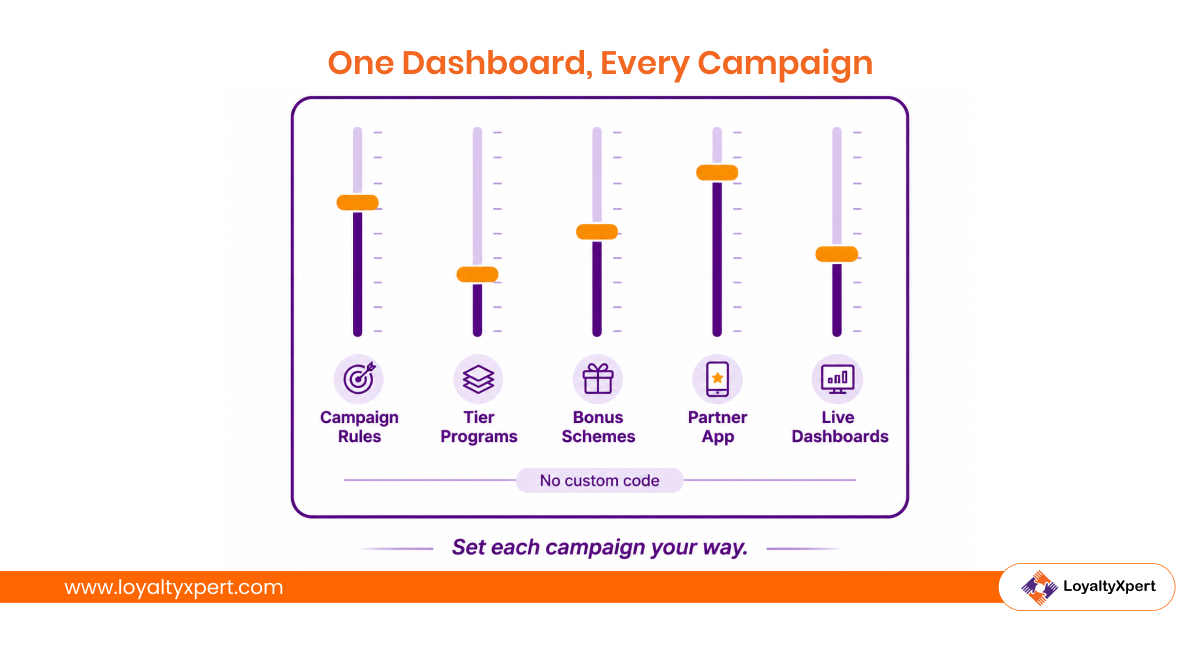
As personalized loyalty program software, LoyaltyXpert lets your team configure these elements without custom code:
- Campaign rules that target a region, SKU, partner segment, or date range.
- Several tier programs running side by side across brands, product lines, or regions.
- Bonus schemes, points multipliers, and gamification elements like scratch coupons and leaderboards.
- A partner app where dealers, distributors, and influencers track points, tier status, and progress.
- Real-time dashboards that show primary and secondary sales for each campaign.
This flexibility matters most for brands running customized loyalty programs across many states and partner types. When software is built around loyalty programs for manufacturers, every scheme sits in one system instead of separate files. Dealer loyalty programs, distributor loyalty programs, and influencer tracks then share one data layer. Running each channel loyalty program from a single B2B loyalty platform also lets sales teams compare campaigns on the same numbers, without a spreadsheet for every scheme.
How to Plan Personalized Loyalty Programs in 5 Steps
Planning personalized loyalty programs starts with clear business goals, not reward ideas. Manufacturers first segment partners and products, then match each segment to one campaign type. After launch, they compare sales lift by campaign and adjust rules each quarter. This keeps the program lean, measurable, and tied to revenue.
- Set one measurable goal per campaign, such as more first-time orders in a weak state.
- Segment partners by role, region, and purchase history.
- Match each goal to a campaign type: location, product, partner, seasonal, or performance.
- Configure rules, budgets, and end dates in your personalized loyalty program software.
- Review results by campaign each month and retire schemes that stop working.
Before step four, many teams compare B2B loyalty software platforms on how well they handle several partner types at once. That check matters more for loyalty programs for manufacturers than for retail brands. One platform must serve every layer of the channel.
Is It Time to Move Beyond a Single Loyalty Scheme?
Personalized loyalty programs give manufacturers control over where every reward point goes. Instead of one scheme for the whole channel, you run targeted campaigns by region, product, partner, season, and performance. Customized loyalty programs like these turn reward spend into a planned sales lever. Dealer loyalty programs and distributor loyalty programs both become easier to measure and adjust.
If your current scheme feels flat, these next steps can help:
- Book a Demo — See regional, product, and seasonal campaigns set up for your own channel.
- Contact Us — Talk through your partner segments and scheme goals with our team.
- Reward Program Software — Explore how bonus schemes and redemptions run on one system.
- Become a Partner — Bring LoyaltyXpert to the manufacturers you already work with.
- Visit LoyaltyXpert — Explore the full platform for manufacturer loyalty programs.