 Max 9min read
Summary
Small manufacturers need loyalty software sized for lean teams, thin margins, and focused dealer networks. This 2026 buyer’s guide defines the category, compares SME and enterprise platforms, and lists must-have features. It also explains pricing factors and shows how low MOQ manufacturers can reward repeat orders. It closes with 10 vendor questions and a step-by-step evaluation framework.
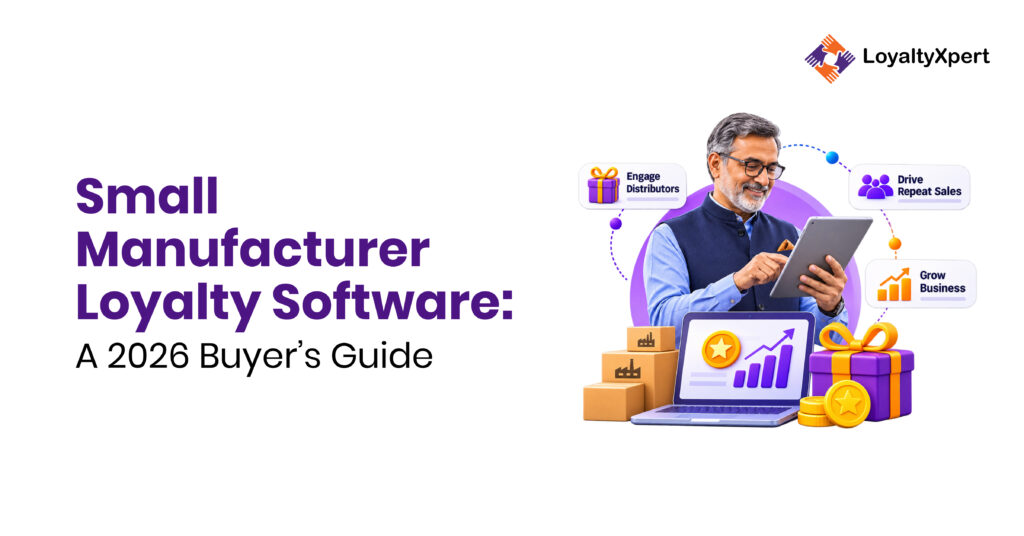
Most loyalty software guides picture an IT team, a big budget, and thousands of partners. A small manufacturer may run 40 dealers with one sales manager. Margins stay thin, orders arrive in smaller lots, and a distributor can switch brands over one better scheme. That reality calls for small manufacturer loyalty software, not a scaled-down enterprise suite. Generic loyalty program software for small business often misses this channel reality too. This guide covers features, cost, low MOQ rewards, and vendor questions. LoyaltyXpert built its small-business loyalty program software around this kind of lean channel.
What Is Small Manufacturer Loyalty Software?
Small manufacturer loyalty software rewards dealers, distributors, retailers, and trade influencers for purchases. It runs points, schemes, partner data, campaigns, and reports in one system. It suits brands with smaller channel networks, lean teams, and limited budgets, and it replaces manual scheme tracking.
Partners earn points through QR scans or invoice uploads, and rewards credit automatically. B2B loyalty software for manufacturers tracks secondary sales, partner tiers, and SKU movement. Good loyalty software for manufacturers also connects with your ERP, so sales data flows without re-entry. It is loyalty management software sized for a smaller channel.
Why Do Small Manufacturers Need Loyalty Programs in 2026?
Small manufacturers need loyalty programs because repeat orders from existing partners fund most of their growth. A structured program gives dealers a reason to stay, reorder, and recommend your brand. Loyalty software for manufacturers also captures sales data small teams rarely track. Loyalty software for SMEs makes this affordable.
Grand View Research (June 2026) valued the global loyalty management market at USD 13.6 billion in 2025. The same report names SMEs the fastest-growing segment through 2033. Cloud-based loyalty management software drives much of that shift.
3 Pressures Small Manufacturers Face Right Now
- Larger competitors offer dealers richer schemes every quarter.
- Distributors carry several brands and push whichever pays fastest.
- Small teams cannot track every dealer’s purchases without automation.
Consistent rewards answer all three. Well-designed loyalty programs help small businesses grow recurring B2B revenue, and small-business loyalty software keeps that effort manageable.
Why Doesn’t Enterprise Loyalty Software Fit SMEs?
Enterprise loyalty software fails SMEs because it charges for complexity a small manufacturer never uses. These platforms assume dedicated admins, long implementations, and thousands of partners. A smaller brand pays for unused modules and waits months to launch. Loyalty software for SMEs solves the same problem with a lighter setup.
Enterprise suites often need consultants for basic scheme rules. Consumer loyalty program software for small business fails differently, rewarding one-off shoppers over dealers. Purpose-built loyalty software for SMEs keeps B2B logic and drops overhead. Small business loyalty program software also launches within weeks, which matters when a competitor’s scheme is already live.
What Features Should Small Manufacturers Look For in Loyalty Software?
Small manufacturers should look for loyalty program software for small business that captures sales simply, automates rewards, and clearly reports partner performance. Must-have features include QR or invoice point earning, scheme management, tiered rewards, a partner app, ERP integration, and fraud controls. Extra modules should match a real business need.
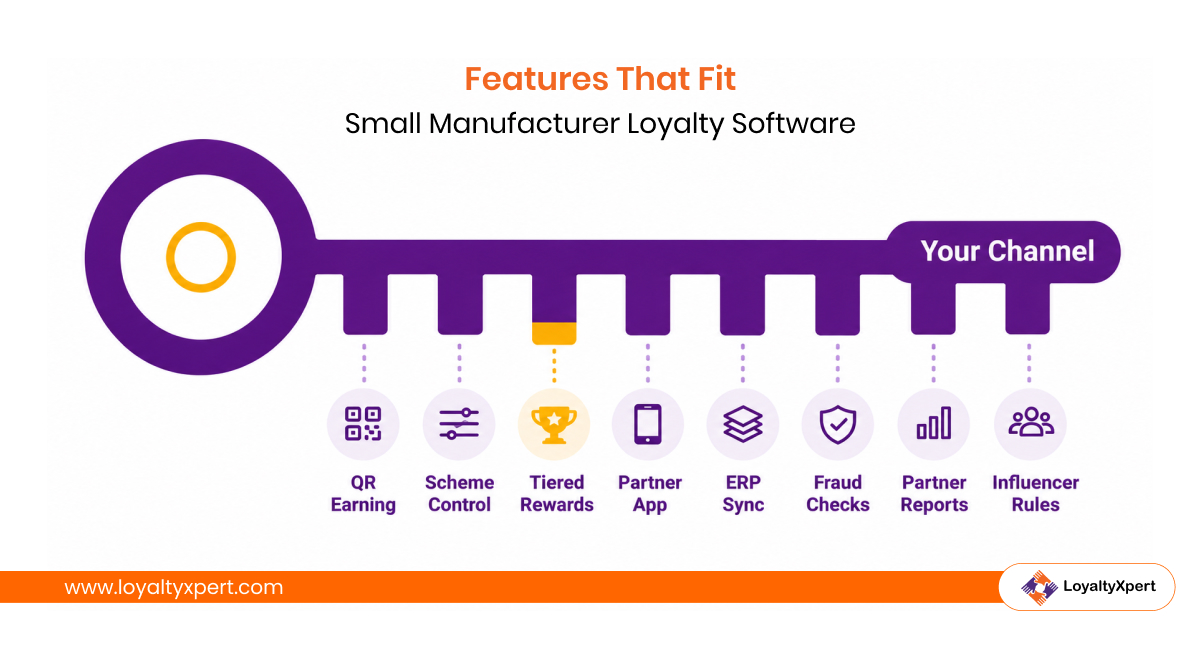 Use this checklist to shortlist small business loyalty program software:
- QR code or invoice upload for instant point earning
- Digital scheme and campaign management by SKU or region
- Tiered rewards that recognize cumulative purchases
- A branded partner app in regional languages
- Integration with Tally, SAP, or your current ERP
- eKYC, TDS handling, and duplicate-scan protection
- Dealer-wise, zone-wise, and SKU-wise reports
- Separate rules for trade influencers such as electricians or carpenters
Distributor loyalty software deserves special attention here. Distributors move the most volume, so they need their own targets and payout logic. Good distributor loyalty software tracks primary and secondary sales separately. Without visibility into secondary sales, distributor loyalty software becomes a simple payout tool. The best loyalty software for small manufacturers covers these needs without forcing extra modules. Any small business loyalty program software you shortlist should pass this checklist, since good loyalty management software brings these features into one dashboard.
How Does Small Manufacturer Loyalty Software Compare With Enterprise Platforms?
Small manufacturer loyalty software differs from enterprise platforms in setup time, cost structure, and operational demand. Small business loyalty program software launches in weeks, prices by users or modules, and needs no dedicated IT staff. Enterprise suites suit large multi-country networks. Smaller brands should buy for current complexity, not maximum features.
| Factor | Small Manufacturer Loyalty Software | Enterprise Loyalty Software |
|---|---|---|
| Typical Channel Size | Dozens to a few thousand partners | Tens of thousands of partners |
| Launch Time | Weeks | Several months |
| Admin Team Needed | One trained manager | Dedicated program team |
| Pricing Basis | Modules, users, or partner count | Custom licensing and services |
| Customization | Configurable templates | Deep custom builds |
| Distributor Loyalty Software | Built-in tiers and targets | Separate module or custom build |
| Best Fit | Focused regional channels | Multi-country, multi-brand networks |
Many enterprise rewards platforms excel at scale, but scale isn’t your problem today. Your real problems are getting dealer attention, driving repeat orders, and managing data. Loyalty software for SMEs targets those, while loyalty management software built for enterprises targets scale. The best loyalty software for small manufacturers still leaves room to grow.
How Can Low MOQ Manufacturers Use Loyalty Programs?
Low MOQ manufacturers use loyalty programs to turn small first orders into steady repeat business. Low MOQ (minimum order quantity) production serves startups, D2C brands, private label sellers, and niche B2B buyers. Thin margins mean rewards should encourage reorders, not single large purchases.
A low MOQ buyer often tests your product with one small batch, and profit appears only on later reorders. That makes customer retention the real profit engine, not first-order value.
5 Loyalty Mechanics That Suit Low MOQ Buyers
- Tiered rewards based on cumulative orders, not single-order size.
- Reorder bonuses that credit points when a buyer repeats within 60 days.
- Referral rewards when one brand introduces another buyer.
- Early access to new batches, colors, or formulations.
- Points redeemable against future orders instead of cash payouts.
Avoid copying B2C retail points models built on basket size. Low MOQ buyers value faster reorders and credit on the next run. Flexible loyalty software for manufacturers sets these rules without custom code. That focus keeps small manufacturer loyalty software tied to real profit.
How Much Does Loyalty Software for Small Manufacturers Cost?
Small manufacturer loyalty software costs depend on partner count, modules, integrations, and reward fulfillment rather than one fixed price. Most loyalty program software for small business charges a subscription plus setup fees. The reward budget sits separately from software fees. Buyers should compare total cost of ownership, not headline pricing.
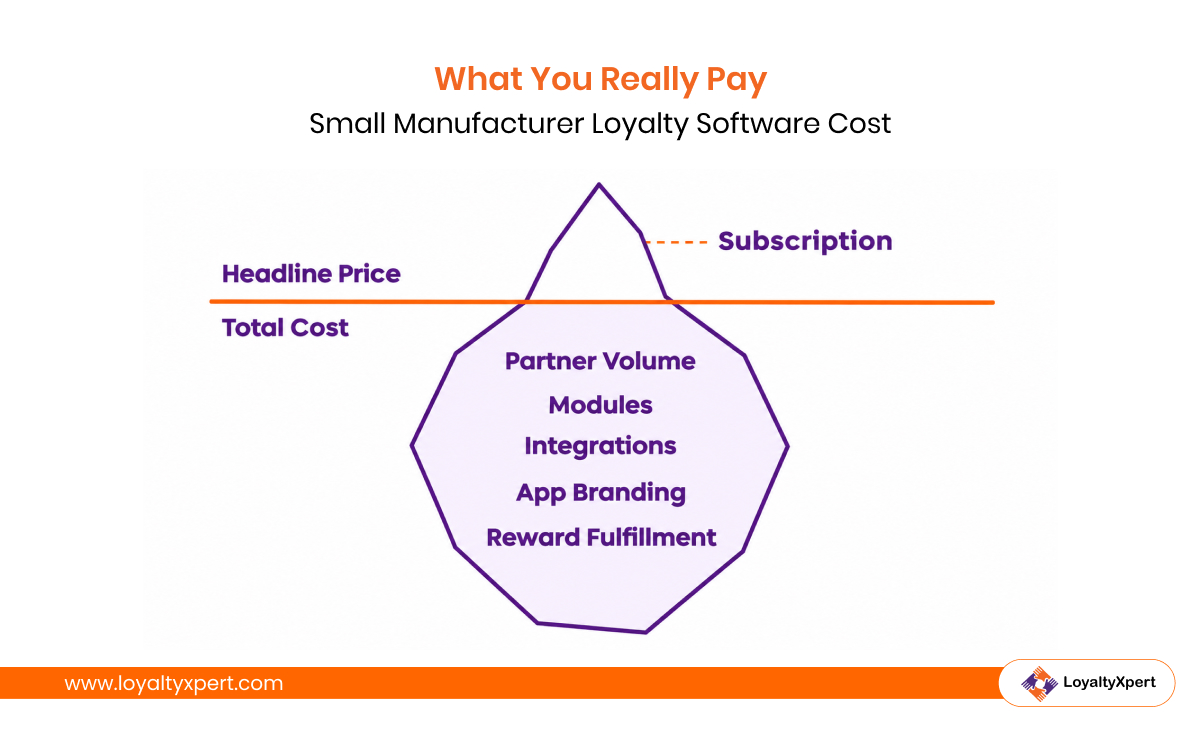 Five factors shape your final bill:
- Partner volume, often priced by active users or QR codes.
- Modules, such as warranty, sales tracking, or event management.
- Integration effort with your ERP or accounting system.
- App branding and regional language support.
- Reward fulfillment, including gift catalogs and bank transfers.
Ask vendors to quote these lines separately and compare loyalty management software quotes line by line. Good loyalty software for SMEs should also price growth clearly. Mapping your loyalty program cost across setup and running budgets avoids surprises in year two.
What Mistakes Do Small Manufacturers Make When Buying Loyalty Software?
Small manufacturers buying loyalty management software often overbuy, ignore dealer adoption, and launch without clear reward economics. Other common errors include skipping a pilot and migrating messy partner data. Each mistake delays results and erodes partner trust, but a simple buying process prevents most of them.
Buying too much software tops the list, usually after a feature-heavy demo. Dealer adoption comes next, because confused partners stop scanning within weeks. Without a reward-to-revenue ratio, schemes overspend in peak season. A 60-day pilot with 20 dealers reveals problems cheaply. Poor data hygiene breaks reporting, so clean dealer and SKU records before import. Even the best loyalty software for small manufacturers cannot fix bad source data.
What Questions Should You Ask a Loyalty Software Vendor?
Buyers evaluating the best loyalty software for small manufacturers should ask about setup time, pricing, integrations, partner adoption, data ownership, and support. These questions separate a right-sized partner from an oversized suite. Small business loyalty program software vendors should answer each one in writing.
- How many weeks does a typical launch take?
- What does pricing include, and what costs extra?
- Which ERPs and accounting tools do you integrate with?
- Does the partner app support our regional languages?
- How do you prevent duplicate scans and reward fraud?
- Does your distributor loyalty software support separate rules from dealers?
- Who owns our partner and sales data?
- What reports can our sales manager pull without help?
- Do you offer a pilot before full rollout?
- How does pricing change as our network grows?
Strong answers on questions 1, 2, and 9 signal a vendor that understands loyalty program software for small business buyers. That vendor likely offers the best loyalty software for small manufacturers on your list.
How Do You Choose the Right Loyalty Software for a Manufacturing Business?
Choosing small manufacturer loyalty software starts with one clear goal and ends with a scalability check. A structured process keeps manufacturer loyalty software grounded in real needs. Buyers should define participants, map current processes, and test usability before signing. These ten steps form a practical evaluation framework.
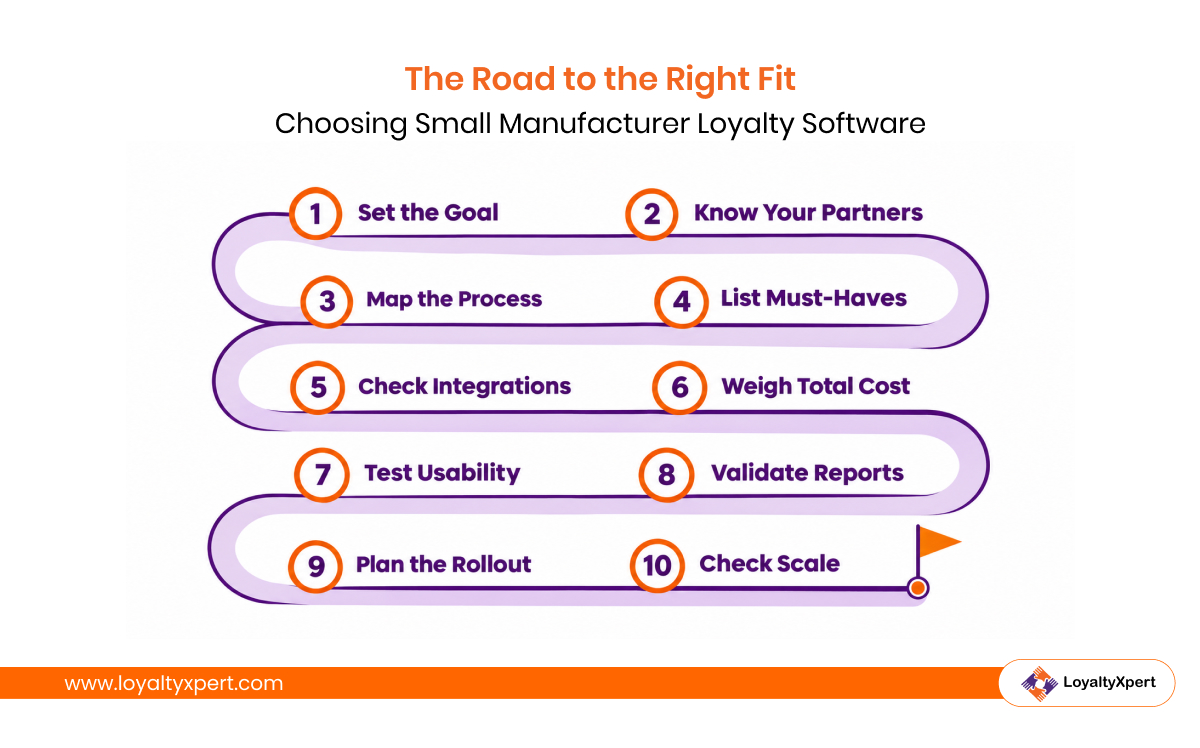
- Define the business goal, such as more reorders or wider dealer reach.
- Identify participants, including dealers, distributors, retailers, and influencers.
- Map your current scheme process and its manual pain points.
- List must-have capabilities from the checklist above.
- Check ERP and accounting integrations.
- Evaluate total cost, including rewards and services.
- Test usability with a few real dealers.
- Validate the reports your sales team will use.
- Plan implementation, training, and partner onboarding.
- Review how distributor loyalty software scales with your network.
These steps make the best loyalty software for small manufacturers easier to spot, because you compare fit rather than feature counts.
Final Thoughts
Small manufacturers need loyalty software for SMEs that fits their channel, team, and margins. The right small manufacturer loyalty software rewards partners on time and shows where growth comes from. Set clear goals, run a pilot, and scale once dealers adopt the app. Loyalty software for manufacturers should grow with you, not ahead of you.
- Book a Demo – See the platform run on your dealer workflow.
- Contact Us – Discuss your channel size, schemes, and budget.