
 Max 10min read
📝Summary
Manual reporting tells you what happened yesterday. Mobile sales tracking shows you what is happening now. This comparison breaks down both approaches across field visibility, reporting accuracy, rep productivity, visit verification, decision speed, and scalability. You will also learn when manual reporting becomes a bottleneck, and what changes when a sales tracking app carries the reporting load instead of your reps.
Every field sales manager knows this particular frustration. You need to know what happened in the territory yesterday. One sheet says one thing. Another says something slightly different. And the rep who could clear it up is already three visits into today.
Manual reporting rarely arrives as a decision. It accumulates. A spreadsheet here, a WhatsApp group there, a daily sales report format that someone designed four years ago. Over time, the reporting process becomes a ritual instead of a tool. Managers keep receiving field data. They just keep receiving it too late to use.
Mobile sales tracking handles the same job from the opposite direction. It records activity at the moment the activity happens, then puts that record in front of a manager immediately. A purpose-built sales tracking app does not ask a rep to reconstruct the day from memory. It captures the day as the rep lives it.
This comparison of Mobile Sales Tracking vs Manual Reporting works through both approaches honestly, parameter by parameter. Not as a feature checklist, but as a question about what each one lets a sales manager actually do.
What Is Mobile Sales Tracking, and How Does It Differ From Manual Reporting?
Mobile sales tracking is a digital system that captures field sales activity as it happens. Reps log visits, orders, and locations from a phone. Managers see that data instantly. Manual reporting collects the same information much later, through Excel sheets, WhatsApp updates, or end-of-day sales reports compiled by hand.
The gap is not really about tools. It is about timing.
Manual reporting is retrospective. Someone records an activity, then someone else consolidates it, then a manager reviews it. By the time the sheet reaches you, the customer has moved on. Mobile sales tracking is concurrent. The record and the activity happen together, in the same minute, from the same device.
That single shift changes what a manager can do with field data. A weekly summary supports review. A live feed supports intervention.
Mobile Sales Tracking vs Manual Reporting: How Do They Compare Across 6 Parameters?
Mobile sales tracking outperforms manual reporting on speed, accuracy, and effort. Manual reporting depends on memory, honesty, and free time at the end of a long day. A sales tracking app removes all three dependencies. The table below compares both approaches across the six parameters field sales managers care about most.
| Parameter | Manual Reporting | Mobile Sales Tracking |
|---|---|---|
| Field Visibility | Known after the day ends | Visible while the day runs |
| Reporting Accuracy | Depends on recall and rewriting | Captured at the point of activity |
| Rep Productivity | Admin work eats selling hours | Reporting takes seconds per visit |
| Customer Visits | Self-declared, hard to verify | GPS-verified check-in and check-out |
| Decision-Making | Reactive, based on old data | Same-day, based on live dashboards |
| Scalability | Breaks past a few territories | Holds across regions and headcount |
Read that last row twice. Most teams do not abandon spreadsheets because spreadsheets are bad. They abandon them because ten reps became forty.
Why Does Manual Reporting Become a Bottleneck for Growing Field Teams?
Manual reporting becomes a bottleneck when data volume outgrows human processing time. Every extra rep adds another sheet to chase, another format to standardize, and another day of delay before consolidation. The reporting effort grows linearly. The report’s usefulness shrinks because the insight arrives after the decision window closes.
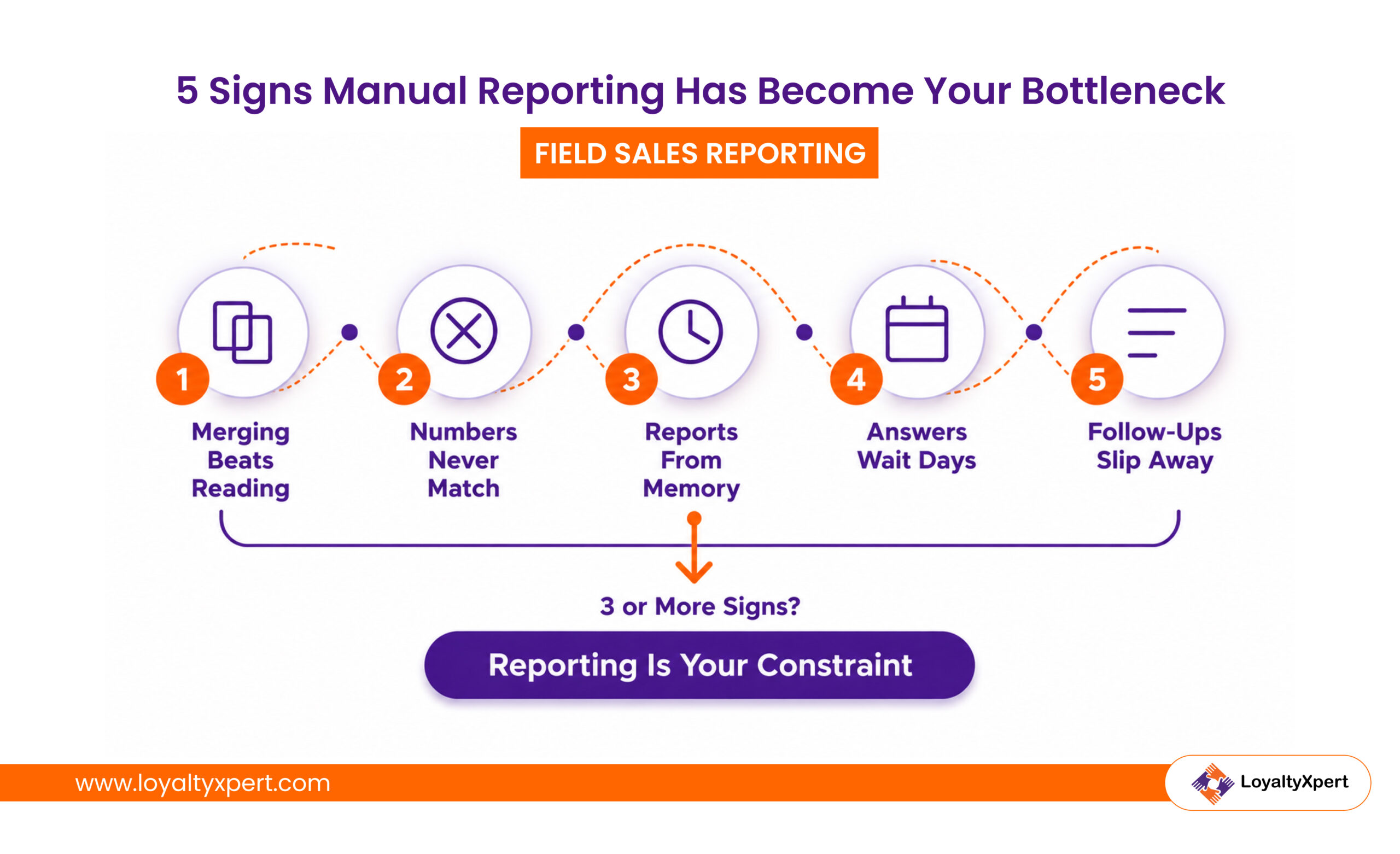
You can usually spot the tipping point. Watch for these signals:
- Consolidation Takes Longer Than Analysis-Your team spends more time merging files than reading them.
- Numbers Never Match-Two sheets report the same territory differently, and nobody knows which is right.
- Reps Report From Memory-Visit notes get written at 9 PM, four visits after the fact.
- Questions Wait for Monday-A simple query about yesterday’s coverage needs a follow-up call.
- Follow-Ups Slip Silently-No system flags a customer who has not been visited in six weeks.
Three or more of these signals usually mean the reporting process, not the sales team, is the real constraint. Manufacturers hitting this wall generally move to structured sales management software rather than adding another reporting layer on top of the old one. Sales tracking software solves the sequencing problem, not just the storage problem.
How Does Real-Time Sales Tracking Improve Field Visibility?
Real-time sales tracking gives managers a live view of field activity across every territory. Visits, orders, locations, and outcomes appear on a dashboard as reps record them. Managers no longer wait for a consolidated report. They see coverage gaps, idle routes, and stalled deals while the working day is still open.
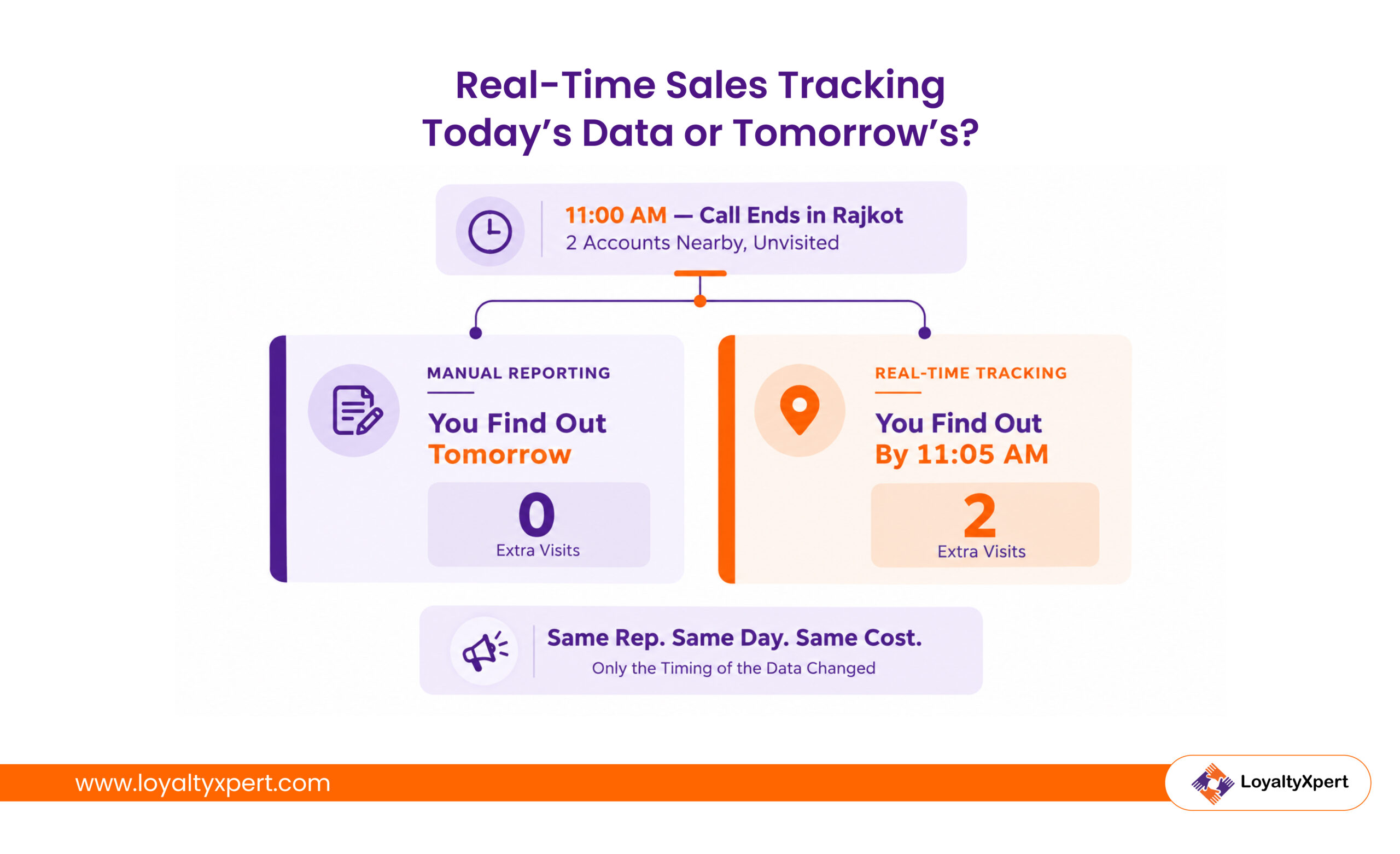
Visibility only matters if it is actionable. Consider a normal Tuesday.
A rep finishes a call in Rajkot by 11 AM. Two nearby accounts haven’t been visited this month. Under manual reporting, nobody knows that until the daily sales report lands. With real-time sales tracking, the manager sees the open window and reroutes the rep the same morning. One nudge, two extra meetings, zero extra cost.
That is the practical value of a field sales tracking app. It converts field data into a decision you can still act on.
Do GPS-Verified Visits Really Prove Field Activity?
GPS-verified visits confirm that a rep was physically present at a customer location, at a recorded time. The sales tracking app captures coordinates during check-in and check-out. This replaces self-declared visit logs with a timestamped activity trail, which strengthens incentive claims, distributor disputes, and territory performance reviews.
The framing here matters, so let us be direct about it.
GPS verification is not surveillance. It is proof. Reps who genuinely work hard are the ones who benefit most, because their effort finally shows up in the record. When visit data is verified, incentive payouts stop being arguments. Territory reviews stop being opinion contests.
It also protects the business side. Verified visit history supports scheme eligibility and channel payouts across any loyalty program software you run for dealers and distributors. Clean field data upstream means defensible incentive decisions downstream, and richer dealer data insights when you review network performance each quarter.
How Much Selling Time Does Automated Field Sales Reporting Give Back?
Automated field sales reporting removes the daily admin block from a rep’s schedule. Instead of rebuilding numbers each evening, reps capture data once during the visit. The system generates the report. Those recovered hours move back into customer conversations, which is the only field activity that actually produces revenue.
The market has noticed this shift. According to Fortune Business Insights, the global field force automation market is projected to grow from USD 4.56 billion in 2026 to USD 13.66 billion by 2034, at a CAGR of 14.70%. The same 2026 report notes that field force automation can lift sales by around 30% and cut sales management time by 14%.
Run the arithmetic on your own team. Forty minutes of daily reporting, across twenty reps, is over 13 hours lost every day. Automated field sales reporting recovers most of it. Nobody has to work harder for that gain.
Three admin tasks disappear almost immediately:
- Evening Report Writing. Visit data is already recorded and submitted.
- Weekly Consolidation. Dashboards replace the merge-and-clean ritual.
- Order Follow-Up Chasing. Order status updates flow through the app, not through phone calls.
Which Reports Help Sales Managers Decide Faster?
Managers decide faster when reports answer one question each. A sales tracking app converts raw field activity into focused views: coverage against plan, visit frequency per outlet, order value by territory, and rep-level productivity. Each view supports a specific action, unlike a consolidated spreadsheet that demands interpretation before it delivers any answer.
Manual reports usually fail for a subtle reason. They are complete, but not conclusive.
A 12-tab workbook contains everything and clarifies nothing. Good sales tracking software flips that. It surfaces the exception first: the outlet that skipped two cycles, the rep whose conversion dropped, the territory running below plan. You act on the exception, not on the whole dataset.
Teams comparing platforms often shortlist the best sales tracking apps on reporting depth alone. Depth is useful. Decision-readiness is better.
4 Reasons Why a Sales Team Tracking App Scales Better Than Spreadsheets
A sales team tracking app scales because it separates data capture from data processing. Reps enter information once. The system handles storage, validation, and reporting for teams of any size. Spreadsheets fail here because every new rep, region, or product line multiplies manual effort somewhere in the chain.
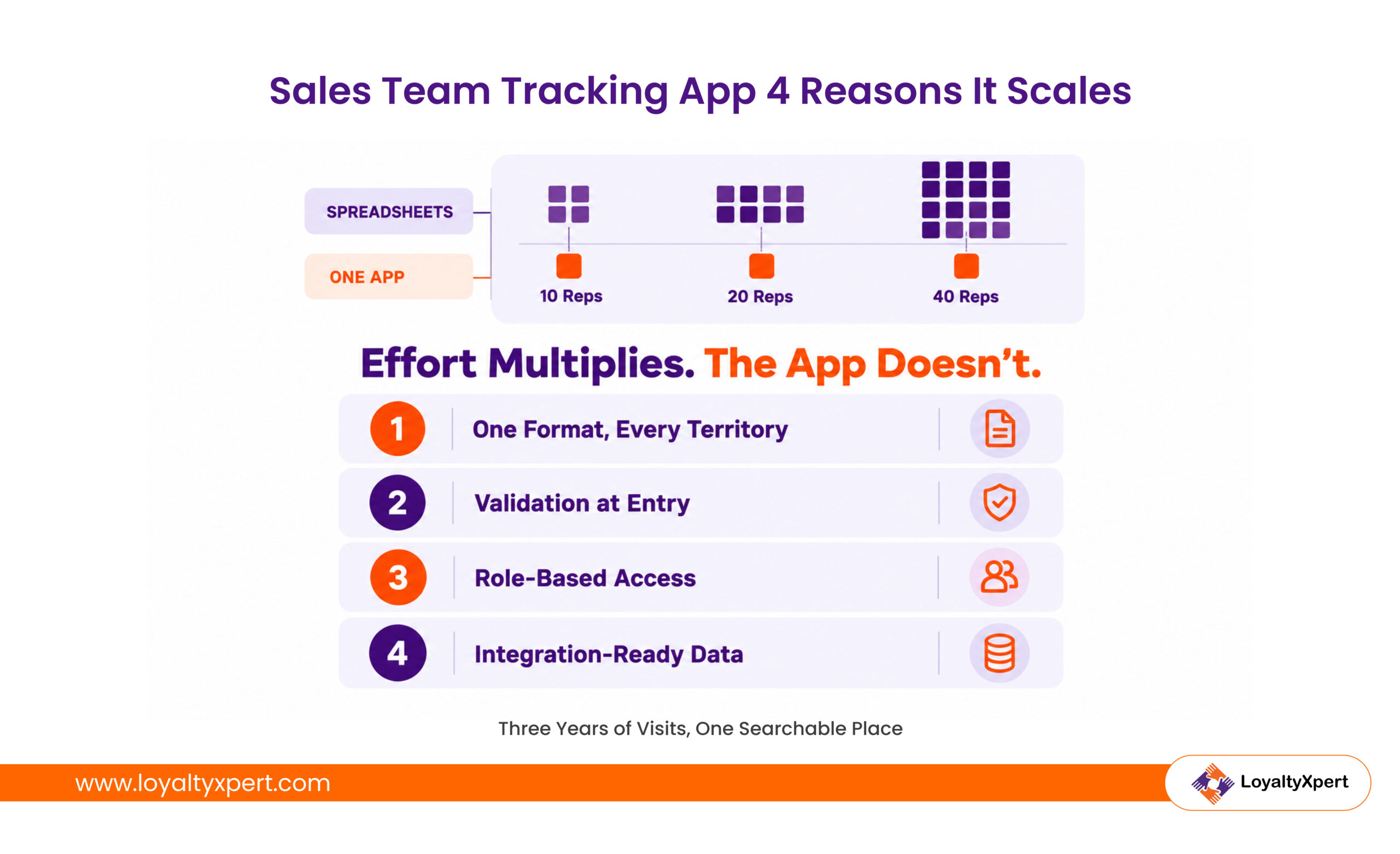
- One Format, Every Territory- Standardized entry fields end the reconciliation problem permanently.
- Validation at Entry- The app rejects incomplete or impossible records before they pollute your data.
- Role-Based Access- Regional managers see their teams. Leadership sees the rollup. No file-sharing chaos.
- Integration-Ready Data- Field activity connects to your CRM, ERP, and channel incentive engines without re-keying.
A field sales tracking app also preserves history in a usable form. Three years of visit data sits in one queryable place, not across 300 archived files. A sales team tracking app makes that history searchable by rep, outlet, or period.
When Should You Move From Manual Reporting to a Sales Tracking App?
Move to a sales tracking app when reporting delays start costing you deals. Sales tracking software earns its place at a specific point. The practical trigger is not team size. It is decision lag. If you cannot answer basic questions about yesterday’s field activity within minutes, manual reporting has already become a liability, regardless of how disciplined your reps are.
Ask yourself four questions honestly:
- Can you confirm today’s completed visits right now?
- Do you know which outlets were skipped this cycle?
- Can you verify a disputed visit claim with evidence?
- Do your reps spend under ten minutes daily on reporting?
Two or more “no” answers point clearly in one direction. Evaluation is the easier half of the job, and the criteria for choosing the right field sales tracking software have not changed much: offline capture, GPS verification, clean dashboards, and integration with what you already run.
How Do You Roll Out Mobile Sales Tracking Without Team Resistance?
Mobile sales tracking succeeds when reps see personal benefit first. Position the rollout around reduced paperwork, faster incentive payouts, and fewer evening reports. Lead with monitoring, and adoption stalls. Lead with time saved, and reps begin using the app voluntarily within the first two weeks.
A four-step rollout works well for most field teams:
- Start With One Region-Pilot with a single territory and a willing manager.
- Replace, Never Add-Retire the old daily report the day the app goes live.
- Show the Payoff Early-Share the first incentive cycle calculated from verified app data.
- Train on the Phone-Run adoption sessions on the device reps will actually use.
Skip step two and you guarantee failure. Reps will not maintain a spreadsheet and a field sales tracking app. Choose one system, then commit to it.
See your whole field team on one live dashboard
Wrapping Up
Manual reporting still works for very small, very local teams. Everywhere else, it quietly taxes your best reps and starves managers of timely information. A sales team tracking app ends that trade-off. Mobile sales tracking removes that tax. It captures activity at the source, verifies it, and turns it into decisions the same day.
The question is no longer whether real-time sales tracking beats manual reporting on capability. It clearly does. The real question is how much longer your team can afford the delay.
If you are ready to see what verified, real-time field data looks like for your business, here is where to start:
- Book a Demo — Walk through live dashboards, GPS check-ins, and automated field sales reporting with our team.
- Contact Us — Share your current reporting workflow and get a practical migration view.
- Explore the Sales Tracking App — Review features, reporting modules, and field use cases in detail.