
 Max 11min read
One of the biggest challenges manufacturers face today is managing their in-house sales teams and multiple sales channels efficiently.
Without a proper system, tracking sales performance, monitoring field activities, or consolidating data across dealers and regions becomes chaotic. That’s where real-time sales management software or field sales management software steps in helping manufacturers streamline operations, improve visibility, and make faster, data-backed decisions.
Why Traditional Sales Tracking Methods No Longer Work
Many manufacturing businesses still rely on manual methods — spreadsheets, phone calls, and end-of-day summaries — to monitor their sales teams.
In such setups, there’s usually:
No clear visibility into what’s happening on the ground.
Delays in receiving updates from sales reps or distributors.
Scattered data across different channels and formats.
When manufacturers can’t see real-time sales data, they end up making delayed or inaccurate decisions. Reports are often incomplete, performance issues go unnoticed, and market opportunities are missed.
? Did you know?
The global market size for sales tracking software is projected to grow at a compound annual growth rate of 10.7 percent between 2023 and 2031.
As per the latest Verified Market Research report, the market will grow from USD 2.8 billion in 2023 to USD 7.1 billion by 2031 — reflecting how rapidly businesses are shifting from manual to automated sales tracking solutions.
That’s why more and more manufacturing companies are turning to real-time sales management software and sales tracking software, not just to automate data collection but to bring transparency, accuracy, and control into their entire sales process.
With the rise of sales CRM software and field sales management software over the last few years, it has become easier for manufacturers of all sizes to monitor field teams, track sales performance, and manage multiple territories — all from a single dashboard.
As a result, manufacturers who’ve adopted such systems are already seeing major improvements in sales efficiency, dealer engagement, and overall productivity, while those still relying on manual processes are struggling to keep up.
Challenges Manufacturing Businesses Face Without Real-time Sales Management Software
Even with advanced tools available today, many manufacturing businesses still manage sales manually — through spreadsheets, calls, and WhatsApp updates. While this might work in the short term, it quickly becomes inefficient as teams grow and operations expand.
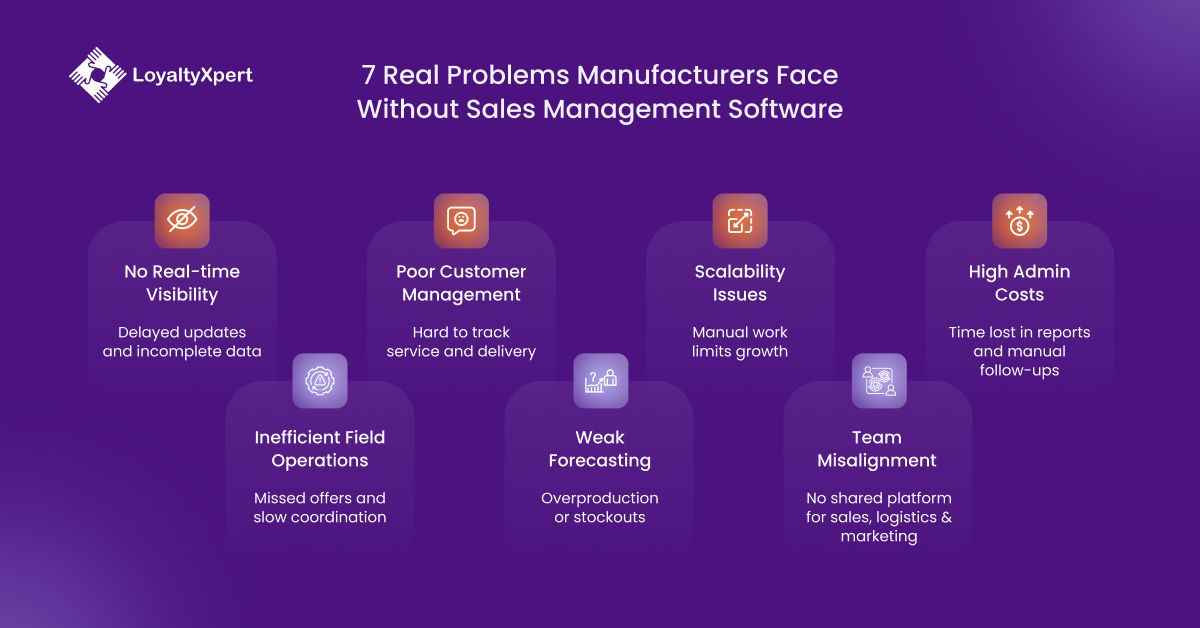
Here are some common challenges manufacturers face when they don’t use a real-time sales management system:
1. Lack of Real-time Visibility
Without a real-time sales management tool, sales managers often wait until the end of the week to get updates from their regional teams. Even then, most of these reports are manual and incomplete some figures are forgotten, some are delayed, and others simply don’t match the ground reality. This lack of live visibility means missed opportunities, delayed decisions, and poor accountability.
2. Inefficient Field Sales Operations
For field teams, remembering every sales offer, discount, or festive scheme can be a real struggle.
Without an automated app, reps rely on memory or scattered WhatsApp messages which often leads to mistakes during client interactions. It also becomes hard for the company to communicate region-specific offers on time. This affects the sales pitch and leads to inconsistent messaging in different markets.
A mobile sales management app, on the other hand, ensures every rep always has updated offers, pricing, and product details right in their phone.
3. Poor Customer Relationship Management
When sales data is scattered across emails or Excel sheets, even loyal distributors feel neglected. Without proper CRM integration, sales reps can’t recall previous pricing, deliveries, or complaints.
As a result, customer follow-ups get delayed, delivery issues go unnoticed, and it becomes difficult to track whether products have actually reached the end customer or not.
All of this directly affects customer satisfaction and long-term trust.
4. Inaccurate Forecasting and Planning
When production teams ask for sales projections, manual systems leave little to work with. Without analytics, demand planning becomes guesswork resulting in overproduction, stockouts, or delayed deliveries. It’s also hard to track sales region-wise, which often leads to higher transportation costs and poor supply chain coordination.
5. Limited Scalability
As manufacturers expand into new cities and regions, manual reporting systems collapse under their own weight. Managing hundreds of distributors or reps through spreadsheets becomes confusing and time-consuming.
A real-time sales management platform simplifies scalability helping manufacturers grow faster while maintaining control and consistency.
6. Communication Gaps Between Teams
When sales, production, logistics, and marketing teams operate in silos, coordination becomes a nightmare. If sales projections aren’t accurate, production plans suffer. If production is delayed, logistics can’t deliver on time. And when sales data isn’t shared, marketing teams don’t know which products to promote, discount, or push harder.
A shared, real-time sales management software ensures every team sees the same data and works in sync toward the same goals.
7. High Administrative Burden
Many manufacturers assume that digital sales tools are “expensive.” But in reality, manual management costs more in both time and money.
? Did you know?
A Salesforce study found that a majority of sales teams spend less than 30 percent of their time actually selling.
Sales teams spend hours compiling data, verifying entries, and preparing reports instead of actually selling. With automation, administrative burden drops sharply, reducing human errors and improving decision-making.
Even a small investment in the best sales management software can save much larger costs from miscommunication, missed leads, and poor forecasting while unlocking new sales and marketing opportunities.
Why Should Manufacturers Use Sales Management Software Today?
Manufacturers today work across multiple cities, serve dealers in different states, and manage distributors across hundreds of pin codes. With such a wide network, keeping track of sales, field activities, and regional performance manually is almost impossible.
Here are the main reasons why every manufacturer should start using real-time sales management software now:
1. Managing Geographically Dispersed Sales Teams
Most manufacturing companies today have sales teams spread across multiple regions, cities, and even time zones. Managing these teams through phone calls or spreadsheets makes it hard to track daily activity, product movement, and regional performance.
A field sales management software or mobile sales management app makes it easy for managers to monitor visits, check-ins, and sales progress in real time no matter how widely their teams are spread. It also ensures better visibility into product movement across all areas.
2. To Stay Competitive
Almost every business today uses some form of CRM or ERP software. But these tools usually track leads not actual sales movement, conversions, or field activities.
To stay competitive, manufacturers now need a system that tracks everything from lead to delivery including on-ground sales performance, product movement, and regional demand.
Sales management software helps businesses see what’s selling, where it’s selling, and how to focus efforts where they matter most.
3. Rising Customer Expectations
Today’s customers, whether dealers, distributors, or end buyers expect quick responses, real-time updates, and personalized service. Without automation, it’s difficult to meet these expectations. A sales CRM platform helps manufacturers track orders, manage service requests, and communicate faster.
It also allows personalized support so you can treat every dealer and distributor based on their purchase history and preferences. That’s what creates long-term loyalty in today’s competitive market.
4. Increasing Complexity of Modern Supply Chains
Supply chains today are bigger, digital, and more connected than ever. Manufacturers don’t just sell to distributors anymore they sell through online platforms, regional partners, and logistics aggregators too.
With so many moving parts, even a small delay in sales reporting can disrupt production and delivery.
A real-time sales tracking software connects all touchpoints sales, production, and logistics so departments can make faster, more informed decisions and work in sync.
5. Smarter, Data-driven Decisions
In today’s data-driven world, business decisions can’t rely on assumptions. With real-time dashboards and analytics, manufacturers can track what’s working, forecast demand accurately, and identify underperforming regions or product lines. Better visibility means better decisions from managing production to planning marketing campaigns.
6. Easier Scalability
As manufacturers expand into new regions, cities, and pin codes, manual tracking becomes chaotic. Each new territory adds complexity: more sales reps, more dealers, and more reports to manage.
Automating the process through a mobile sales management app or sales tracking software makes expansion smoother, faster, and more cost-effective. It ensures consistency across all regions without adding unnecessary workload.
7. Improved Efficiency and Cost Reduction
Manual data collection, follow-ups, and reporting consume valuable time and money. Sales reps spend hours creating reports instead of selling, and managers spend days consolidating them. Automation solves this. A sales management system reduces administrative work, prevents errors, and improves team efficiency saving both time and operational costs.
In fact, a small investment in automation often saves far more by cutting delays, preventing miscommunication, and improving forecasting accuracy.
How Can Manufacturers Get the Best Out of Sales Management Software?
The right sales management software can completely transform how manufacturers track sales, manage field teams, and make business decisions. But buying the software is only half the job the real impact comes from how you use it.
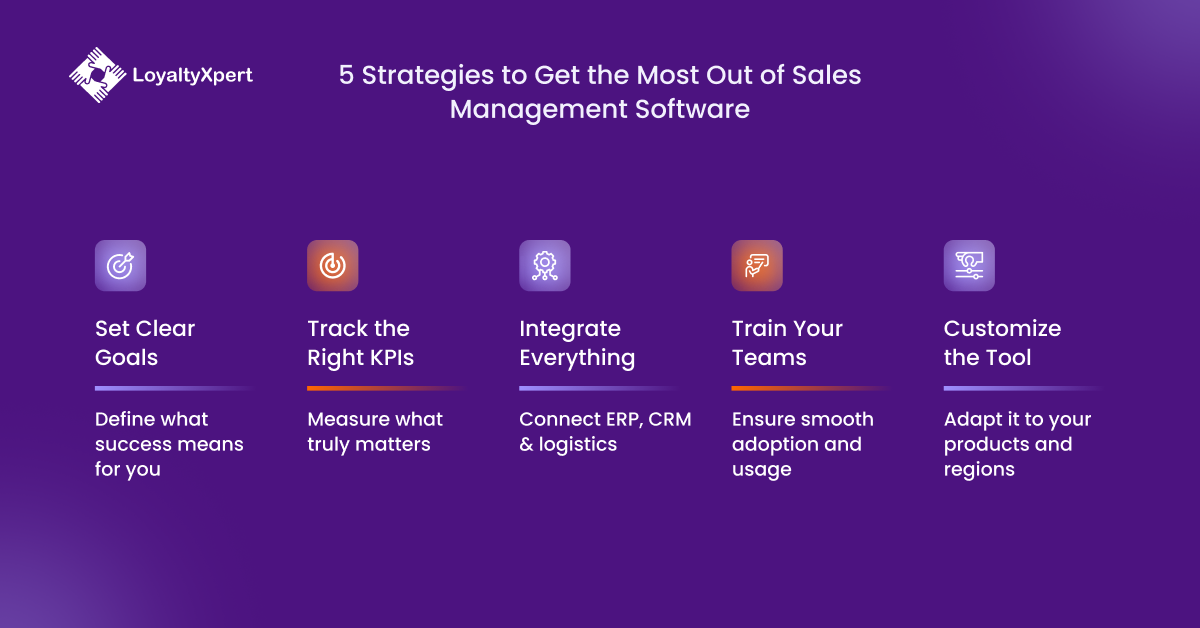
Here are a few strategies to get the most out of your investment:
1. Set Clear Goals Before Choosing the Software
Don’t just pick the first software you find online. Start by defining what you really want to achieve do you want to improve visibility across regions, reduce reporting time, or track field team performance in real time? Once you know your goals, evaluate whether the sales management software you’re considering helps you achieve them.
Look for sales tracking software features and reports that align directly with your business objectives like product-wise performance, dealer-wise growth, or region-wise sales.
2. Define KPIs and Track the Right Metrics
To get the best results, you need to know what success looks like.
Set clear KPIs (Key Performance Indicators) for your team — such as:
- Monthly revenue
- Order turnaround time
- Sales visits completed
- Customer satisfaction scores
The best sales management tracking software allows you to customize dashboards to measure exactly what matters to you. Platforms like LoyaltyXpert can help you set up personalized KPI tracking, so you can monitor and improve performance continuously.
3. Ensure Seamless Integration with Existing Systems
If you’re already using an ERP, inventory, logistics, or CRM system, your sales management software should integrate smoothly with it. This ensures all your data stays connected from lead generation to final delivery without jumping between multiple tools.
No CTA found.
For instance, LoyaltyXpert’s ecosystem combines sales tracking, meeting management, warranty management, and loyalty programs in one place, eliminating data leakage and improving overall visibility.
4. Train Your Sales Teams Properly
Implementing a new system is easy getting your team to use it effectively is the real challenge. Before rollout, train your sales team thoroughly on how to use the app, track sales, and submit reports correctly. Address any hesitations early. Show them how automation helps them close more deals and reduces manual work.
Choosing a solution with multi-language support (like LoyaltyXpert’s 10+ regional languages) makes adoption easier for field teams across different regions.
5. Customize It to Fit Your Business Needs
Every manufacturer works differently with unique products, dealer networks, and regional sales models. That’s why a one-size-fits-all tool doesn’t work. Choose a customizable sales management software that adapts to your processes whether it’s tracking city-wise distributors, monitoring product movement, or managing region-specific pricing.
Work with a partner who can tailor workflows, dashboards, and reports to match your business so you’re not adjusting your process to the software, but making the software work for you.
Final Thoughts: Building a Smarter, Stronger Sales Network
For manufacturers, real-time visibility is no longer a luxury it’s a necessity. Without it, tracking sales performance, managing teams, and responding to market shifts becomes guesswork.
A modern sales management software brings everything together your field teams, distributors, and data onto one unified platform. It helps you make faster decisions, improve sales accountability, and stay competitive in a rapidly evolving market. If you’re still managing your sales operations manually, now’s the time to move forward.
A single, well-implemented software can help you reduce costs, improve productivity, and unlock real growth without the chaos of spreadsheets or endless follow-ups. If you are curious to know how our sales management software can help you track your sales teams and streamline your sales processes, contact us today and book a free demo.