 Max 8min read
📝 Summary
Manufacturers still lose money on messy claims. Manual warranty processes slow teams down daily. Warranty management software fixes this problem fast. It automates registration, claims, tracking, and payouts. This guide breaks down features, benefits, and trends. Read on to pick the right platform.
Warranty once sat quietly in the background of manufacturing, treated as an after-sales obligation and little else. That has changed. Claim volumes are rising, dealer networks stretch wider than ever, and buyers now judge a brand by how quickly a broken product gets put right. Manual processes buckle under that pressure.
Spreadsheets lose registrations, email threads bury approvals, and fraudulent claims slip through unnoticed. The right warranty management software turns that pressure into an advantage instead. This guide covers how the technology works, the features that matter, the industries that gain most, and where warranty tech is heading next.
What Is Warranty Management Software?
Warranty management software automates the entire warranty lifecycle. One warranty management platform handles product registration, coverage tracking, claim intake, and settlement. It validates every request against policy rules, flags suspicious claims, and keeps service, finance, and channel teams working from a single record.
The shift is less about adding a tool and more about removing scattered ones. Most manufacturers run warranty across three or four disconnected systems: a spreadsheet for registrations, a shared inbox for claims, an ERP for payouts, and a dealer’s memory for the rest. Warranty claim management software collapses that into one trail, where every claim and decision sits timestamped and auditable.
Curious how it works in practice?
💡The data tells a clear story:
According to Fortune Business Insights, the global warranty management system market will grow from USD 7.38 billion in 2026 to USD 22.28 billion by 2034.
Why Do Manufacturers Need a Warranty Management System in 2026?
Manufacturers need a warranty management system to control costs as claim volumes climb. Manual tracking cannot scale alongside wider distribution networks and shorter customer patience. Automation cuts fraud, shortens disputes, and speeds payouts. It also converts raw claim data into product insight, which protects margins and supports repeat sales.
The gap between manual and automated runs deep:
| Warranty Task | Manual Process | Warranty Management System |
|---|---|---|
| Claim intake | Buried in email threads | Captured through a portal |
| Validation | Slow, manual checks | Instant and rule-based |
| Fraud control | Often missed entirely | Flagged automatically |
| Defect visibility | Almost none | Live analytics dashboards |
| Payout speed | Days or weeks | Hours |
How Does Warranty Management Software Work?
Warranty management software follows a clear lifecycle. It pushes each claim through defined stages. Automation replaces manual checks at every step. Digital warranty management starts the moment products ship.
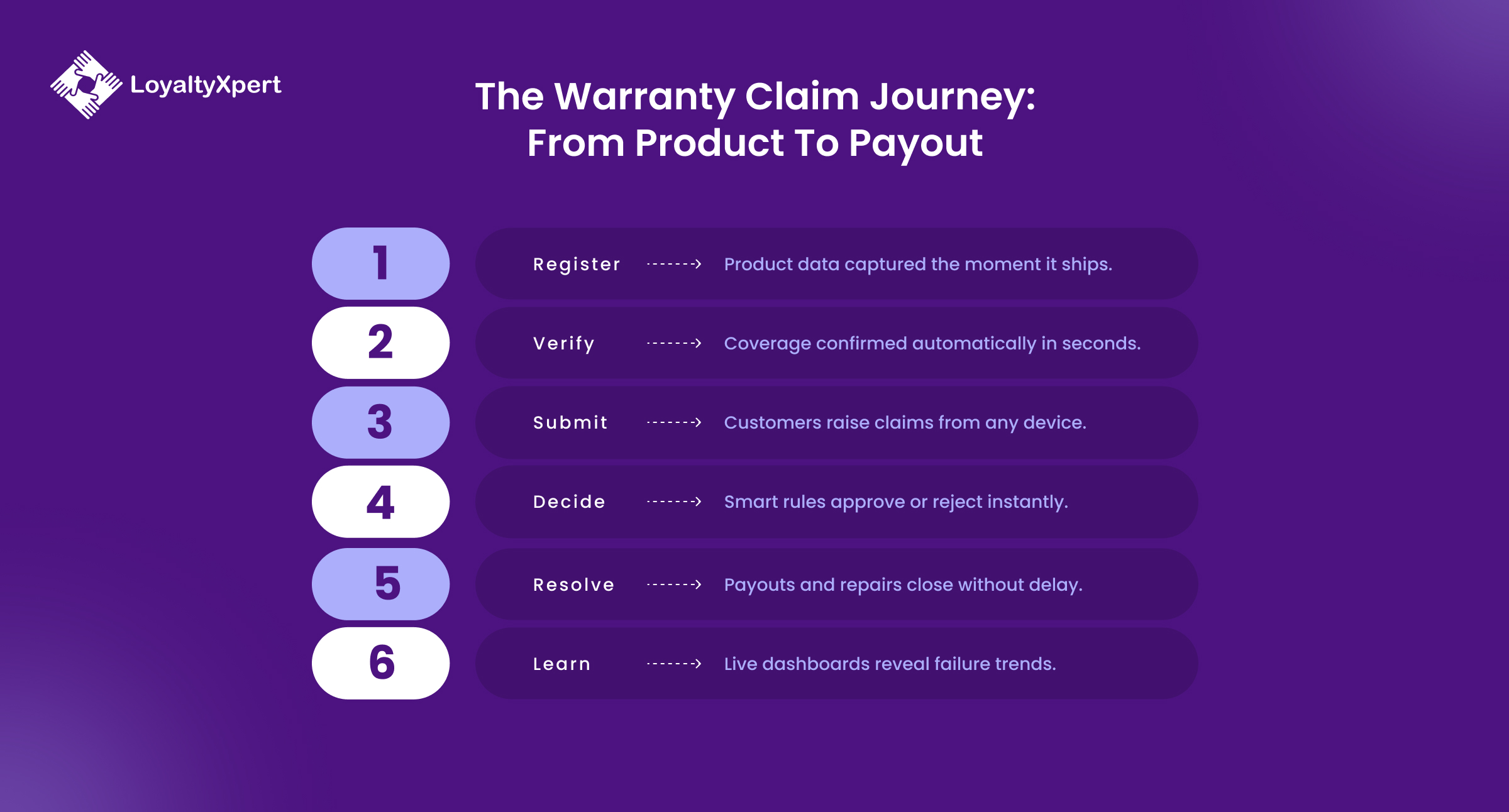
Here is the journey, end to end.
- Product Registration — Warranty registration software captures product, batch, and dealer data through a QR scan or invoice upload.
- Coverage Validation — The system checks the serial number against policy terms and confirms eligibility in seconds.
- Claim Submission — Customers or dealers raise claims through a portal or app, with photographs attached at source.
- Adjudication — Rules engines clear straightforward claims automatically and route the rest for human review.
- Resolution and Payout — Service teams close the claim, and credit notes or replacements are issued without a separate approval chain.
- Analytics — Dashboards group claims by SKU, batch, and region so failure trends surface early.
See the full claim lifecycle live.
This flow removes guesswork from every claim. Speed and accuracy improve at each stage.
What Features Define a Strong Warranty Management Platform?
A capable warranty management platform works on two levels. Core features carry the daily workload of registration, validation, and tracking. Advanced features turn that activity into intelligence about products and channel partners. The better platforms deliver both, and some brands extend them further with warranty management features inside a loyalty app.
Core Capabilities
- Claims Validation — Warranty claim management software checks each request against coverage rules and approves clean claims without manual review.
- Live Tracking — Warranty tracking software shows real-time claim status to customers, dealers, and internal teams at the same time.
- Self-Service Portals — Dealers and end customers register products and raise claims themselves, which cuts inbound calls sharply.
Advanced Capabilities
- Fraud Detection — Rules and pattern checks flag duplicate serials, backdated invoices, and dealers whose claim rate spikes without explanation.
- Defect Analytics — Dashboards group claims by batch and component, surfacing recurring defects long before they turn into recalls.
- Claim Automation — Routing moves every claim to the right owner without manual handoffs or chasing emails.
Together, these features form a complete system. Core tools keep operations running smoothly. Advanced tools turn warranty data into strategy. The strongest platforms deliver both without forcing a trade-off between them.
How Does Warranty Management Software Pay Off?
Warranty management software for manufacturers pays back on three fronts: operations, finance, and loyalty. It removes manual work, plugs revenue leaks, and turns claims into repeat sales. These returns are not one-time wins. They compound across every product line you sell.
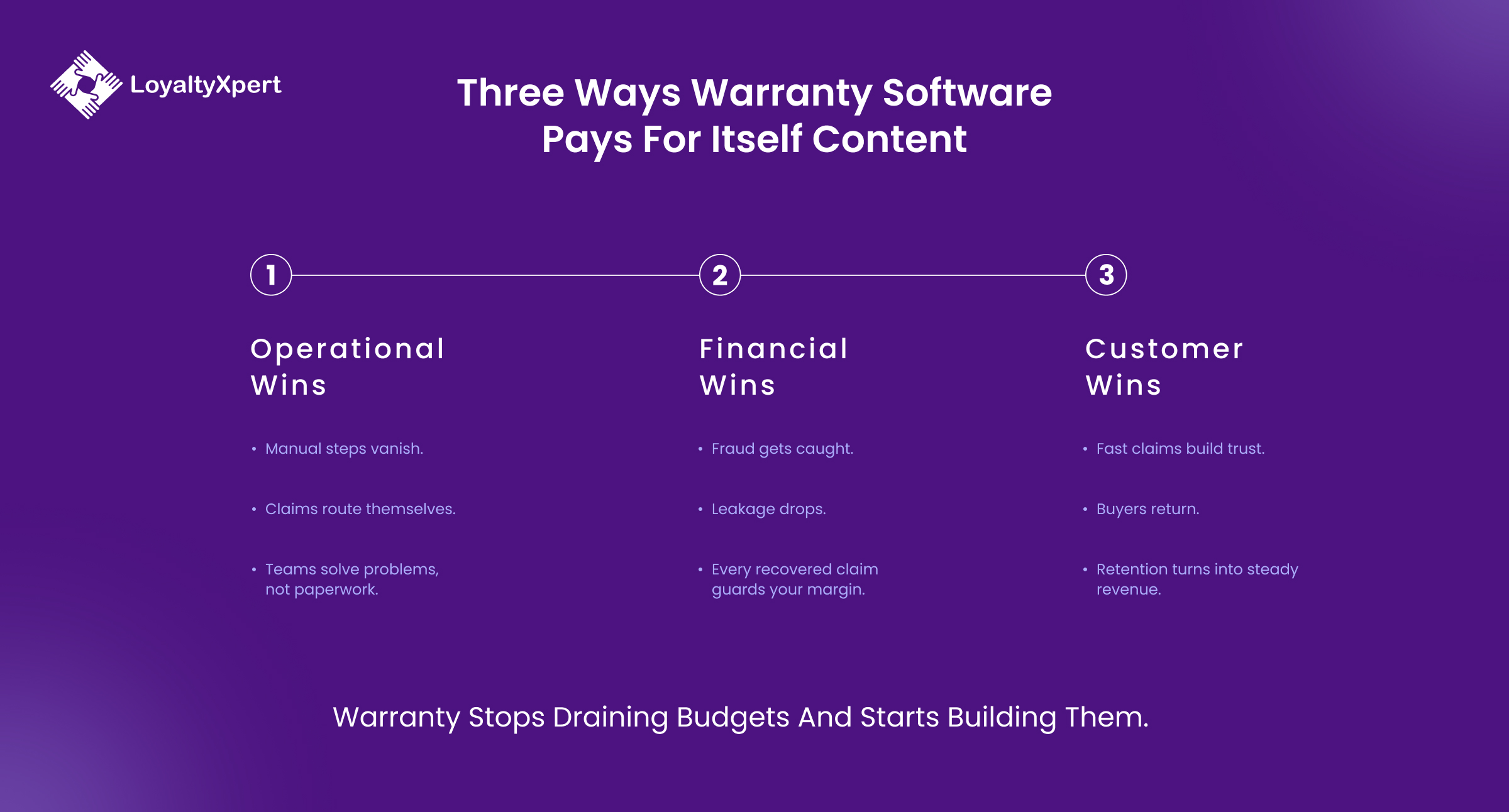
Each front delivers value differently. Here is how the returns break down.
Operational Payoff
Automation strips manual steps from every claim. Warranty claim management software handles the busywork of logging, chasing, and reconciling. Teams stop working through email threads and spreadsheet tabs. Registration, validation, and routing run themselves. Staff move from data entry to the cases that need judgement, and resolution times fall while accuracy climbs.
Financial Payoff
Fraud detection stops duplicate and inflated claims before they reach payout. Warranty leakage shrinks across the board. Analytics expose defect patterns early enough to act on, which keeps a contained batch issue from becoming a recall. Cleaner data also steadies warranty reserves, so finance forecasts on evidence rather than last year’s average.
Customer Payoff
A smooth claim is a loyalty moment. Fast, transparent service earns lasting trust, and slow service undoes years of it in a fortnight. Strong claim handling is one of the clearest drivers of long-term customer retention. Satisfied buyers return, and they tell their dealer why.
See how automation slashes turnaround time.
Stack these three payoffs together and the return on investment becomes clear. Warranty stops draining budgets and starts building them. That shift is why manufacturers are adopting automation now.
Which Industries Benefit Most From Digital Warranty Management?
Digital warranty management suits any product-heavy sector, but the returns climb sharply where claim volumes are high and sales run through a dealer network. Industries carrying long coverage periods, expensive repairs, or strict compliance obligations feel the difference first.
Here is how it lands across five industries.
- Automotive — Parts, dealers, and recalls create claim chaos. Software tracks every claim across the network and ties it back to the supplier behind the component.
- Consumer Electronics — High volume meets short product cycles. Automation validates claims at scale without adding headcount each quarter.
- Home Appliances — Long warranty periods bring years of claim traffic. Registration and claims run without manual work, even when the original invoice is gone.
- Industrial Machinery — Costly repairs demand strict service levels. The system enforces every SLA timeline and records who breached one.
- Medical Devices — Compliance and traceability stay non-negotiable. Every action is logged, so audits pull a full history instead of a reconstruction.
A solid warranty management solution adapts to each one. The workflows differ, but the underlying need does not, which is why loyalty management software for manufacturers increasingly carries warranty as a native module rather than a bolt-on.
How Do You Choose the Right Warranty Management Solution?
Start with your claim volume and complexity. First, map the common warranty claim management challenges you already face. Match features to real operational gaps. Prioritize integration, scalability, and fraud control. A good warranty management solution fits your workflow. Test the platform before you commit fully.
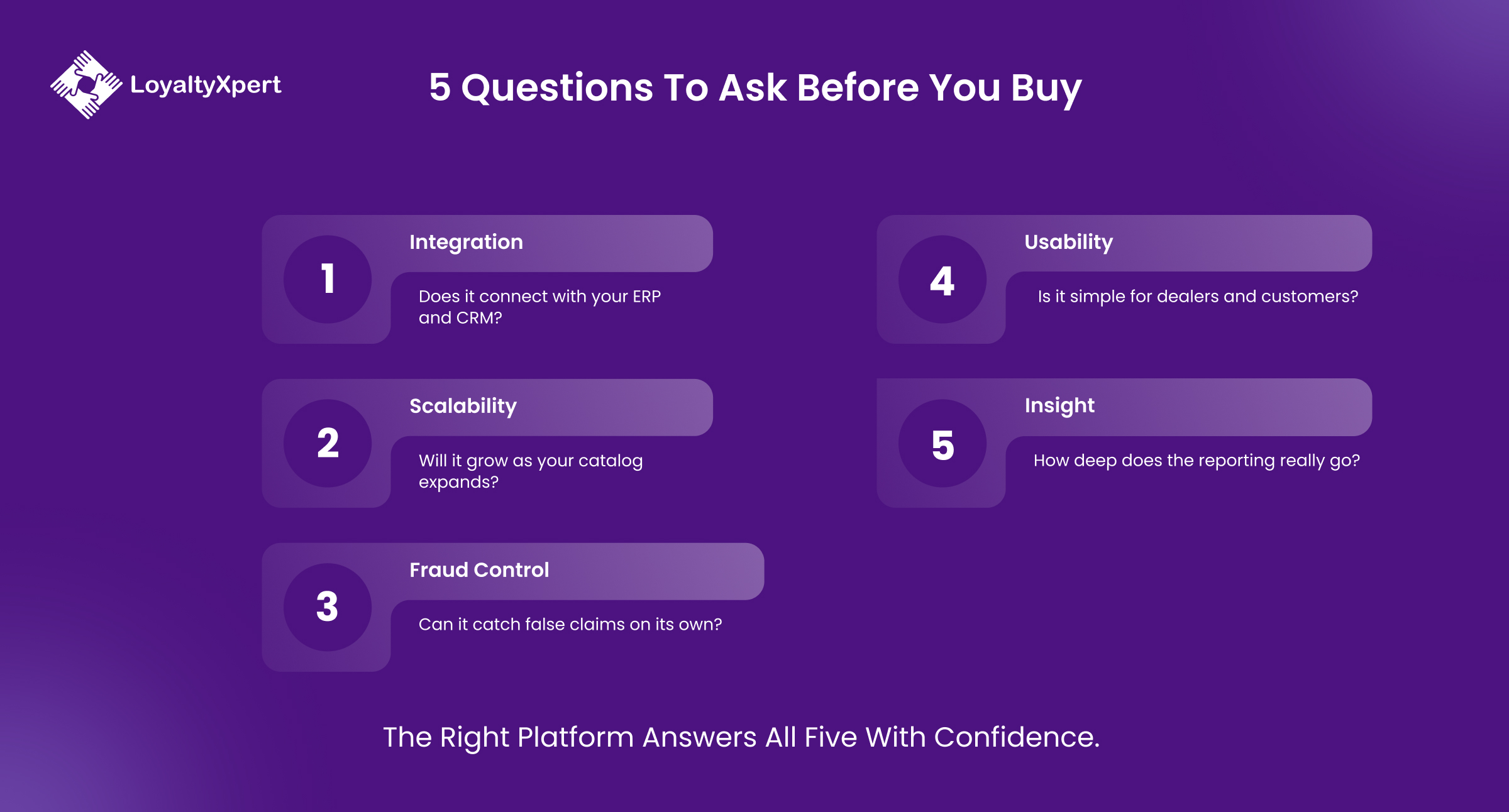
5 Questions to Ask Every Vendor
Pressure-test every shortlist with these:
- Does it integrate with your ERP and CRM?
- Will it scale as your catalog grows?
- How does it detect and flag fraudulent claims?
- Can dealers and customers navigate it easily?
- What depth of analytics and reporting does it offer?
Ask every vendor these questions. The strongest fit will answer all five clearly. Choose the platform that matches your scale today and your goals tomorrow.
What Are the Future Warranty Management Trends for 2026-27?
Warranty management is shifting from reactive to predictive. Four forces will reshape the space by 2027. Manufacturers who track them early gain ground.
AI-Driven Claim Adjudication
AI engines now score claims in real time. They clear clean claims without human review. Adjusters handle only the complex cases. Decision times fall from days to seconds.
Predictive Failure Analytics
Machine learning spots defects before they spread. It reads field data and warranty patterns. Manufacturers fix issues before mass claims hit. This cuts recall exposure sharply.
Blockchain Claim Records
Smart contracts store tamper-proof claim histories. Every party trusts the same shared ledger. Fraud and disputes drop almost immediately. Suppliers settle recovery claims far faster.
IoT-Triggered Warranty Events
Connected products now report their own faults. Sensors raise claims without any customer effort, and warranty registration software links each device automatically. Service frequently begins before a call comes in.
Self-service portals will become the default channel rather than the alternative one. Warranty management software for manufacturers keeps absorbing these shifts, and the gap between leaders and laggards widens every year.
Wrapping Up
Warranty is now a moment of truth. Handle it well and loyalty grows. Handle it poorly, and buyers walk away. Warranty claim management software tips that balance forward. It trims costs, speeds claims, and builds trust. Automation has moved from an edge to an expectation.
The choice facing manufacturers is simple. Keep firefighting claims with manual tools. Or turn warranty into a real advantage.
The takeaway: Warranty is not a cost to manage. It is loyalty waiting to be earned. The manufacturers who act now pull ahead.
Ready to modernize your warranty operations? Choose your next step: Book Demo