Car Wash Lubricant Loyalty: Fueling Customer Retention

With ever-increasing competition in the automobile services sector, service providers are constantly coming up with innovative ways to retain and acquire customers. Creating a large pool of customer loyalty is a non-negotiable in today’s highly competitive market across industries, and the Car Wash & Lubricant Loyalty programs are no different. These programs are designed to ensure repeat business and foster long-term relationships, helping service providers stay ahead in the car wash and lubricant service industry.

In 2024, the passenger car market is expected to generate US$6.4 billion in revenue. And by 2028, the market is predicted to have grown to a projected volume of US$6.6 billion, with revenue estimated to expand at an annual rate of 0.89% (CAGR 2024-2028). Where the growth of the automobile industry is at its peak, as in the Middle East, loyalty programs have emerged as the most potent weapon for any business looking to create a difference and generate long-term customer relationships. 

In this blog we explore how Car Wash & Lubricant Loyalty can be leveraged to retain customers, focusing especially on the UAE market. Not only this, we also share practical tips on how to maximize the benefits of such programs. So grab your tea and stay with us till the end!

Understanding Car Wash Loyalty Programs

An automobile wash loyalty program is the kind of structured marketing activity that enables the rewarding of customers for repeat businesses. Most programs guarantee to offer incentives, discounts, or free services, among other special offers, which encourage customers to come back for regular car washes. In the UAE, where the harsh climate and frequent sandstorms render car maintenance a regular necessity, car wash loyalty programs have received appreciable traction. Such programs not only increase customer satisfaction but also ensure a customers stickiness and loyalty with a particular brand.

What Does Customer Loyalty Look Like in the Car Wash Industry?

Customer loyalty for a car wash business is when repeat and consistent business emerges, along with positive word-of-mouth. Loyal customers are increasingly likely to recommend this car wash service to another, thus contributing to organic growth. Most owners of high-end luxury vehicles in the Middle Eastern market consider having a squeaky clean and shiny sparkling vehicle making regular car wash mandatory. This then forms the basis of loyalty creation in a car wash business through offers of quality services that meet the discretionary eye of the customers. With a highly lucrative car wash reward program structure in place, it is possible to roll occasional customers into the business and, in the process, increase the revenues warranted with customer retention.

What is a Lubricant Loyalty Program?
A lubricant loyalty program is similar to a car wash loyalty program but is particularly designed to best meet the requirements of customers purchasing volumes of engine oils and lubricants. These programs provide rewards on repeat purchases of lubricants, whether personal vehicles or large commercial fleets. Given the critical role that lubricants play in vehicle performance, especially in the extreme weather conditions in the Middle East, a loyalty program can help incentivize customers to choose one brand or service provider over another consistently. By offering benefits like discounts on future purchases, free oil changes, or bundling services, lubricant loyalty programs play a crucial role in securing customer retention and strengthening long-term relationships.

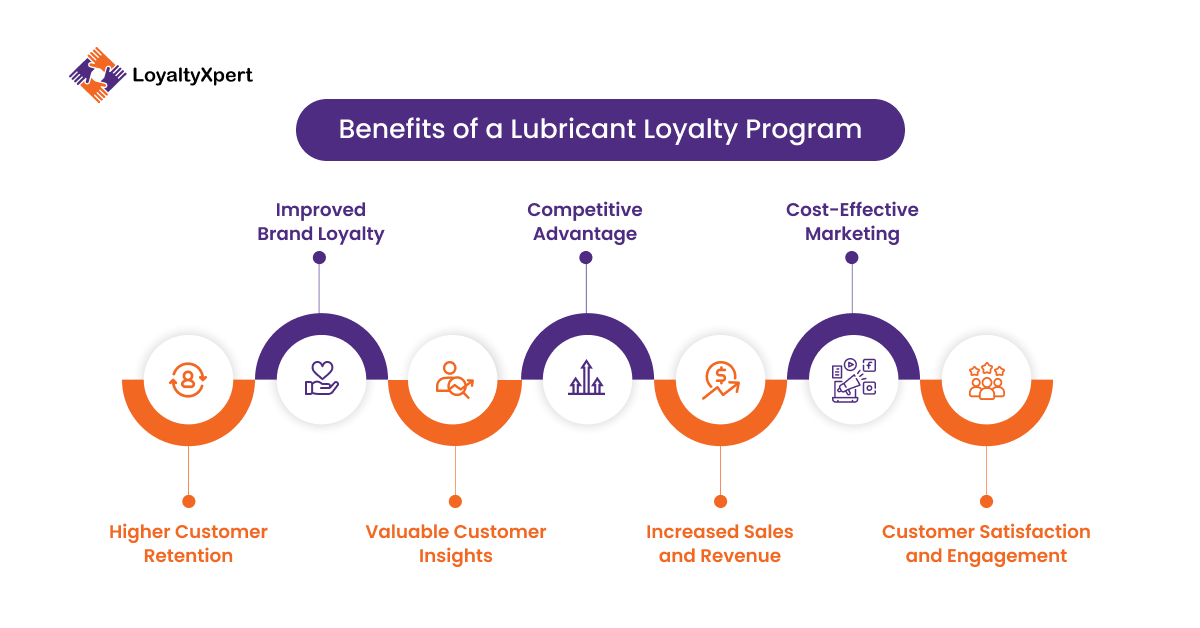
Benefits of a Lubricant Loyalty Program

Benefits of a Lubricant Loyalty Program

  • Higher Customer Retention: The lubricant loyalty programs reward and incentivize repetitive purchases, thereby increasing the chances of customers coming back to their respective brands or service providers, hence reducing the switching probability to competitors.
  • Improved Brand Loyalty: Customers who enroll in the loyalty programs usually connect better with the brand and hence exhibit long-term loyalty, thus favoring your products over others available in the market.
  • Valuable Customer Insights: Loyalty programs provide businesses with information about consumer behavior and preferences to come up with more focused marketing strategies and personalization of offers that will really speak to the audience.
  • Competitive Advantage: A well-designed lubricant loyalty program in a crowded market like the Middle East can help the business stand out from the competition, showcasing itself as a customer-focused and value-driven provider.
  • Increased Sales and Revenue: The lubricant loyalty programs, by rewarding repeat purchases, increase the sales and revenues considerably, more so when the customer redeems points or rewards to get some extra services or products.
  • Cost-Effective Marketing: Loyalty programs are cost-effective marketing in the sense that, other than retaining existing customers, they also attract new ones through positive experiences shared by the loyal customers and word-of-mouth.
  • Customer Satisfaction and Engagement: Reward customers with something of value, such as discounts on future purchases or free services, enhancing satisfaction levels and keeping them engaged with your brand over time.

How Does a Car Wash Loyalty Program Work?

A typical car wash loyalty program is usually a point or tier-based system. Customers are awarded points or move upwards in the tier based on the value and frequency of their purchases. For example, a customer could earn one point for every car wash; then, there would be a certain number of points required to get a free wash or a discount for another service. Some businesses run tiered programs that give premium benefits, such as express service or special treatment for luxury vehicles, based on spending thresholds.

Increasingly, in the UAE, car wash loyalty programs are operated through digital platforms that allow customers to monitor their points and rewards on mobile applications. Technology integration, therefore, makes for a flawless and convenient process and also helps businesses in collecting data to analyze consumer behavior.

Tips for Maximizing Car Wash & Lubricant Loyalty Program Benefits

1. Personalize the experience: In a marketplace where customers demand good service, personalizing loyalty programs pays dividends. Consider offering rewards that are tailored to a customer’s preference or vehicle type. For instance, a customer who drives an expensive SUV might appreciate free detailing service; a commercial fleet operator may value discounts on bulk lubricant purchases.

2. Leverage technology: Implement mobile apps and digital platforms to fast-track the process of the loyalty program. This will not only make the program easily accessible to customers and encourage participation, but also benefit businesses with valuable data on customer behavior that could come in handy in refining and improving the program.

3. Promote exclusivity: Create exclusivity by offering premium rewards or services to your very best customers. For example, in the Middle East, where there is immense value for luxuriousness and status, exclusive rewards are very instrumental in enhancing customer loyalty and satisfaction.

4. Refresh rewards regularly: Refresh the rewards and offers from time to time so that the program does not become stagnant. This shall avoid monotony and ensure further engagement on the part of the customer. Seasonal offers, especially relating to climates, such as offering discounts on summer car care packages, make for great examples in this regard in the UAE.

5. Educate Your Customer: Make sure that they understand the benefits of the loyalty program and how to maximize it. Clearly communicate in person and digital on how it works to get maximum participation and satisfaction.

6. Partner and Collaborate: Think about collaborating with other businesses to offer a collective reward. For example, a car wash service can partner with a fuel station or lubricant brand to give combined rewards in their loyalty program. This will bring better value to the customers and help expand the reach of the program.

Ending Note

In the competitive environment characteristic of the Middle East automotive services market, loyalty programs offer a potent way to spur customer retention and lasting relationships concerning car wash and lubricant services. Therefore, businesses may only design and carry out a loyalty program meeting its value to attract repeat business, reinforce brand loyalty, and ensure a good number of customers through customer satisfaction. It will be those that are very well structured and the most innovative investments in loyalty programs that yield very well once the market continues to evolve.

We are second to none in thinking out and managing effective loyalty programs at LoyaltyXpert. Whether it’s a car wash loyalty program or a lubricant rewards program, our professionals will help you build a solution meeting your business requirements. Avail our free trial and demo today and let us show you how we can help you in fueling customer retention and driving growth in the competitive Middle Eastern market.
Fueling Customer Loyalty: Key Elements of a Successful Fuel Rewards Program

In a highly competitive UAE fuel retail market, wherein fuel prices and customer expectations play an important role, loyalty programs are being seen by fuel companies as a differentiator. The fuel station market in the United Arab Emirates is projected to increase at a compound annual growth rate (CAGR) of 2.21% from 2024 to 2029, from 2.01 million barrels per day in 2024 to 2.25 million barrels per day in 2029. 

Within the context of fuel companies, such fuel loyalty programs are highly effective ways to build customer loyalty, improve brand reputation, and drive growth in business. With a key market dominated by major players like ENOC, ADNOC, and Emarat, a well-designed fuel loyalty program gives significant competitive leverage to companies. In this blog we deep dive into what makes an effective fuel rewards program, what it is capable of doing for customers, and how to build one to suit the unique demands of the UAE market.

What Are Fuel Loyalty Programs?

Fuel loyalty programs are among the strategic marketing activities established solely to reward customers based on their continuous patronage at particular fuel stations. Some of these programs come with numerous incentives, which could be in terms of points, cash back, discounts, or special offers that customers redeem for future purchases of fuel or other related services. Principally, their main motive is customer loyalty, repeat business, and gathering resourceful information toward better service offerings and customer experiences.

Fuel loyalty programs are, therefore, very significant with respect to the UAE fuel retail market, which is extremely competitive in nature among key market players like ADNOC, ENOC, and Emarat. For instance, Rewards by ADNOC and Yes Rewards by ENOC represent two popular loyalty schemes for fuel and offer their customers a variety of privileges against their loyalty.

How Do Fuel Loyalty Programs Help Customers?

The benefits of fuel loyalty programs for customers are many, making such reward programs appealing and a smart strategy for customer retention. This is especially true in the UAE, where value is based on convenience and savings.

– Cost Savings: Fuel loyalty programs will have a lot of opportunities for the customers to save off the fuel costs, which is very lucrative in an area where driving is an indispensable part of everyday life. For example, ADNOC Rewards allows customers to earn points with every purchase from an ADNOC station and redeem them against fuel or other merchandise and services.

– Convenience and Flexibility: Fuel loyalty programs offer customers flexibility in redemption options, allowing them to use the rewarded points for not only fuel but for many other associated products and services, such as car wash and maintenance. The ENOC ‘s Yes Rewards program is another case where customers are offered points to redeem at various outlets, enhancing convenience.

– Customer Experience through Value Addition: Fuel loyalty programs boost the customer experience largely by enabling promotions tailored for individuals, increasing service speed, and allowing other privileges. ADNOC has its Rewards program embedded right into its mobile app, letting the users manage their accounts, track rewards, and get tailored offers., thereby making its user interface hassle-free and user-friendly.

– Exclusive Offers: Members often receive special access offers and promotions not available to non-members, such as discounts on car care services or special offers on fuel.


How to Design an Effective Fuel Loyalty Program

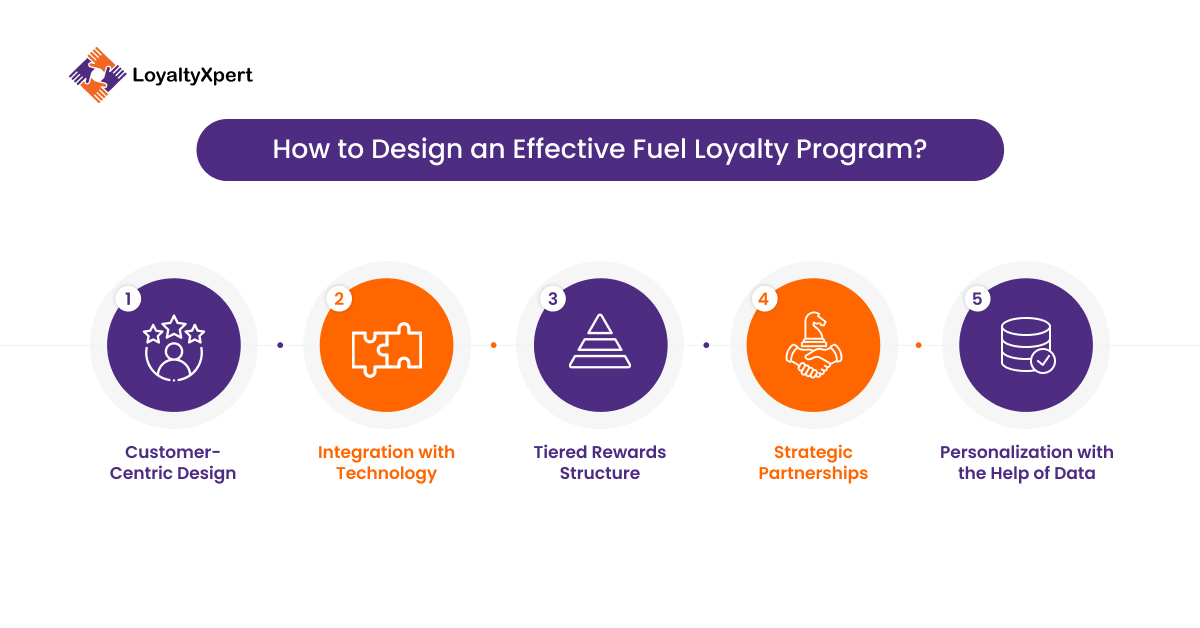
How to Design an Effective Fuel Loyalty Program?

The success of a fuel loyalty program in the UAE requires taking into account the conditions and needs of the local market, customer preference, and competitive dynamics. Some of the key strategies are:

– Customer-Centric Design: It is very important to understand the needs and preferences of customers in this process. An example would be the UAE, where the two large customer segments are individual drivers and corporate fleets; a successful program must therefore be designed to meet both these sets of consumers. For instance, under the Rewards program introduced by ADNOC, there are tailored benefits for personal and business customers to ensure that it addresses a myriad of needs among its target audience.

– Integration with Technology: Integrate your fuel loyalty program with the use of digital platforms, which is important in a tech-savvy market like the UAE. A mobile application or web portal through which customers may track their points, redeem rewards, and even receive personalized offers is critical to the making of a program more accessible and hence more appealing to customers. The Yes Rewards app from ENOC, where users can manage their rewards on-the-go, is a great example of how technology can be used to bring about better engagement with customers.

– Tiered Rewards Structure: Implement a tiered reward structure that encourages customers to spend more to move them up the level in terms of benefits. This strategy not only works toward engaging customers but also helps the company derive higher revenues from them. For example, such a tiered structure could grant basic rewards to regular customers and premium benefits, such as bigger discounts or special services, to the top tier.

– Strategic Partnerships: One can further enhance the value of the fuel loyalty program through cooperation with other businesses. This could include partnerships with retail chains, restaurants, or auto service providers that give customers more redemption opportunities. With ADNOC, given the vastness of its participating partners, one can redeem the points for thousands of goods and services, thereby increasing the value of the program outside the confines of only fuel purchases.

– Personalization with the Help of Data: The data collected through a fuel loyalty program will allow the company to present more personalized and relevant offers to its customers. Fuel companies can tailor rewards and promotions to each customer based on trends in purchase behavior and preferences, elevating engagement and loyalty. ENOC’s Yes Rewards program makes use of customer data in creating pointed offers that are relevant to members’ needs.

Why is a fuel loyalty program crucial for boosting customer retention at gas stations?

A fuel loyalty program forms a very vital part of improving customer retention at a gas station. This is because customers get tangible incentives that help them choose one brand over the other in a very competitive market. A well-structured loyalty program can set such gas stations apart from others in a sector where price fluctuations and service offerings are similar among various brands by offering rewards such as discounts or points, or even special perks for loyalty members. 

Furthermore, fuel loyalty programs improve customer experience through personalization and conveniences beyond just fueling up. For instance, most of the programs are complemented by mobile apps through which customers could track their rewards, get personalized offers, and have a host of other added services like car washes or maintenance at special prices. It is this additional ease and experience that is personalized that fulfills their needs and creates an emotional bond with the brand, thereby improving customer retention.

What Offers and Rewards Are Valued the Most in Fuel Loyalty Programs?

The success of the fuel loyalty program in the UAE largely depends on the type of rewards and offers offered. Here’s what normally works the best for customers:

– Fuel Discounts: A direct discount on fuel purchases is still the most cherished reward by customers. Be it a direct discount at the pump or cashback on fuel card usage, customers appreciate the immediate savings.

– Cashback and Vouchers: Next in line of choice for rewards are cash back or vouchers that can be redeemed with future purchases of both fuel and other retail items. For instance, ADNOC Rewards lets customers redeem their points for vouchers that can be used at a multiplicity of partner outlets.

– Exclusive Services: Premium services in terms of priority fueling, dedicated lanes, or even free car maintenance services would do a lot toward increasing the perceived value of the fuel loyalty program, especially with large buyers such as fleet operators.

– Non-fuel Rewards: Luring non-fuel rewards into the fuel loyalty program, such as on groceries, dining, travel, etc., will make the program more attractive. It’s very versatile in this regard, considering that ENOC’s Yes Rewards can be redeemed against a host of other products and services.

– Temporary Offers: These can be used to stimulate short-term activity and immediate increased levels of spending within certain time frames. An example is double points days or holiday points bonuses. Such promotions are especially used in the UAE, where seasonal promotions are big favorites with consumers.

Case Studies of Fuel Loyalty Programs That Have Worked Right


  1. ADNOC Rewards

ADNOC Rewards is one of the largest and most successful fuel loyalty programs in the United Arab Emirates. It meets the needs of individual drivers and corporate customers by covering a wide area with rewards and benefits. The program is integrated with the ADNOC Distribution app, which helps users manage their rewards, track their points, and get personalized offers. ADNOC Rewards also partners with several retailers to allow customers to redeem points against a host of products and services. This holistic approach has carved a niche for ADNOC Rewards as a leader in the minds of UAE residents and businesses alike.

  1. ENOC Yes Rewards

ENOC’s Yes Rewards program is yet another sterling example of how fuel loyalty programs have indeed come of age in the UAE. This loyalty program rewards customers with points for every purchase they make at any of the ENOC and EPPCO service stations, which can be redeemed for fuel, car wash, or other items from affiliated retail outlets. It is also well-integrated within the ENOC mobile app, making it easy and hassle-free to manage rewards. This is successful, as it gives a wide range of redemption options, thereby being able to meet the various needs of customers, whether these are individual drivers or large fleet operators.

The Bottom Line

Fuel loyalty programs are one of the top strategies in winning the competitive fuel retail market of UAE. It is how to provide real value with meaningful rewards, improve customer experience by using digital, and make seamless transactions with technology that will help fuel companies in designing loyalty programs bound to drive repeated business and nurture long-term relationships with their customers. Just like what has been successfully demonstrated by successful programs like ADNOC Rewards and ENOC Yes Rewards, a well-designed fuel loyalty program gives an organization important competitive leverage.

Be it a new loyalty program that a fuel retailer wants to launch or an existing one that needs enhancement, LoyaltyXpert makes sure to have the program strategically designed and effectively implemented. With customized loyalty solution development expertise at our fingertips, we help accelerate rewards and drive success in the UAE’s fuel retail market. Schedule a free trial and a demo with us today!

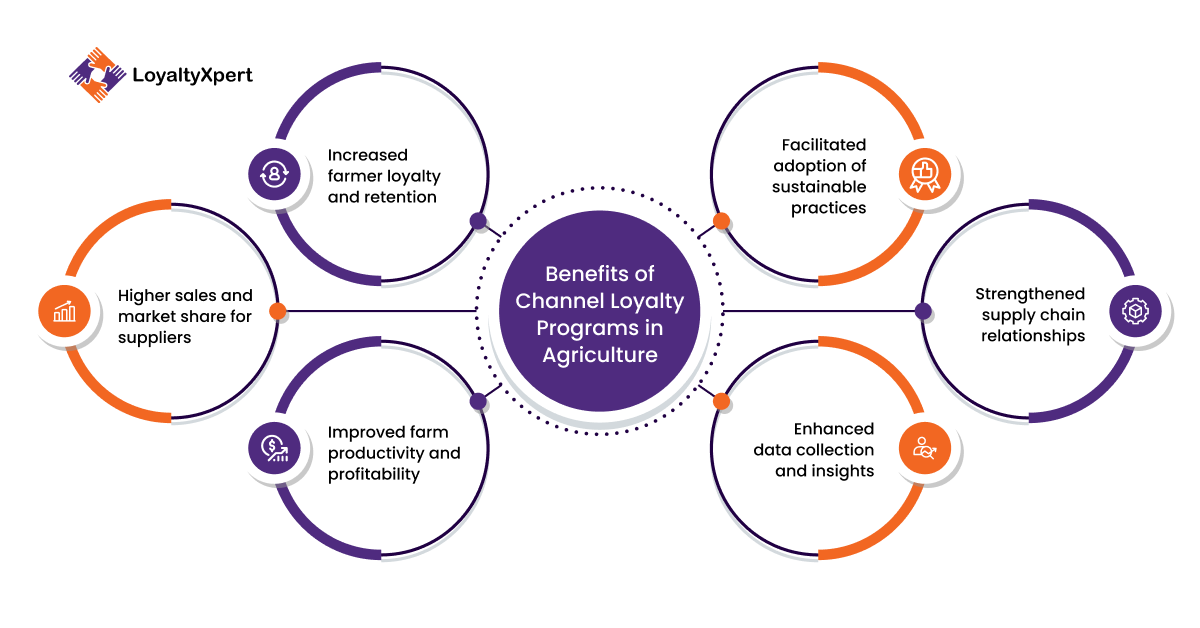
Your Ultimate Guide For Channel Loyalty Programs

Most businesses look for ways to drive and reinforce key relationships with their partners to thrive in the modern market. One such strategy is the implementation of a channel loyalty program. The Incentive Research Foundation (IRF) reports that channel partner reward programs contribute to a 71% increase in product/brand awareness among channel partners, a 67% rise in sales and market share, and a 55% increase in customer loyalty and satisfaction. Such programs not only empower channel partners to sell your products or services but also ensure long-term loyalty and commitment. This comprehensive guide will take you through the basics of channel partner programs and how they can help in the sustainable growth of your business.

A well-structured channel loyalty program is not only about increasing sales; it’s a strategic initiative to help you build a robust ecosystem around your brand. You can leverage mutually beneficial relationships with your partners to increase your market reach, enhance customer satisfaction, and achieve greater profitability. Whether building from scratch or fine-tuning an established program, in either case, long-lasting success is based on an organization’s ability to grasp critical concepts and challenges in channel incentive programs.

What is a Channel Partner Incentive Program?

A channel partner incentive program is a structured undertaking to reward partners on the basis of certain achieved sales targets, desired behaviors, or effectively promoting your products. According to a report, A 32% rise in overall revenue and a 30% increase in market share were attributed by 81% of top-performing businesses to their non-cash partner reward programs. These programs include not only financial incentives, such as discounts, rebates, or commissions, but also non-monetary rewards in the form of recognition, training opportunities, and access to new products in advance of anybody else.

An example of a channel partner program is Cisco’s tiered incentive program. The classification runs from Select to Premier to Gold, in that ascending order. For instance, the best-selling partners are Gold, who enjoy top-category benefits such as deep discounts, prioritized availability to new products, and dedicated support. This design inspires its partners to reach farther and gets value in their contributions toward mutual growth, deepening their loyalty to the Cisco ecosystem.

Who are Channel Partners?

Channel partners are third-party entities that perform the functions related to getting the product or service of the company to the market. This may include additional resellers, distributors, consultants, system integrators, or value-added resellers. Normally, the role of these partners is to act like an intermediary between your company and the customers at the far end; most often, they offer expert services, specialized skills, or geographical presence that a company may not possess.

For example, a VAR might bundle Microsoft Office 365 with the sale of laptops, installation services, and ongoing IT support to businesses. This allows Microsoft to extend its access to varied markets without having to communicate with each customer individually. Value is added by the VARs because they will adapt the solution to accommodate the specific needs of their customers; thus, this deal works for Microsoft and the VARs as well as for the end customers.

How Do I Choose the Right Channel Partners?

The success of your channel loyalty program largely relies on what kind of channel partnership is chosen. Following are some key factors to be considered in a channel partner:

  • Market Expertise: The type of partners you need to have are those with a good knowledge base regarding the market you are targeting. Such partners can add great value, particularly if you are getting into new regions or industries.

  • Reputation and Reliability: The reputation and reliability of the track record of the partner are to be evaluated. This could add trust among customers towards your brand and hence credibility.

  • Goal Alignment: Ensure that the business goals of the partner are aligned with yours. Misaligned goals will lead to conflicts of interest and will reduce the effectiveness of the partnership.

  • Technical Capabilities: Consider the technical experience in supporting your products or services. A partner that has technical capabilities adds value through support, customization, and integration services.

  • Commitment to Growth: Go for partners who demonstrate their commitment to growth and are ready and willing to make investments in training, marketing, and sales efforts. This commitment is usually an excellent pointer to the potential of their capacity to drive long-term success.

What are the Types of Channel Incentive Programs?

There are various channel loyalty programs with different objectives. Some common types include:

  • Rebate/Discount: Rebate or discount products to drive partners to sell more. For example, a distributor may get a rebate for selling above a certain level.  Channel loyalty programs like this are especially good at forcing volume and cleaning out inventory.

Example: Cisco offers rebates to distributors who exceed sales targets for specific products, helping clear out inventory while boosting overall sales volume.

  • Performance-Based Bonuses: Directly sales performance-based or any key metric-based bonuses let partners focus fully on certain goals, like meeting quarterly sales targets. These bonuses may be scaled for the level of achievement, providing further incentive and reward for top performers.

Example: Dell EMC rewards its top-performing partners with bonuses for meeting quarterly sales targets, driving focused efforts on achieving specific sales goals.

  • Co-Marketing Funds: By providing co-marketing funds, you are empowering the partner to co-invest in mutually beneficial marketing activities—the promotion of your products through their channels while sharing related costs. Not only is the reach of your marketing expanded, but so is the partnership in terms of aligning marketing goals within this area. 

Example: HP collaborates with its partners by providing co-marketing funds, enabling them to jointly promote HP products through local campaigns, thus expanding market reach and strengthening the partnership.

  • Training and Certification Programs: The incentive, upon completion of training or achievement of certifications, will enhance the partners’ skills in efficiently selling and supporting your products. This investment in partner education ensures that they are fully endowed with the necessary skills and knowledge to do justice to the representation of your brand.

Example: Salesforce offers certifications to its partners, enhancing their expertise in selling and implementing Salesforce solutions, ensuring that partners are well-equipped to provide high-quality service to end customers.

  • Tiered incentive programs: Channel loyalty programs are designed to offer different levels of rewards based on the partner’s performance, thereby motivating them to move up the tiers. This is an especially effective way to get a sense of competitiveness instilled within partners to reach the highest level.

Example: Microsoft’s Partner Network uses a tiered system where Gold Partners receive the highest rewards, motivating partners to strive for excellence and earn greater benefits, which in turn leads to higher sales and stronger market presence.

Why Do You Need a Channel Incentive Program?

A channel incentive program is a prerequisite for driving engagement and performance across your partner network. It is through the use of such targeted incentives that you will motivate channel partners to increase their focus on your products and services, leading to growing sales and market share. Channel loyalty programs are designed to encourage partners to concentrate their efforts on helping you achieve your business goals—whether that be attaining sales objectives, growth in new markets, or improvement in customer satisfaction. With the right incentives in place, you will create a competitive environment among your partners and drive them toward higher success and commitment for your channel loyalty programs.

A well-structured channel incentive program binds stronger relationships between you and your partners. It proves that you value their contribution to your organization and are ready to invest in their success. Such mutual support will help to increase partner loyalty and, therefore, make them more likely to recommend your brand above your competitors. You continue rewarding and recognizing them for efforts, hence creating a mutual ecosystem in which your business and partners thrive for long-term growth and profitability.

What are the Challenges we face in Running Effective Channel Incentive Programs

Effective channel loyalty programs raise a number of challenges:

  • Management Complexity: Management of huge and diverse partner networks can be really difficult, specifically when performance has to be tracked, fairness ensured, and rewards distributed across many regions with varying regulations.

  • Misaligned Incentives: If the channel loyalty programs are not aligned to business goals, then partners can work on activities which will not help in contributing to long-term growth.

  • Budget Constraints: Because a persuasive incentive program may prove rather expensive, budgetary constraints may readily curtail your ability to offer competitive rewards while staying in the black.

  • Keeping the Partners Engaged: There is always the battle to keep partners interested, especially if the channel loyalty program gets too stagnant or their expectations are not met, causing a fall in participation and the effectiveness of the program.

  • Performance and data tracking: Partner performance needs to be tracked accurately; rewards need to be distributed on time and correctly. Otherwise, the process could be marred by errors and delays that frustrate partners.

How to Overcome the Challenges of Running Channel Incentive Programs

Such challenges require extra attention to detail to make your channel loyalty program successful. Following are some ways to achieve this:

  • Program Simplification: The channel loyalty program design should be kept uncomplicated and easy to understand. Clear definition of rewards, goals, and criteria of participation helps avoid confusion and builds trust.

  • Align Incentives with Business Goals: The best channel loyalty programs keep partner incentives aligned with business goals. It’s worth ensuring that the efforts of the partners are driving mutually beneficial outcomes.

  • Budget Wisely: Be very smart about your budget—just spend where it’ll count in terms of motivating your partners. This may mean a mix of both monetary and non-monetary rewards.

  • Refresh and Innovate Regularly: Keep refreshing your channel loyalty program by updating the rewards and criteria periodically. Devise new incentives or challenges to keep your partners interested in the game.

  • Invest in Technology: Keep pace with technology in making data collection, performance tracking, and reward distribution easier. Automation tools will help you manage the channel loyalty program more efficiently and reduce administrative burdens.

  • Provide Ongoing Support: Offer continuous support to your partners with training, communication, and feedback. This will help in keeping the partner engaged and motivated.

Wrapping Up

If run effectively, channel loyalty programs can be the ultimate business growth tool, aside from being a good way of building long-term relations with partners. You could create a channel loyalty program that provides extensive value if you choose your partners carefully, design an incentive program consistent with your objectives, and then work out the most common problems.

In addition, channel loyalty programs shall help in building up a great and healthy ecosystem that supports all the current business requirements of your organization and grows with the organization in the future. If designed correctly, then a channel partner incentive program helps your organization stand apart in the crowded market and creates your brand as the obvious choice for all the partners.

Ready to optimize your channel partner strategy? At LoyaltyXpert, we provide end-to-end solutions with personalized attention to every client for building and managing channel loyalty programs that result in real output. Whether it is just initiating a new program or optimizing an existing one, at each step of the journey, our team of experts will stand by your side. Find out how we can help you achieve your business goals—Schedule a demo with LoyaltyXpert today or avail our free trial

The Retention Revolution: Innovative Approaches to Employee Loyalty Programs

A talented, capable, and stable workforce is the bedrock of businesses that are successful and thriving. However, changing employee expectations, shift in work culture, technology, and various other factors have left business across the globe grappling with high employee attrition. Companies operating in regions like the Middle-east where there is no dearth of good work opportunities are at a higher risk of employee attrition.

We are all aware of the “Great Resignation’ momentum that happened in 2021 in the USA. The momentum did have a ripple effect on other locations too. However, business owners learned their lessons quickly and have worked on effective strategies to woo employees back and ensure they stay. One  such move that has played a key role is employee loyalty programs. In this blog, we deep dive into what drives employee loyalty and how a well designed and easy to access employee loyalty program can help organizations retain employees. 

Let’s begin with understanding what employee loyalty programs exactly entail.

Understanding Employee Loyalty Programs

In the modern workplace employee loyalty programs are more than just occasional bonuses/perks/or a gift on work anniversary and birthdays. Today employee loyalty programs are a strategic tool which organizations use to engage, reward, and retain employees. It is a structured approach towards the creation of loyalty through continuous alignment of employee motivation to organizational goals. 

New-age employee loyalty incentive programs must resonate with employees at a  psychological and emotional level and foster a sense of attachment to their workplace. These programs should facilitate trust, mutual respect, and a strong emotional connection between an organization and an employee. 

A deep understanding of what drives employee loyalty is therefore imperative to build an employee loyalty program that makes an impact. Let’s explore the key drivers of employee loyalty. 

What Drives Employee Loyalty?

A number of elements come together to create an employee’s sense of loyalty: 

Recognition and Reward: It is human for anyone to expect appreciation and recognition for their efforts and good work be it in the professional or personal space. Recognizing your employees’ contributions through a formal awards ceremony or a simple ‘thank you’ on a public forum makes a big difference in morale and loyalty. Employee reward initiatives to complement this appreciation goes a long way in driving employee loyalty.

Career Development: The provision of growth and development opportunities is another key loyalty driver. Employees who have a clear roadmap of their growth in the company are more likely to stay.

Work-Life Balance: Flexible working conditions and work-life balance are greatly appreciated in cultures like the Middle East, where family and community are an integral part of day-to-day life.

Corporate Culture: If the corporate culture is such that employees feel included and supported, then they will belong. If the values of employees are shared by the organizations and a good working atmosphere is provided, employees will be loyal to such organizations.

Employee Empowerment: Empowering employees to have a say  in decision-making and providing autonomy to take decisions for their team are effective strategies to win employee loyalty.

Crafting an Employee Loyalty Program

While designing an employee engagement and rewards program, keep in mind what is meaningful to your team. A few must haves of modern employee loyalty programs are:

Personalized Incentives: Offer incentives in the form of rewards depending on personal preferences. There can be some employees who prefer a financial bonus, whereas others are more interested in having time off or more professional development time. Look into such employee loyalty program ideas that would serve diverse needs.

Continuous Feedback: Regular check-ins and feedback sessions allow employees to be heard and valued. This also gives management an opportunity to identify potential problems and proactively resolve them before they become a serious threat.

Clear Communication: Clearly communicate the loyalty program’s goals, rewards, and expectations to employees to build trust, encourage participation, and foster ownership. Transparency drives engagement and motivation.

Diverse Reward Options: Offer a diverse range of rewards that cater to varied interests and needs, ensuring something for everyone. This includes wellness initiatives for physical and mental well-being, travel vouchers for exploration and relaxation, professional development courses for career advancement, and other incentives that appeal to different passions and priorities, making the program inclusive, engaging, and meaningful.

Link Rewards to Performance: Directly tie rewards to performance, making it clear that incentives are earned through achievement. This transparent connection fosters fairness, motivation, and a sense of accomplishment, driving employees to take ownership of their work and strive for excellence.

Ways to Encourage-Participation in Employee Loyalty Program

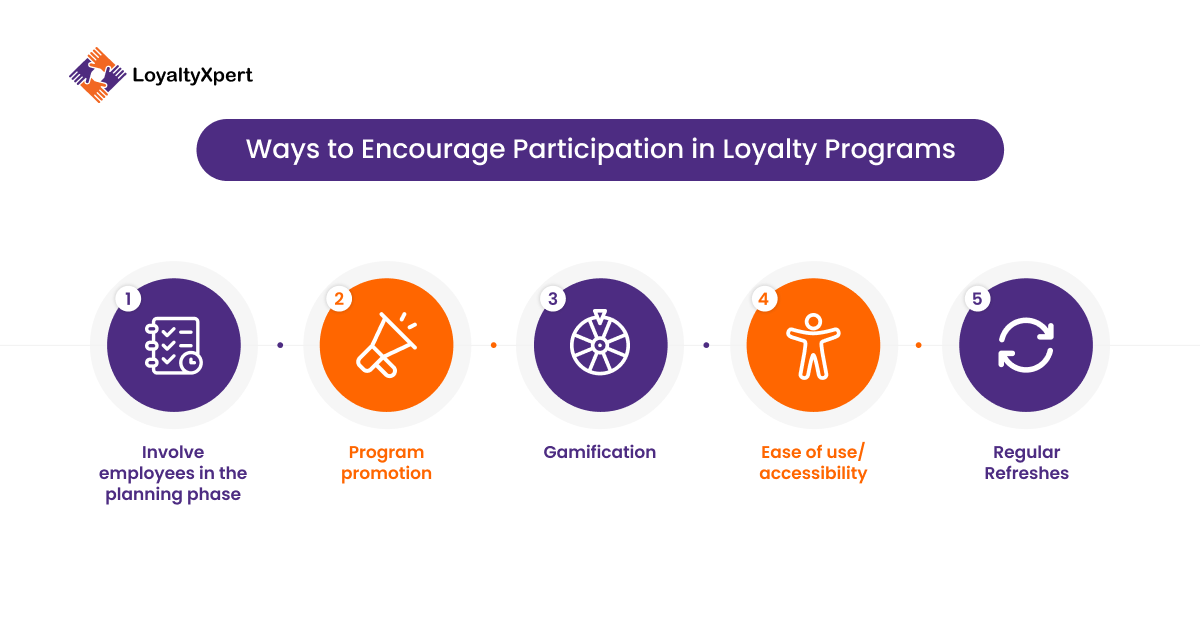
Ways to Encourage Participation in Loyalty Programs

No matter how brilliantly an employee loyalty program is designed, it serves no purpose if it fails to engage your employees. A successful loyalty program is one in which your employees participate wholeheartedly. But here’s the thing: getting people actively involved in any program can be an uphill task. But by employing the below mentioned. strategies you can increase employee participation in loyalty programs. 

Involve employees in the planning phase: As you are building the program, get their ideas. This might create a sense of ownership and will make them more invested in the idea.

Program promotion: Publicize the program through regular internal communications, including newsletters, company groups, internal website and communication network. Share examples of successes within these communications. Employee engagement activities, such as workshops or meetings, can also be used to educate employees about the program and its benefits.

Gamification: Include exciting and competitive game features, such as leaderboards and a point system, to encourage participation.

Ease of use/accessibility: A loyalty program and its rewards should be simple to use and access. Employees do not want to have to go through lengthy forms, complex interfaces, and a series of permissions/approvals to rightfully claim the fruit of their hard work.

Regular Refreshes: Maintain the program’s novelty by periodically changing the recognition standards and awards. This will keep the program from going stale and employees interested.

Why Your Organization Needs an Employee Loyalty Program

Investment in an employee loyalty program is not a choice but a strategic imperative. Here’s why:

Reduced Turnover: A loyalty program can reduce turnover by incentivizing partners to continue doing business with your company, rather than switching to a competitor. Schneider Electric’s Partner Program loyalty program offers benefits like dedicated support, training, and rewards to its partner businesses.

Increased Productivity: A loyalty program can increase productivity by providing partners with the tools, training, and resources they need to succeed. Intel’s Partner Alliance loyalty program offers benefits like technical training, marketing support, and sales tools to its partner businesses.

Enhanced Reputation: A loyalty program can enhance a company’s reputation by demonstrating its commitment to its partners’ success. Cisco’s Channel Partner Program loyalty program offers benefits like training, support, and rewards to its partner businesses.

Encourages Team Spirit: A loyalty program can foster a sense of community and teamwork among partners, leading to increased collaboration and joint success. Microsoft’s Gold Partner Program loyalty program offers benefits like training, support, and rewards to its partner businesses.

Cultural fit: In the Middle East, there is no clear boundary between personal and professional relationships. A well-implemented loyalty program will help to adjust the corporate culture with local values and improve overall satisfaction among employees.

The Benefits of Employee Loyalty Program

There are manifold benefits of an employee loyalty program:

  1. Employee Retention: The retention of skilled employees saves the organization the time and cost associated with recruiting and training new employees.
  2. Cost Reduction: High turnover of employees is costly. Loyalty programs can reduce such costs by keeping them engaged and committed.
  3. Boosted Morale: This keeps morale high, which has great implications for the general atmosphere and productivity at the workplace.
  4. Higher Engagement: Engaged employees will do more in their jobs to contribute to the firm’s success.
  5. Competitive Advantage: Companies that have effective loyalty reward programs create a uniqueness in the marketplace that helps firms attract good people and retain others.


Steps to Creating a Successful Employee Loyalty Program

An effective employee loyalty program requires proper design, planning, and implementation. The steps are enlisted herein below:

  • Identification of objectives: The objectives or targets to be achieved through the program need to be spelt out. It could be in the form of reduction in attrition rate, productivity enhancement, or betterment of the satisfaction level of the employees.
  • Understand what matters to your employees: While designing the program, learn from employee surveys or focus groups what really motivates them and what they would appreciate in a loyalty program.
  • Program Design: Based on your research, develop a program that will support organizational goals and employee preferences.
  • Clearly Communicate: Clearly communicate all the details of the program—how it works, the rewards available, and how an employee can take part in the program.
  • Launch and Promote: Launch the program with an internal marketing campaign to ensure every employee is aware of the program. Keep it top of mind by using multiple channels.
  • Monitor and Adjust: Check the program frequently, and make relevant changes that are aligned with employee feedback and participation rates.

Wrapping Up

An employee reward scheme can be a powerful tool for motivating employees and enhancing staff retention. If you understand the drivers of loyalty, then embed the key elements within your program and never stop promoting and enhancing it, you will make certain that your team feels valued and appreciated in the workplace. This not only reduces turnover but also increases productivity and enhances your company’s brand as an employer of choice.

In case you need to establish or improve your employee loyalty scheme, LoyaltyXpert will help with individual solutions that are most appropriate for your business and retain the best talent with a loyal, highly engaged workforce. Avail our free trial and demo today!

7 Metrics To Improve (And Measure) Customer Retention

Building solid ties with your clients is decisive in today’s fiercely competitive market. Strategic planning and ongoing assessment of client contacts are essential to customer retention, in addition to offering excellent products or services. Tracking metrics that provide information on consumer behavior and satisfaction is one efficient approach to accomplish this. Through the development of improved customer retention strategies, these indicators can help firms retain and grow their consumer base.

Decoding Customer Retention

A business’s capability to get a one-time buyer to make a repeat purchase and engage them so that they do not switch to a competitor is known as customer retention. It is an essential indicator of a company’s viability and health, showing how well it can preserve long-term connections with its customers. According to a report, Despite having access to less expensive options, 39.4% of consumers will still spend extra on a product. Retention involves more than just keeping customers from leaving; it also entails growing and improving the relationship’s value. 

What is churn rate?

The percentage of clients that discontinue doing business with a company within a specified time frame is known as the churn rate, also known as the attrition rate. Excessive turnover rates may be a sign of discontent with the offerings, services, or general customer experience. Improving retention and lowering churn are crucial goals for companies seeking long-term success. Businesses can take corrective action by identifying patterns or common factors that lead to client departure by regularly tracking their churn rate. This measure is especially important for subscription-based businesses where recurring income is essential.

Why is customer retention important?

There are several reasons behind the importance of customer retention. First off, retaining your current clientele is typically less expensive than attracting new ones. 

The Harvard Business Review states that it can cost 5 to 25 times as much to bring on a new client as it does to retain an existing one. Second, devoted clients typically make larger, more frequent purchases. More steady revenue streams and higher average order values are the results of this increasing purchase behavior. Third, loyal clients frequently turn into brand ambassadors who spread the word about the business to attract new clients. They are more likely to join loyalty programs, write positive reviews, and refer others to your company. Thus, concentrating on retention tactics might result in lower expenses, more revenue, and a better reputation for the business.

What are customer retention metrics?

Customer retention metrics are quantitative measures that aid in understanding customer acquisition and retention performance. These measures shed light on client satisfaction, loyalty, and general company health. Businesses can identify areas for development and put plans in place to boost client retention by routinely observing these indicators. These indicators provide a thorough picture of how successfully a company is retaining its client base by delving into customer behavior, preferences, and engagement levels in addition to simple sales data.

How to Measure Customer Retention

1. Customer Retention Rate (CRR)

The percentage of customers that a business keeps over a specific time period is measured by its customer retention rate. It’s computed by taking the total number of customers at the beginning of the period and dividing it by the total number of customers at the end, less any new customers that were added during that time. A high CRR is indicative of successful retention tactics. Personalized experiences, loyalty programs, and customer service are often areas where businesses with high CRRs make significant investments.

Formula: CRR = ((E – N) / S) * 100

Where:

  • E = Number of customers at the end of the period
  • N = Number of new customers acquired during the period
  • S = Number of customers at the start of the period

2. Customer Churn Rate (CCR)

The percentage of customers lost over a certain time period is determined by the Customer Churn Rate. Monitoring CCR makes it possible to spot retention problems early on and take action before they get worse. A high percentage of client turnover can be a sign of deeper issues like poor product quality, unsatisfactory customer service, or uncompetitive pricing.

Formula: CCR = (L / S) * 100

Where:

  • L = Number of customers lost during the period
  • S = Number of customers at the start of the period

3. Repeat Purchase Rate (RPR)

This indicator calculates the proportion of customers who make multiple purchases. Strong client loyalty and satisfaction with the good or service are indicated by a high RPR. Recurring purchases are a certain sign of brand loyalty and client pleasure.

Formula: RPR = (R / C) * 100

Where: 

  • R = Number of repeat customers
  • C = Total number of customers

4. Customer Lifetime Value (CLV)

A business’s overall revenue from a single customer account is estimated by Customer Lifetime Value. Understanding CLV is essential for determining the long-term worth of client relationships and for guiding marketing and retention spending decisions. It offers a monetary viewpoint on the value of keeping an existing customer as opposed to gaining a new one.

Formula: CLV = (Customer Value * Average Customer Span)

5. Net Promoter Score (NPS)

By asking customers if they would suggest the business to others, NPS is able to determine how loyal a customer is. Customers rank products on a 0–10 scale, and the results are useful in identifying supporters, lapsers, and critics. Positive word-of-mouth is more likely to come from promoters, but if their complaints are not taken seriously, detractors could damage the brand’s reputation.

Formula: NPS = % of Promoters − % of Detractors

6. Customer Satisfaction Score (CSAT)

Customer satisfaction gauges how happy customers are with a business’s products, services, or interactions. Usually, questionnaires with a scale for customers to score their satisfaction are used to collect this data. Good customer experiences are indicated by high CSAT scores, which are also correlated with greater retention rates.

Formula: CSAT = (Sum of all customer satisfaction scores / Number of Respondents) * 100

7. Customer Engagement Rate (CER)

CER monitors the level of interaction that consumers have with a brand through a variety of channels, including emails, social media, and website visits. Improved retention is frequently correlated with higher engagement rates. Customers that are actively involved with a company are more likely to be devoted, make repeat purchases, and promote it.

Formula: CER = (Total customer interactions / Total customers) * 100

The importance of Tracking Customer Retention Metric

Tracking customer retention metrics provides invaluable insights into customer behavior, preferences, and satisfaction. By regularly monitoring these metrics, businesses can:

  • Identify trends and patterns in customer behavior.
  • Pinpoint areas that need improvement.
  • Develop targeted strategies to enhance customer experience.
  • Measure the effectiveness of retention initiatives.
  • Forecast future business growth and profitability.

Metrics serve as a compass, guiding companies in the direction of the most effective tactics. They support data-driven decision-making that improves customer satisfaction and loyalty as well as understanding the effects of various initiatives. A culture of continuous improvement, where feedback is actively sought and used to improve customer service, is also fostered by consistent tracking and analysis.

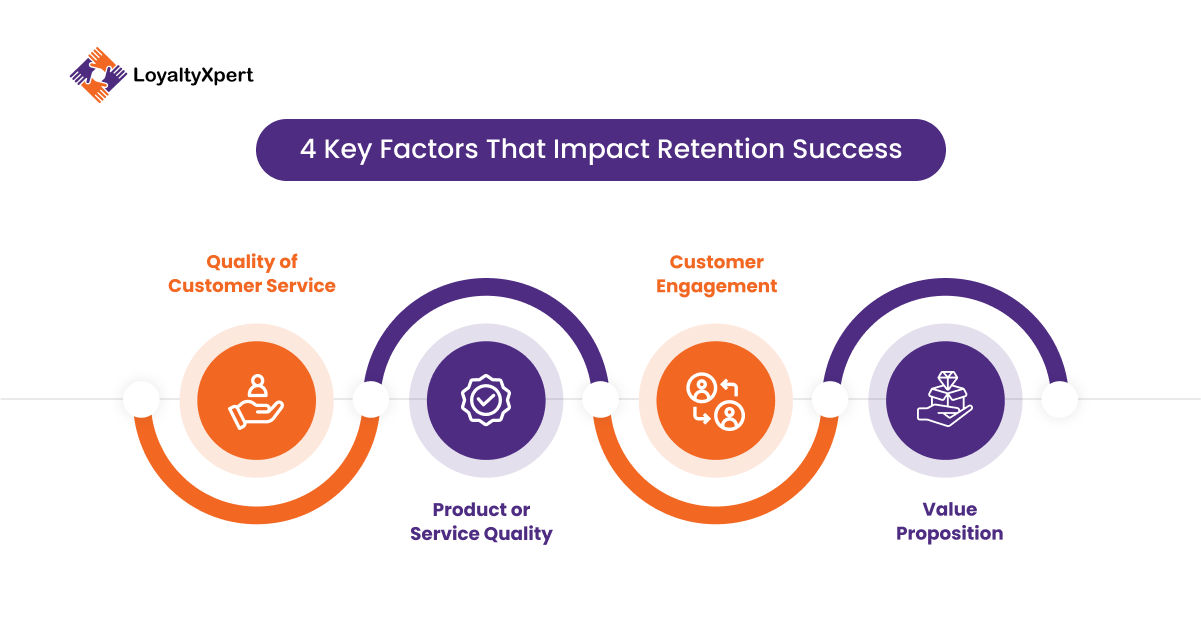
4 Key Factors That Impact Retention Success

4 Key Factors That Impact Retention Success

1. Quality of Customer Service

One important factor in retention is providing outstanding customer service. Efficient, kind, and timely support can convert an unhappy customer into a loyal supporter. Prioritizing customer service helps businesses achieve better satisfaction and decrease attrition rates. Putting money into educating customer care representatives and putting strong support systems in place are important first steps.

2. Product or Service Quality

It is essential to supply high-quality products or services on a regular basis. Clients are more likely to stick with a business that meets or exceeds their needs. Retention rates can be greatly increased by guaranteeing product dependability, usability, and ongoing improvement based on client input.

3. Customer Engagement

Maintaining a connection and brand loyalty with customers is achieved through personalized communication, loyalty programs, and frequent updates. A solid relationship can be developed with consistent communication through emails, social media, and personalized messages. Creating a community around the brand, providing exclusive deals, and providing quality content are some ways to increase brand engagement.

4. Value Proposition

Making sure that your offerings are valued highly by customers in comparison to those of your competitors can have a big impact on retention. This covers not just the product or service itself but also the whole experience and any extra advantages. The perceived value can be increased by emphasizing special features, delivering excellent customer service, and offering material rewards like discounts or special access.

How to Improve Customer Retention

Now, let’s look at the essential ways to improve customer retention:

1. Customer Feedback

Listening to your customers is one of the most compelling ways to increase customer retention. For instance, you can always send surveys to customers and get their feedback. The survey results will provide insights into understanding your customers about their preferences. Also, you can identify if they are unsatisfied with any services. Once you find the pain points, resolve them as soon as possible to retain them in your business.

2. Build Trust

Transparency is to build customers’ trust. The more transparent services you offer to customers, the more they will remain loyal to your business. It helps to eliminate the suspicions or anxiety your customers might have about the services or products they are buying.

3. Increase Customer engagement

It is an impactful way to get customers’ involvement in your business. Offer them add-on benefits, encourage them to get referrals or conduct a contest. Engaging them with such events helps them to interact with your business. And, once they get delighted with your offerings, they are more likely to stay loyal to your brand.

4. Offer Rewards

A customer loyalty program is an efficient way to acquire brand-loyal customers. When customers make a purchase, you can offer various distinct perks such as reward points, coupons, special discounts, etc.

Moreover, you can create a loyalty program to encourage them to make frequent purchases. Actually, offering some kind of reward is a great way to keep them stay connected with your business.

5. Value Proposition

When you are designing a loyalty program, think about offering value to your customers. Do not merely offer a free gift. Make them feel valuable with the rewards, and they will remain in your business. With the value proposition, your customers will emotionally connect to your brand. Thus, they will not turn to your competitors.

Hence, you need to identify what your customers want so that you can keep them in your business. Understand them and follow the above-mentioned ways to improve customer retention.

Further, according to a survey, more than 70% of loyal customers will recommend your product to their friends or family members. It means that once you have a large number of loyal customers, you can get more sales.

Hence, as mentioned earlier, it is beneficial to nurture current customers instead of getting new customers. But, in order to get more brand-loyal customers, you need to measure customer retention periodically. And, after finding the results, adopt the right strategies like creating a loyalty program to improve customer retention.

Conclusion

Maintaining customers is essential to the expansion and longevity of any organization. Businesses can obtain important insights into consumer behavior, identify areas for development, and put into practice effective strategies to increase loyalty by comprehending and monitoring critical retention measures. In addition to cutting expenses, investing in client retention increases income and strengthens a brand’s reputation. Long-term profitability and a devoted clientele are the results of proactive approaches to customer retention, where companies foresee and attend to customer needs.

Ready to transform your customer retention strategy? Discover how LoyaltyXpert’s advanced analytics and personalized loyalty programs can keep your customers engaged and loyal. Avail our free trial and demo today to learn more about how we can help you drive growth and build lasting customer relationships. Elevate your retention game with LoyaltyXpert!

Customer Loyalty Or Brand Loyalty: What’s Better For Customer Retention And Repurchase Rate?

In today’s cutthroat business environment, retaining existing clients is just as important as finding new ones. According to Forbes, companies have between a 60% and 70% chance of closing a deal with an existing client. In addition to bringing in recurring business, loyal customers promote your brand and encourage friends and family to engage with and transact with your brand.

But there are a lot of different ways to go about earning a customer’s loyalty. When talking about customer acquisition and retention, two important ideas frequently come up: brand loyalty and customer loyalty. To ensure that customers come back and continue making purchases, however, which one is more important? This blog explores these ideas in depth to find out how they affect client retention and repurchase rate

What is Customer Loyalty?

The term “customer loyalty” refers to a long-lasting relationship a customer has with a specific company, or its products or services. 60% loyal customers will make more regular purchases from the businesses they choose. Recurring business, a high degree of satisfaction, and trust are the key drivers in building customer loyalty. Positive experiences and perceived value lead loyal customers to prefer a business over its competitors. This loyalty is frequently the result of excellent customer support, premium goods, tailored experiences, and successful loyalty initiatives.

What is Brand Loyalty?

Brand loyalty refers to a customer’s inclination towards a certain brand, which is frequently fueled by favorable associations and the reputation of the brand. It is a tendency for customers to stick to a brand in the face of slight price changes or even when a competitor has better offers on a similar product. Brand perception in the market, quality, and consistent brand message all contribute to the gradual development of brand loyalty.

Moreover, a brand’s capacity to continuously fulfill its commitments strengthens its customer commitment to it. Consistency fosters dependability and trust, increasing the likelihood of repeat business from clients. Good branding initiatives, such as marketing, storytelling development, and community building, are important for creating brand loyalty since they make sure customers not only know about the brand but also like it.

How is Brand Loyalty and Customer Loyalty Related?

Although brand loyalty and customer loyalty may appear to be identical, they differ greatly and have different business-related implications. They can, however, have an impact on one another because they are also connected.

Focus

Brand loyalty centers on the client’s preference for the brand itself, whereas customer loyalty highlights the relationship between the customer and the business in question. This implies that a client could be devoted to a brand for its quality and principles while remaining faithful to a company for its exceptional customer service.

Drivers

Individual interactions and experiences with the business, such as outstanding service or tailored attention motivate and inspire customer loyalty. On the other hand, perception and reputation of the brand as a whole, which encompasses components like brand identity, marketing campaigns, and brand values, is what drives brand loyalty.

Retention

Although their methods and impact can differ, both forms of loyalty help to keep customers. While brand loyalty plans may place more emphasis on emotional ties to the company and brand consistency, customer loyalty strategies might focus on improving service delivery and customer happiness.

Rational vs. Emotional

Brand loyalty can be more rational, based on the perceived value and constant quality of the brand, but customer loyalty might be more emotional, based on personal experiences and relationships. Nonetheless, both kinds of loyalty have the capacity to elicit deep emotional bonds that promote recurring business.

Customer Loyalty : Driving High Retention Rate

Retention of customers can be directly predicted by their loyalty. Customers that are devoted to you are more likely to stick around, which lowers your attrition rates. It is less expensive to keep loyal clients than to find new ones, and they offer a consistent source of income.

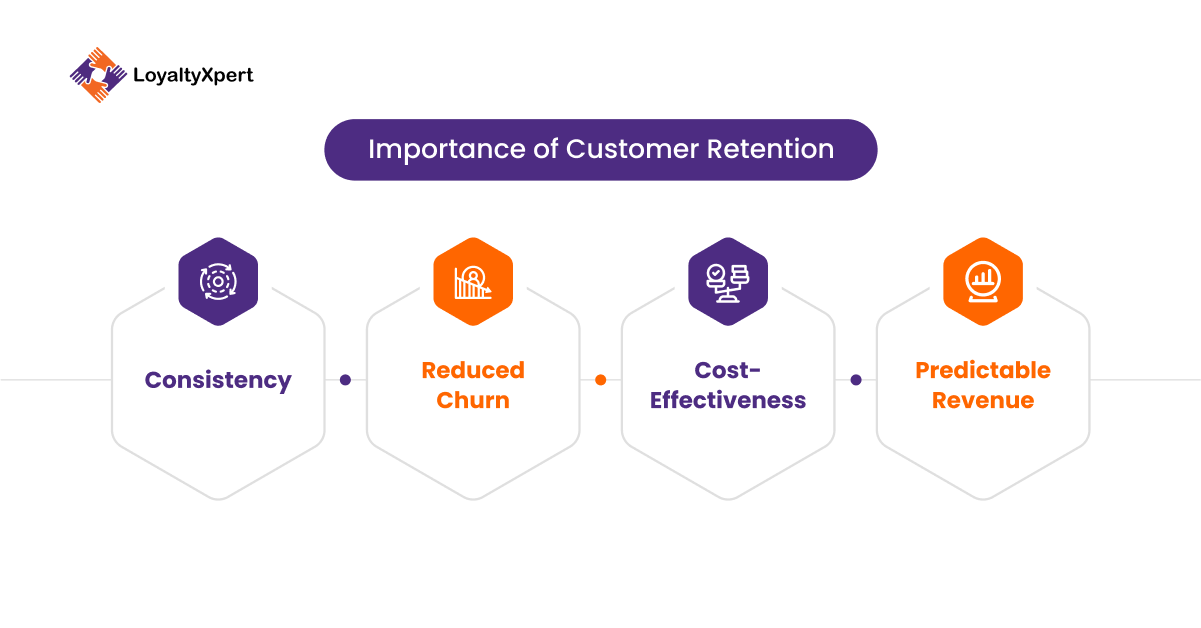
Importance of Customer Retention

Importance of Customer Retention

  • Consistency: A steady flow of income is ensured by the consistent business that loyal consumers bring. They often endure small ups and downs and provide a steady stream of revenue.
  • Reduced Churn: Since contented customers are less inclined to deflect the customer churn rate is quite low which gives a business an assurance of a stable customer base. 
  • Cost-Effectiveness: Keeping current clients is more economical than finding new ones, which improves return on investment. The costs of acquiring new customers and marketing are typically higher than those of maintaining a pleased existing customer pool.
  • Predictable Revenue: Businesses are better able to forecast demand and revenue when they have a devoted customer base. This predictability offers a strong basis for strategic decision-making and aids in resource allocation and financial planning.

Customer Loyalty and Repurchase Rate

Repurchase rate is a metric that tracks the percentage of customers that have purchased from a business again within a certain time period. This metric indicates how successful a businesses retention strategy is.  It is an indicator of customers’ trust in a business and their loyalty towards a business. Over time, this recurring business boosts profitability and serves as the foundation of a steady revenue stream.  

Brand Loyalty and Repurchase Rates

Due to the long-lasting relationship it fosters between the customer and the brand, brand loyalty plays a major role in customer retention. Long-term retention is ensured when customers exhibit brand loyalty, as it reduces the likelihood of them switching to competitors. Along with the emotional bond customers form with the brand, this loyalty is frequently based on the products or services’ constant quality and dependability. Businesses may cultivate a sense of trust and reliability that motivates customers to remain faithful and sustain their patronage by keeping their word and upholding a high standard of quality.

Brand Loyalty and Retention

Harvard Business Review reports that studies show that a just 5% increase in client retention rates can result in a 25% to 95% boost in earnings. Furthermore, according to an Invesp survey, 89% of consumers stick with brands that reflect their values. The aforementioned data underscore the monetary advantages and competitive edge that arise from fostering brand loyalty. Companies that concentrate on creating and preserving brand loyalty can benefit from increased customer lifetime value, steady clientele, and long-term expansion.

Brand Loyalty : Long-Term Impact on Business

Over time, brand loyalty has a significant influence on the success of businesses. In addition to generating steady income, loyal consumers also act as brand ambassadors, promoting the business and attracting new clients through favorable word-of-mouth. This advocacy can improve the brand’s standing in the marketplace and drastically lower marketing expenses. Customers that are enthusiastic about a brand will inevitably tell others about their wonderful experiences, serving as effective brand ambassadors.

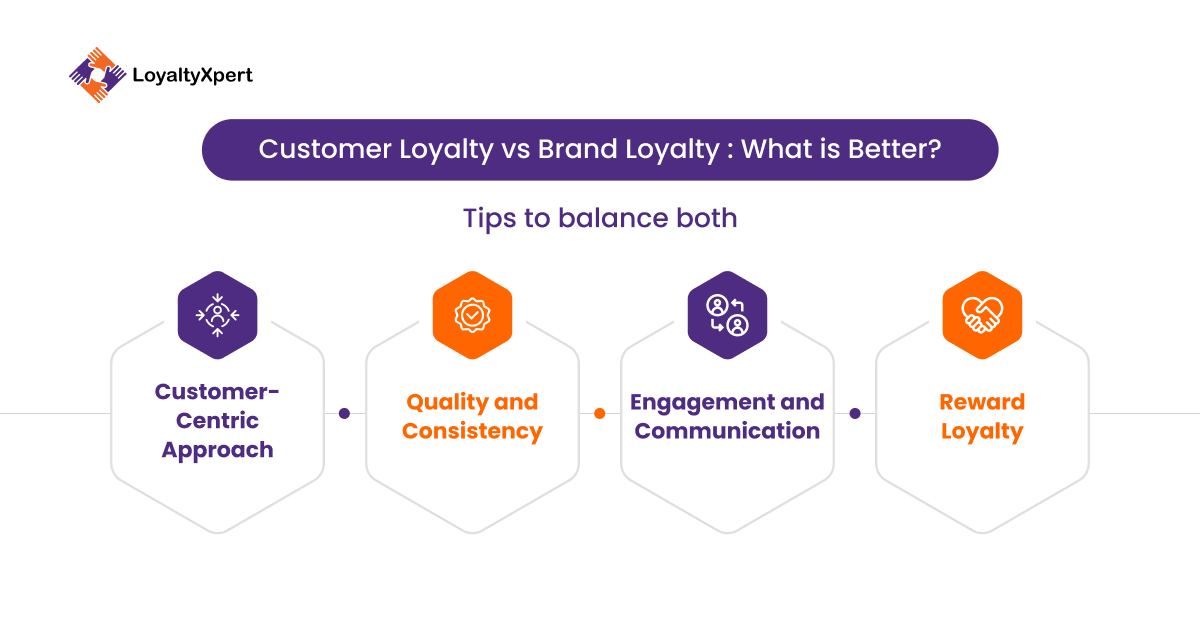
Customer Loyalty vs Brand Loyalty : What is Better?

Customer Loyalty vs Brand Loyalty What is Better.

Picking one out of brand loyalty and customer loyalty can be tricky. Both are essential to the success of businesses, and their effects frequently overlap. But concentrating on both can guarantee a thorough plan for keeping customers and raising repurchase rates.


Tips to balance both

1. Customer-Centric Approach

To increase brand and customer loyalty, concentrate on delivering outstanding customer experiences. Making sure that every encounter is constructive will help you build strong emotional and intellectual ties with your clients.

2. Quality and Consistency

Make sure your products and services constantly live up to or surpass the expectations of your clients. Both kinds of loyalty require high standards and dependability.

3. Engagement and Communication

Communicate your brand values clearly and engage with customers on a regular basis. Customers are educated and connected when there is clear and consistent communication, which supports brand reinforcement.

4. Reward Loyalty

Put in place customer loyalty programs that give incentives for both brand advocacy and consumer loyalty. Overall loyalty and retention can be improved by initiatives that reward and acknowledge both brand promotion and repeat purchases.

Conclusion:

Need a tried and tested strategy to retain loyal consumers? Build a customer loyalty program today. It’s a fool-proof way to identify and maintain your loyal customers. Investing in such an initiative can result in improved customer satisfaction, positive reviews, and more referrals. Why wait when you have experts willing to work for you? LoyaltyXpert’s team can guide you in setting the best loyalty management solution. Feel free to contact us; let us schedule a demo for you today.

Why is Word-of-Mouth Marketing Still a Game Changer in 2025?

Do you know that 64% of marketing experts believe that word-of-mouth is the most effective type of marketing?

Do you remember the last time you couldn’t stop telling your friends and family about a new restaurant you discovered? Or about the new pair of shoes you just bought from a small online store? 

Telling your friends, family, or even your social media followers about your good experience with a product or service, is referred to as word-of-mouth marketing. Word-of-mouth marketing (WOMM) is one of the most powerful forms of marketing that involves the user sharing a positive experience with friends or family.

  • To Note: Word-of-mouth marketing can lead to 5x more sales than paid advertising.

While technology has evolved significantly in the last few years, businesses still utilize the age-old, time-tested strategy of word-of-mouth marketing. In this article, we are going to discuss how word-of-mouth marketing strategy is still a game changer in 2024, and how you can utilize it effectively to expand your business.

Getting Familiar with Word-of-Mouth Marketing?

Word-of-mouth marketing refers to the organic spread of information from one person to another. This information is typically about a product or service, which is driven by genuine enthusiasm and satisfaction. The power of word-of-mouth dates back to the times when it was confined to face-to-face interactions and small social circles. Over time, it has evolved to leveraging online platforms. Online reviews, recommendations, and influence endorsements have helped businesses reach global audiences instantly.

It even influences Gen Z, the most tech-advanced generation. According to a report by Roundel, 40% of Gen Z consumers trust the recommendations of their friends and inner circles.

Key Characteristics of Word-of-mouth marketing:

  • Personal Recommendations
  • Trust
  • Authenticity
  • Power of Peer Influence

The evolution from traditional word-of-mouth to its digital counterpart has transformed how brands connect with customers. This unique and effective strategy leverages the power of personal experiences to build trust and drive sales.

The Digital Evolution of Word-of-Mouth Marketing 

The rise of social media platforms, online reviews, and influencer marketing have transformed the meaning of word-of-mouth marketing in this digital-age. All these elements play a crucial role in digital word-of-mouth marketing. 

  • A report by Gartner shows that 53% of the customers in the US look for online reviews on the product or service they want to purchase.

In addition, even a single positive tweet or Instagram post from an influencer can give a significant boost to the brand’s visibility. For instance, if an influencer tweets about a positive customer experience, it can be retweeted or shared across various platforms. This amplifies the reach of the tweet, leading to better visibility for the brand.

Here are a few word-of-mouth marketing examples:

  • Viral Social Media Campaigns: Brands like Wendy’s have successfully utilized viral tweets to engage millions of users.
  • Positive Online Reviews: Companies like Amazon rely heavily on user reviews to drive purchases.
  • Influencer Collaborations: Influencer Kylie Jenner, promoted SugarBearHair vitamins on Instagram. The post generated massive sales and brand awareness and led to a significant boost in the brand’s visibility and credibility. This demonstrates the power of influencer marketing.

Power of Trust in Word-of-Mouth Marketing

Trust and credibility are at the core of word-of-mouth marketing. As per the report by Nielson, 88% of people inherently trust recommendations from their friends and family. They also tend to trust the influencers they follow. This trust is built on perceived authenticity and personal experience making WOMM a reliable strategy for businesses. 

Psychological research shows that people are more likely to act on recommendations from their peers, making them highly influential. In addition, trusted influencers lend their credibility to the brands they endorse. This makes them a crucial part of modern marketing.

Adapting to Current Trends and Consumer Behaviors

Consumer behavior and technological advancements continue to underscore the importance of WOMM. In 2024, consumers are more informed, connected, and discerning than ever. Social media and online communities play significant roles in their purchasing decisions. 

  • To Note: According to a report by Ogilvy, 74% of consumers identify word-of-mouth as a key influencer in their purchasing decisions.

The increasing use of social media and review platforms amplifies the reach and impact of WOMM. There are various platforms that allow customers to share their experiences, which influences potential buyers. Some of these platforms include:

  • Yelp
  • Google Reviews
  • Social media networks

The Data Behind Word-of-Mouth Marketing

Recent statistics emphasize the effectiveness of WOMM. Here are a few statistics that give insight into why WOMM is important for businesses:

  • About 72% of people receive news from friends and family, emphasizing the popularity of word-of-mouth.
  • According to research by BridgtLocal, around 88% put the same amount of trust in online customer reviews as they put in the recommendations given by their personal contacts.
  • According to Esteban Kolsky, 72% of customers like talking about their good experience.
  • Word-of-mouth campaigns can be one of the top sources of traffic for small businesses doing affiliate marketing. 
  • Research shows that an increase of 10% in word-of-mouth (both online and offline) can result in a 0.2 – 1.5% increase in sales.

Beyond statistics, what makes WOMM important for businesses is its ability to build authentic relationships with customers.  

As Mark Zuckerberg, CEO of Facebook, famously said, “People influence people. Nothing influences people more than a recommendation from a trusted friend. A trusted referral influences people more than the best broadcast message. A trusted referral is the Holy Grail of advertising.

WOMM creates a loyal customer base and fosters organic growth by leveraging these trusted relationships. Comparatively, WOMM outperforms other marketing strategies in terms of cost-effectiveness and impactful on customer retention. Businesses leveraging this marketing strategy can expect substantial growth and customer loyalty through authentic and trusted recommendations. 

Let’s learn more about the benefits of word-of-mouth marketing for businesses.

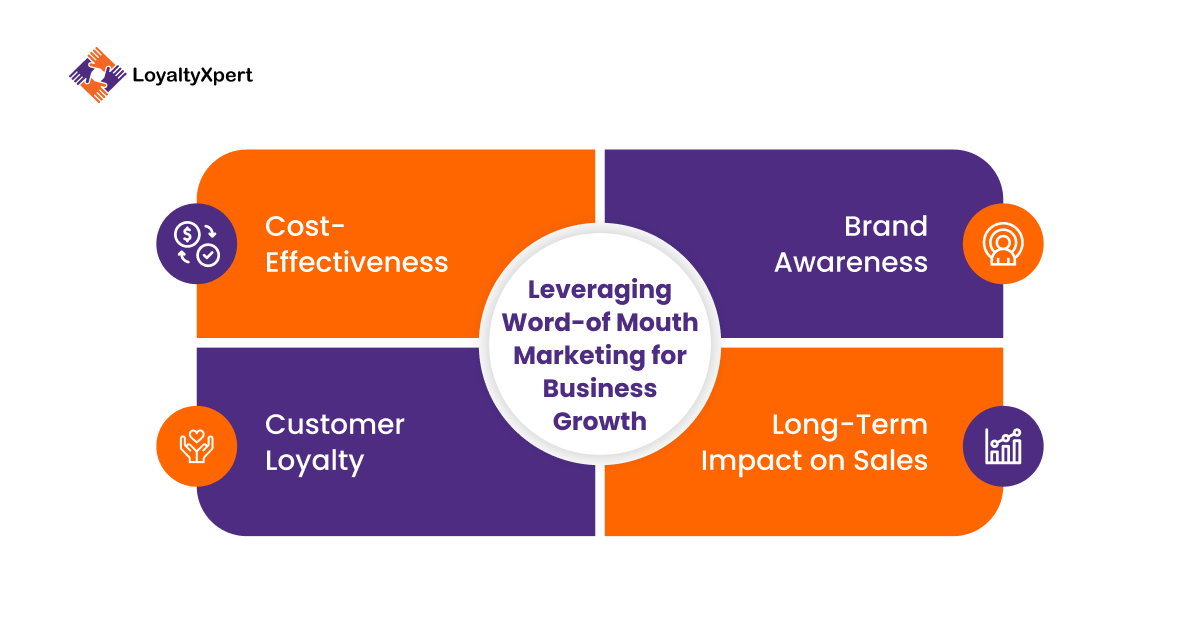
Leveraging Word-of-Mouth Marketing for Business Growth.

Leveraging Word-of-Mouth Marketing for Business Growth

Here are the key benefits of word-of-mouth marketing:

  • Cost-Effectiveness

In terms of marketing, WOMM is one of the most cost-effective approaches. It relies on organic promotions rather than expensive paid advertising. Your business can simply focus on delivering excellent products and services that naturally encourage customer referrals. 

According to a report, WOMM delivers $6 trillion of annual consumer spending and is responsible for 13% of all consumer sales.

  • Brand Awareness

Your brand visibility and reputation can be boosted through positive word-of-mouth. It increases visibility through organic recommendations, helping brands reach a wider audience. Customers share their positive experiences with their friends and family. This makes them a brand ambassador, helping the business reach new potential customers. WOMM can influence purchasing decisions, as the marketing is done naturally by a trusted source. 

  • Customer Loyalty

WOMM helps you build a loyal customer base that actively promotes the brand, leading to higher customer retention and advocacy. 

The customers who are satisfied and have had positive experiences with your brand are more likely to come back for more purchases. They also become the advocates for your brand within their networks. This loyalty helps in fostering a strong, supportive community for your brand, making it crucial for long-term success.

  • Long-Term Impact on Sales

The trust and credibility built through WOMM and referrals can lead to sustained sales growth, ensuring long-term benefits for the business. The network of referrals grows as more customers share their positive experiences with others. This creates a circle of ongoing promotions and increased sales.


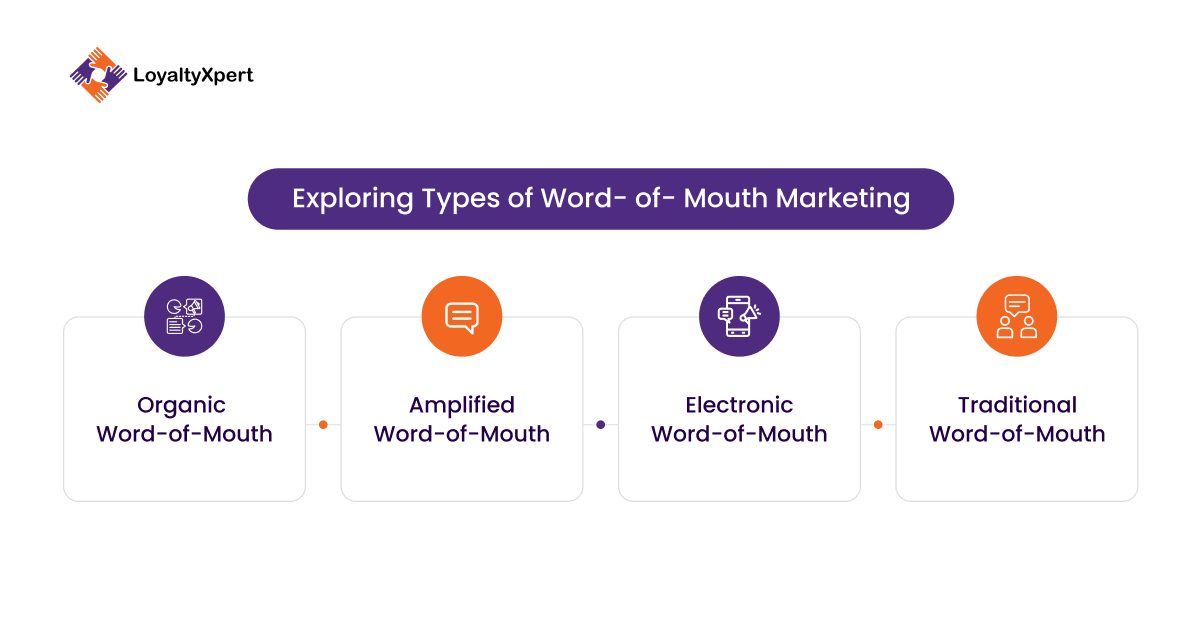
Exploring Types of Word-of-Mouth Marketing

Exploring Types of Word- of- Mouth Marketing

Organic Word-of-Mouth

  • Natural sharing of information by satisfied customers.
  • Example: A customer sharing their positive experience with friends.

Amplified Word-of-Mouth

  • Encouraged by the brand through campaigns or incentives.
  • Example: Referral programs, like an influencer loyalty program and customer loyalty program, for new customer sign-ups.

Electronic Word-of-Mouth

  • Online reviews, social media interactions, and influencer posts.
  • Example: Product reviews on e-commerce sites or social media mentions.

 Traditional Word-of-Mouth

  • Face-to-face recommendations and conversations.
  • Example: Discussing a favorite restaurant at social gatherings or workplace.

Each type of WOMM comes with its own set of advantages that you can leverage based on your target audience and marketing goals.

Crafting an Effective Word-of-Mouth Marketing Strategy

Here are a few strategies that you can use to implement WOMM:

  • Develop a WOMM Strategy

Define goals, target audience, and key messages to ensure consistent and effective outreach.

  • Encourage Customer Reviews and Referrals

Actively ask for reviews, and create incentives for customers to share their positive experiences.

  • Leverage Social Media and Influencer Partnerships

Collaborate with influencers and use social media to amplify positive word-of-mouth to a wider audience.

  • Integrate with Other Marketing Channels

Ensure that WOMM efforts are aligned with overall marketing strategies, including email marketing, for a cohesive approach.

How Loyalty Programs Enhance Word-of-Mouth Marketing

Loyalty programs can enhance the overall efforts put into word-of-mouth marketing. They incentivize customers for their loyalty and encourage referrals. This allows businesses to amplify their WOMM strategies. For instance, Starbucks’ loyalty program rewards customers for referring friends. This leads to increased customer engagement and retention for Starbucks.

Here are a few tips for integrating loyalty programs with WOMM strategies:

  • Offer exclusive rewards for referrals
  • Create engaging and shareable content
  • Encourage user-generated content through social media challenges

This approach boosts word-of-mouth while also strengthening customer relationships, leading to increased retention and sales.

Final Thoughts

Word-of-mouth marketing remains a powerful tool in 2024. It is driven by trust, credibility, and peer influence to enhance business success. It’s impossible to deny the relevance of WOMM in the modern marketing landscape, as digital platforms only amplify its reach. 

If you want to enhance your marketing efforts, LoyaltyXpert offers a comprehensive B2B reward platform that integrates seamlessly with your WOMM strategies. To learn more about the platform, book a demo today

The Power of Brand Advocacy: How to Turn Customers into Loyal Ambassadors

Building a tribe of loyal customers is one of the most difficult tasks for businesses today. This is true, especially in today’s time where people are spoiled with so many choices. However, investing in a strategy to convert customers into brand loyalists has more advantages than you had imagined.

One, retaining customers is easier and less expensive than acquiring new customers. Second, a whopping 83% of customers rely on word of mouth when making any purchase. A well-executed loyalty program can play a huge role in converting one-time buyers into loyal customers and also your brand advocates. Today, besides various tools, brand advocacy remains one of the most important and effective tools in a marketer’s arsenal. Brand advocacy enables a brand to reach out to a much larger audience than it normally would.

But first things first, before we deep dive into exploring the benefits of brand advocacy let’s understand what brand advocacy means.

What is brand advocacy?

A brand advocate is a customer who has used your product or service, may be a part of your loyalty program, has had a good experience with you, and would happily recommend you in his/her close circles.  Besides celebrities and influencers, these real-life users can become your brand ambassadors and help you build genuine and authentic relationships with a larger target audience.

Who can be brand advocates? 

Anyone who backs your company’s expansion and reputation management is a brand advocate.

This comprises:

  • Clients: Clients have no connection to your business. Their assistance becomes more sincere and persuasive to potential customers as a result.
  • Employees: Employee advocates are well-versed in every aspect of your company. Their personal connection and insider knowledge make them an effective advocacy tool.
  • Business partners: Decisions about what to buy are also influenced by charities, associations, and other businesses connected to your brand.
  • Influencers: A popular type of advocate, influencers let you reach a more specific but larger audience.

Methods to encourage customers to become brand advocates.


1. Delivering exceptional customer service

Providing good customer service is essential to converting customers into brand advocates. Customers are more likely to feel valued and appreciated when they are delivered with prompt, cordial, and helpful service, which also increases the likelihood that they will refer others to your business.

2. Create high-quality products and services

Offering top-notch products and services that satisfy clients and go beyond their expectations on a regular basis will inevitably inspire them to recommend your business to others. Being known for excellence serves as a strong incentive for advocacy.

3. Engage with your audience

Developing a close relation with your clients can be achieved by actively participating with the audience on social media and other platforms. Reacting to reviews, messages, and comments displays your concern for other people’s viewpoints and encourages loyalty.

4. Implement loyalty programs

Implementing loyalty programs that give points, discounts and special incentives to loyal customers will largely increase their advocacy and retention. Referral schemes that reward clients for recommending your company can help promote word-of-mouth marketing. 

5. Leverage user-generated content

Encouraging your clients to share their success stories and positive experiences with your products and services can result in a strong, real content. By emphasizing these testimonials in your marketing content, you can increase credibility and trust , which will encourage other businesses to choose your brand and become advocates themselves. 

Benefits of Brand-Advocacy by LoyaltyXpert

Benefits of Brand Advocacy

1. Enhanced perception of the brand

Promoting your brand enhances the public perception of your business. It boosts confidence. A “real person”—a client, worker, or influencer—is praising your business, goods, or services in place of your organization.

2. Reflection of the genuineness of a brand

For the same reason, people believe the advocate’s information to be more reliable. This positively reflects your business and lends legitimacy to your brand.

3. Increased organic brand recognition

Advocates offer a natural means of increasing brand recognition. Positive and enthusiastic conversations about your goods and services are generated via brand advocacy. This is critical for raising your profile, which can result in more leads, sales, opportunities for employment, and business expansion.

4. Increased probability of media coverage

With more and more people talking about your brand, the probability of the media taking notice is higher. Because of all the buzz, magazines, and news organizations might begin to write articles about you. This publicity increases the possibility of reaching new and larger audiences and strengthens community trust in your brand.

5. Increased audience reach

When your customers turn into brand advocates, your reach expands. They share authentic, first-hand user reviews on their personal social media pages. This opens up new markets for you as well as your friends, family, and followers. User-generated content is a great way to build trust.

6. Helps you save money

With all of this low-cost or free marketing available, brand advocacy helps you save money. Just consider how much it would cost you to create all of that content yourself. You can use this money elsewhere if necessary. The ROI would outweigh any initial costs associated with implementing advocacy activities.

How to Boost Customer Loyalty with Effective Brand Advocacy Strategies

1. Go above and beyond

Building a loyal customer base requires going the extra mile to deliver experiences that delight your customers. Personalized product suggestions, offers, and doing that extra bit to make customers feel important can go a long way in getting their unflinching loyalty. Be approachable and receptive, providing efficient assistance across all available channels. Excellent customer service increases the likelihood that your customers will stick around and recommend your business to others.

2. Make Use of Social Proof

With over 5 billion social media users worldwide, social proof can be a great way to convert one-time buyers into loyal customers. Urge pleased consumers to write uplifting reviews and testimonials that highlight their interactions with your company. Showcase user-generated content on your website and social media channels, including images, videos, and narratives. This encourages potential clients to choose your brand and also fosters trust.

3. Launch a referral program

Referral schemes are a useful tool for converting satisfied consumers into brand loyalists. Provide hard-to-resist incentives, like special discounts or rewards, to customers who recommend new customers to your business. Make sure the referral procedure is clear-cut and easy to understand so that consumers will find it effortless to engage and promote your brand.

4. Build a community

Getting like-minded people on a common platform or forum is a great way to generate buzz around your brand. Create and maintain online communities where customers, industry influencers, and leaders can communicate and exchange their experiences. They can share their concerns with you. This helps them feel more connected with your brand. Leverage tools like surveys, competitions, and Q&A sessions to gather feedback, and valuable insights, and promote customer engagement.

5. Produce Useful Content

Delivering high-quality content is essential to establishing and preserving client loyalty. Provide educational content that speaks to the needs and interests of your clients, such as blogs, videos, and webinars. Distribute engaging content that connects with your audience to establish your business as a go-to source for knowledge.

6. Reward Loyalty

Rewarding loyal customers helps them feel more connected to your company. Create a loyalty program that provides repeat customers and members exclusive discounts, offers, or VIP experiences, among other exclusive incentives and privileges. Additionally, show your appreciation and value to them by organizing exclusive events, and early access to new product/service launches.

7. Develop a Powerful Brand Identity

Trust and loyalty can be fostered through a strong, unified brand identity. Make sure the tone, messaging, and imagery of your brand are consistent on all channels. Aligning your brand’s mission and values with the beliefs of your customers requires clear communication.

8. Give Your Clients More Power

Giving your consumers more authority might make them ardent defenders of your brand. Engage people in the process of developing new products or making improvements by asking for their opinions and thoughts. Establish ambassador programs that enable devoted consumers to formally represent and advance your brand in exchange for special benefits and recognition.

Are brand advocacy programs worth the investment?

For companies looking to expand over the long run and have a strong presence in the market, brand advocacy initiatives are definitely worth the cost. These initiatives utilize word-of-mouth marketing, which is the most genuine and effective kind of promotion. Customers that voluntarily spread the word about your business increase its reputation and trustworthiness. When compared to other marketing techniques, brand advocates can help you reach a larger audience, encourage greater engagement, and boost customer loyalty at a comparatively cheaper cost.

Furthermore, brand advocacy initiatives help you develop a closer relationship with your clients, turning them into loyal supporters who feel appreciated. In addition to increasing customer retention, this good relationship promotes referrals and repeat business. Having a committed network of advocates can provide your business with a unique advantage in a competitive market.

Ending Note

A well-thought-out, easy-to-access, and executed loyalty program plays a vital role in converting repeat customers into brand advocates and ambassadors. At LoyaltyXpert, we specialize in helping businesses design and implement effective loyalty programs that drive customer engagement and retention. Our comprehensive solutions are tailored to meet your unique needs, ensuring your customers stay loyal and spread the word about your brand. If you’re considering implementing successful loyalty programs, contact us for a free demo.

The Impact Of Loyalty Programs: Pros And Cons

Businesses in today’s intensely competitive market are always looking for new and creative ways to keep customers and build lasting partnerships. The use of loyalty programs is one strategy that has stood the test of time. In addition to promoting repeat business, these initiatives enhance a customer’s happiness quotient and also loyalty towards your brand. In this blog, we delve deep into some questions that most business owners have such as,  how customer loyalty programs affect company growth, how to design successful ones, and what the future holds for them.

Without any further delay let’s dive in! 

What are Loyalty Programs?

A loyalty program is a business strategy wherein a company offers discounts, rewards, and various perks to its customers in exchange for their loyalty. According to TechJury, 75% of customers stated they would choose a company that offers a rewards program. It helps businesses keep their present customer base and increase sales of their products. Customers who consistently buy from a brand are invited to sign up for a rewards program.

Some of the loyalty programs are as follows:

  • Point-based systems: With each transaction, clients can accrue points that can be exchanged for savings, freebies, or other benefits.
  • Tiered Rewards: Based on their spending amounts, customers advance through tiers, with higher tiers providing access to more exclusive rewards.
  • Cashback Programs: Consumers get cash rewards in the form of a percentage of their purchases.
  • Subscription-based models: Clients pay a recurring charge to obtain certain advantages and savings.
  • Punch Cards: It is an easy-to-use system in which consumers receive a stamp or punch for every purchase, redeemable for a freebie or discount after a certain amount of transactions.

How to Create an Effective Loyalty Program

It takes an in-depth knowledge of your customer’s needs and preferences to design a successful customer loyalty program. Here are a few key steps:

1. Identify your objectives: Decide what you want your loyalty program to accomplish, such as higher sales, better customer retention, or higher levels of consumer involvement. Your program’s design and implementation will be guided by well-defined goals.

2. Recognize your clientele: To comprehend the preferences, habits, and pain points of your target audience, conduct in-depth market research. To obtain information, conduct focus groups, surveys, and analyses of customer data.

3. Select the right program type: Choose a loyalty program model that appeals to your target audience and fits well with your business objectives. For example, a retail business would benefit from a point-based system, whereas a service-oriented organization might benefit more from a subscription-based approach.

4. Provide valuable rewards: Make sure your clients will find the prizes appealing and worthwhile. This might take the form of savings, first dibs on events, unique encounters, or even gifts to charities on their behalf. Making the rewards attractive and relevant is crucial.

5. Promote your program: To get people to join your loyalty program, use a variety of marketing platforms. This could involve banner ads on websites, in-store promotions, social media campaigns, and email marketing. It’s critical to communicate the advantages and create a program that’s easy to join and access.

6. Monitor and optimize: Evaluate your loyalty program’s performance regularly and make the required changes based on customer feedback and data analysis. To determine the program’s success and pinpoint areas for development, monitor important metrics including redemption rates, engagement levels, and enrollment rates.

Future of loyalty programs and their impact on growth

Technology developments and changing consumer expectations will have a significant impact on loyalty programs in the future. Customization will be crucial, utilizing data analytics to deliver unique experiences and incentives. Digital wallets and reward programs that are integrated will further improve customer convenience, while gamification features like leaderboards and badges will boost engagement and enjoyment. Customers that care about the environment will also be drawn to loyalty schemes that integrate sustainability initiatives.

Loyalty programs need to offer a smooth experience through both online and offline channels in order to be successful. Consumers want to be able to use mobile apps, websites, and in-store interactions to earn and redeem rewards from businesses. Businesses can boost consumer satisfaction and loyalty by implementing these trends into the design of their loyalty programs, which will promote expansion and long-term success. Prioritizing omnichannel experiences, convenience, engagement, personalization, and sustainability helps businesses stay ahead of the curve and create customer-resonant loyalty programs.

How to measure the success of a loyalty program

It takes an in-depth knowledge of your customer’s needs and preferences to design a successful customer loyalty program. Here are a few key steps:

  1. Identify your objectives: Decide what you want your loyalty program to accomplish, such as higher sales, better customer retention, or higher levels of consumer involvement. Your program’s design and implementation will be guided by well-defined goals.
  2. Recognize your clientele: To comprehend the preferences, habits, and pain points of your target audience, conduct in-depth market research. To obtain information, conduct focus groups, surveys, and analyses of customer data.
  3. Select the right program type: Choose a loyalty program model that appeals to your target audience and fits well with your business objectives. For example, a retail business would benefit from a point-based system, whereas a service-oriented organization might benefit more from a subscription-based approach.
  4. Provide valuable rewards: Make sure your clients will find the prizes appealing and worthwhile. This might take the form of savings, first dibs on events, unique encounters, or even gifts to charities on their behalf. Making the rewards attractive and relevant is crucial.
  5. Promote your program: To get people to join your loyalty program, use a variety of marketing platforms. This could involve banner ads on websites, in-store promotions, social media campaigns, and email marketing. It’s critical to communicate the advantages and create a program that’s easy to join and access.
  6. Monitor and optimize: Evaluate your loyalty program’s performance regularly and make the required changes based on customer feedback and data analysis. To determine the program’s success and pinpoint areas for development, monitor important metrics including redemption rates, engagement levels, and enrollment rates.

Future of loyalty programs and their impact on growth

Technology developments and changing consumer expectations will have a significant impact on loyalty programs in the future. Customization will be crucial, utilizing data analytics to deliver unique experiences and incentives. Digital wallets and reward programs that are integrated will further improve customer convenience, while gamification features like leaderboards and badges will boost engagement and enjoyment. Customers that care about the environment will also be drawn to loyalty schemes that integrate sustainability initiatives.

Loyalty programs need to offer a smooth experience through both online and offline channels in order to be successful. Consumers want to be able to use mobile apps, websites, and in-store interactions to earn and redeem rewards from businesses. Businesses can boost consumer satisfaction and loyalty by implementing these trends into the design of their loyalty programs, which will promote expansion and long-term success. Prioritizing omnichannel experiences, convenience, engagement, personalization, and sustainability helps businesses stay ahead of the curve and create customer-resonant loyalty programs.

How to measure the success of a loyalty program

Measuring the success of loyalty programs involves tracking key performance indicators (KPIs) such as:

  • Redemption Rate: It is the proportion of rewards that customers use. A high redemption rate is a sign that clients think the benefits are worthwhile and reasonable to pursue.
  • Net Promoter Score (NPS): A metric that gauges how likely customers are to suggest a brand, based on their level of satisfaction and loyalty. A greater NPS indicates that users are content with the service and inclined to recommend your business to others.
  • Customer Churn Rate: The rate at which clients discontinue using the services of the business. A good loyalty program should keep users interested and satisfied, which lowers turnover.
  • Sales Uplift: The rise in revenue that the loyalty program is credited with generating. Calculate the extra money that members of loyalty programs bring in over non-members.
  • Customer Acquisition Cost (CAC): The price associated with bringing in new clients via a loyalty scheme. A lower customer acquisition cost (CAC) suggests that the program is successful in bringing in new clients without requiring large marketing budgets.
  • Engagement Metrics: Monitor data on how often users connect with the program, how many points they accumulate and use, and whether they take part in exclusive offers or events.

Measuring the impact of loyalty programs on business growth

To determine how effective loyalty programs are and where they might be improved, it is essential to measure their effect on business growth. Client retention rate, average order value, repeat purchase rate, new client acquisition, and program participation are important indicators to evaluate. Businesses can monitor these measures to ascertain whether their loyalty program is generating more income, repeat business, and long-term consumer loyalty.

Businesses can obtain important insights into the effectiveness of their loyalty program by keeping an eye on these measures. For example, a high rate of repeat business and client retention show that the program is doing a good job of fostering consumer loyalty. An increase in the average order value indicates increased expenditure levels driven by the program. Metrics related to program participation and new customer acquisition show whether the initiative is drawing in new participants and promoting active engagement.

Businesses can improve their loyalty program to maximize its effect on growth and consumer engagement by examining these criteria.

Loyalty program’s Pros and Cons:

Pros

Advantages of Loyalty Programs - LoyaltyXpert

  • Better customer retention:

    Customer Loyalty programs are essential for building long-lasting relationships with clients and encouraging repeat business. Customers are more inclined to continue with your business when they feel valued and rewarded, which increases loyalty and lowers churn rates. Long-term business success is based on this loyal consumer base.

  • Attract new customers:

    A well-thought-out customer loyalty program aids in bringing in new clients for companies. New clients will sign up for your mailing list with ease to take advantage of the offers thanks to the points or discounts. Also, customers are more likely to try your company when they discover a loyalty program with easily accessible benefits because they can easily obtain the rewards. However, satisfied consumers might still tell their friends and family about your company even in the absence of a referral scheme. As a result, you can use loyalty programs to draw in new clients.

  • Valuable data:

    You can enter a customer’s information into your business’s database when they join up for your loyalty program. You can use this data to ascertain the purchasing habits, tastes, and behavior of your clients. Businesses use this valuable data in a variety of ways, such as customizing their products for specific customer segments, tracking the effects of exclusive promotions, and supporting pricing and inventory control. A strong loyalty program enables businesses to divide their clientele into profitable and unproductive groups.

  • Better communication with customers:

    Businesses can have direct communication with their customers through a loyalty program. This facilitates the development of brand awareness and loyalty by regularly providing insightful content. It is imperative that you disseminate notifications regarding novel goods or services, exclusive deals, and modifications to incentive schemes. Customers will return more frequently if they are aware of your company’s offerings. Additionally, they will tell friends and relatives about the benefits, allowing you to benefit from word-of-mouth advertising.

Cons

Disadvantages of Loyalty Programs - Loyaltyxpert

  • Market Saturation

    Given that every household participates in several reward programs, companies ought to design programs that are special and different from one another. However, developing a loyalty program with a sustained competitive edge is exceedingly challenging. But advocate loyalty programs allow you to differentiate yourself from the competition by rewarding customers for taking special acts that appeal to your target market. You can design a customer loyalty program that is distinctive and sticks out from the competition if you work with a knowledgeable company like LoyaltyXpert.

  • Difficult to identify loyal customers:

    Simply said, customers’ repeated business does not suggest that they are devoted to a certain brand of goods or service. It’s possible that they are purchasing it due to the benefits you are providing. As a result, it’s possible that the loyalty program misidentifies loyal clients. However, you can achieve successful outcomes if you combine your loyalty program with advocate marketing strategies. Give customers rewards for things like submitting reviews and referring friends. This will enable you to identify who is among your devoted consumers and who is just a regular buyer.

  • Constraints of collected data:

    Data-driven reward schemes frequently offer a restricted perspective of clients’ total purchasing patterns. For instance, purchases from different brands and retailers are not included in the data. Customers may find it awkward to provide private information in order to take advantage of the program’s rewards. It’s possible that the data does not accurately reflect client loyalty. A regular consumer is not always a devoted one. As previously said, the customer can be purchasing your goods or service because it’s affordable or handy. Some clients will only make repeat purchases in order to profit from the rewards offered by your program.

Wrapping Up

To sum up, loyalty programs are an effective strategy for customer retention, business outreach, and holistic and sustainable business growth. Businesses can leverage technology to deliver personalized experiences and easy management of reward programs. 

LoyaltyXpert provides you with the right set of tools and a technologically sophisticated platform to run loyalty programs that truly make an impact. Our expert team offers tailored solutions to meet your business needs and drive growth. LoyaltyXpert specializes in managing loyalty programs that deliver measurable results. Whether you’re looking to launch a new program or enhance an existing one, we have the expertise and tools to help you succeed. Avail our free trial and demo today to discover how we can support your business in building stronger customer relationships and driving long-term growth.

The Role of the Channel Loyalty Program in Agriculture Success

Agriculture stands as the backbone of global food security and economic stability. Farmers face numerous challenges, from unpredictable weather patterns to market fluctuations and increasing production costs. Businesses with effective loyalty marketing programs earn 100–400% better returns to shareholders and increase sales 2.5 times faster than the competition.

Channel loyalty programs have emerged as a powerful tool to support farmers and drive agricultural success. These Agriculture loyalty programs foster strong relationships between farmers, suppliers, and distributors, creating a network of support that benefits all parties involved. As we explore the role of channel loyalty programs in agriculture, we’ll uncover how they’re reshaping the industry and paving the way for a more sustainable and profitable future.

Importance of Loyalty Programs in Modern Agriculture

Agriculture loyalty programs play a vital role in enhancing farmer engagement and retention. According to a study by Harvard Business School, boosting 5% retention via loyalty programs can increase profits by 25-95%. They provide access to valuable resources and support, enabling farmers to overcome challenges and improve their productivity. These programs also encourage the adoption of new technologies and best practices, helping farmers stay competitive in a rapidly evolving industry.

One of the key benefits of loyalty programs in agriculture is the creation of a support network for farmers. This network can provide timely information on market trends, new farming techniques, and pest management strategies. Moreover, rewards programs for agriculture can help farmers manage risk by providing access to weather forecasting tools, crop insurance options, and market analysis. This support is particularly valuable for small and medium-sized farms that may not have the resources to access these tools independently.

Key Components of Effective Loyalty Programs in Agriculture

Successful channel loyalty programs in agriculture incorporate several key components that address the unique needs of the farming community:

1. Tailored rewards and incentives: Loyalty programs offer benefits that directly address farmers’ needs, such as discounts on essential equipment or inputs. These rewards might include rebates on seed purchases, discounted rates on equipment rentals, or loyalty points that can be redeemed for farm supplies.

2. Personalized support and advice: Farmers receive expert guidance on crop management, pest control, and other critical aspects of farming. This might involve access to agronomists, soil scientists, or veterinarians who can provide tailored advice based on the specific needs of each farm.

3. Partnerships with key suppliers: Loyalty programs connect farmers with trusted suppliers, ensuring access to high-quality products and services. These partnerships can extend beyond traditional farm inputs to include technology providers, financial services, and even marketing support for farm products.

4. Data-driven insights: Advanced loyalty programs leverage data analytics to provide farmers with insights into their operations, helping them make more informed decisions about planting, harvesting, and resource allocation.

5. Community building: Many successful programs include features that foster a sense of community among farmers, such as forums for sharing best practices or local events that bring farmers together.

Also read: Your Ultimate Guide For Channel Loyalty Programs

The Importance of Water Pumps in Agriculture

Water pumps play a critical role in agriculture, particularly in irrigation and water management. Efficient water pumps significantly impact crop yields and farm productivity by ensuring optimal water distribution. In regions facing water scarcity, the right pumping solution can make the difference between a successful harvest and crop failure.

Modern water pumps offer features such as variable speed drives, which allow for precise control of water flow, and remote monitoring capabilities that enable farmers to manage irrigation systems from their smartphones. These advanced features not only improve water use efficiency but also save energy and reduce labor costs.

Given their importance, loyalty programs for the water pump industry have become increasingly popular. These programs often include benefits such as extended warranties, priority servicing, and access to the latest pump technologies.

Loyalty Programs for Water Pump Suppliers/Industry

Water pump suppliers can benefit greatly from implementing loyalty programs. These initiatives improve farmer access to high-quality water pumps and related services while strengthening supplier-farmer relationships.

Effective loyalty programs in the water pump industry might include:

  • Points-based systems where farmers earn rewards for purchases and referrals
  • Free or discounted maintenance services for loyal customers
  • Early access to new pump technologies
  • Customized training on pump installation and maintenance
  • Financing options for pump purchases

These programs not only incentivize repeat business but also ensure that farmers are getting the most out of their water pump investments, leading to improved farm productivity and water conservation.

Evolution of Loyalty Programs in Agriculture

Agricultural loyalty programs have evolved significantly over time. Initially focused on transactional rewards, these programs now offer more holistic support. Modern loyalty programs in the agriculture industry adapt to changing farmer needs and preferences, providing comprehensive solutions that address the complexities of modern farming.

The evolution of these programs reflects broader changes in the agricultural sector:

  • Shift from product-centric to customer-centric approaches
  • Integration of digital technologies for improved program management and user experience
  • Emphasis on sustainability and environmental stewardship
  • Incorporation of financial services and risk management tools
  • Focus on data-driven decision making and precision agriculture

As agriculture continues to modernize, loyalty programs are keeping pace, offering increasingly sophisticated and valuable benefits to farmers.


Benefits of Channel Loyalty Programs in Agriculture

Channel loyalty for agribusiness offers numerous benefits that extend beyond simple rewards:

  1. Increased farmer loyalty and retention: By providing valuable services and rewards, these programs encourage farmers to stick with trusted suppliers and brands.
  2. Higher sales and market share for suppliers: Loyal customers tend to purchase more frequently and in larger volumes, boosting sales for agricultural suppliers.
  3. Improved farm productivity and profitability: Through access to best practices, new technologies, and expert advice, farmers can optimize their operations and increase yields.
  4. Enhanced data collection and insights: Loyalty programs provide a wealth of data on farmer behavior and preferences, allowing suppliers to tailor their offerings more effectively.
  5. Strengthened supply chain relationships: These programs foster closer ties between farmers, suppliers, and distributors, creating a more resilient agricultural ecosystem.
  6. Facilitated adoption of sustainable practices: Many loyalty programs incentivize the use of environmentally friendly farming methods, contributing to the overall sustainability of the agricultural sector.

How Loyalty Programs Influence Farming Decisions

Loyalty programs have a significant impact on farming decisions across various aspects of agricultural operations:

  • Product and service choices: Farmers are more likely to choose products and services from companies that offer loyalty benefits, influencing their purchasing decisions for seeds, fertilizers, equipment, and other inputs.
  • Adoption of sustainable practices: Many loyalty programs in agriculture offer incentives for adopting sustainable farming practices, such as conservation tillage or precision fertilizer application. This encourages farmers to make environmentally conscious decisions.
  • Investment in technology: Loyalty programs often provide access to or discounts on new agricultural technologies, influencing farmers’ decisions to invest in these innovations.
  • Risk management: Some programs offer benefits related to crop insurance or market information, helping farmers make more informed decisions about risk management strategies.
  • Education and skill development: Access to training and workshops through loyalty programs can influence farmers’ decisions to adopt new farming techniques or diversify their crops.
  • Financing decisions: Loyalty programs that offer financing benefits or partnerships with financial institutions can impact how farmers approach capital investments and cash flow management.

Emerging Trends and Innovations in Agricultural Loyalty Programs

The agricultural sector is witnessing exciting trends in loyalty programs that are reshaping how farmers interact with suppliers and manage their operations:

  1. Integration of digital technologies and data analytics: Advanced programs are leveraging big data and AI to provide personalized recommendations and insights to farmers.
  2. Customized offerings based on individual farmer profiles: Programs are moving away from one-size-fits-all approaches, tailoring rewards and services to each farmer’s specific needs and circumstances.
  3. Gamification and interactive engagement strategies: Some programs are incorporating game-like elements to increase farmer engagement and make the learning process more enjoyable.
  4. Blockchain integration: Blockchain technology is being used to enhance transparency in supply chains and create more secure and efficient reward systems.
  5. Eco-friendly incentives: An increasing number of programs are offering rewards for sustainable farming practices, aligning with global efforts to combat climate change.
  6. Virtual and augmented reality experiences: Some innovative programs are using VR and AR technologies to provide immersive training experiences or virtual farm tours.
  7. Integration with IoT devices: Loyalty programs are beginning to connect with smart farming devices, offering rewards based on real-time farm data.

The Role of Technology in Enhancing Agricultural Loyalty Programs

Technology plays a pivotal role in modern agricultural loyalty programs, enhancing their effectiveness and value to both farmers and suppliers:

  • Data analytics for personalized recommendations: Advanced analytics enable programs to provide tailored advice on crop selection, pest management, and resource allocation based on each farmer’s unique situation.
  • Mobile apps and digital platforms: These tools offer seamless program management, allowing farmers to track their rewards, access benefits, and engage with educational content from anywhere.
  • Integration with precision agriculture tools: Loyalty programs are increasingly connecting with precision farming technologies, using data from sensors and drones to provide more accurate and timely recommendations.
  • AI-powered chatbots and virtual assistants: These technologies provide instant support to farmers, answering questions and guiding them through program features.
  • Predictive analytics: By analyzing historical data and current trends, loyalty programs can help farmers anticipate market changes and optimize their production strategies.
  • Cloud-based solutions: Cloud technology enables real-time updates and seamless integration across different devices and platforms, improving the user experience for farmers.

Measuring the Success of Agricultural Loyalty Programs

Evaluating the effectiveness of channel loyalty programs in agriculture requires tracking key performance indicators (KPIs). These may include:

  1. Farmer engagement rates: Measuring how actively farmers participate in the program.
  2. Retention rates: Tracking how many farmers continue to use the program over time.
  3. Increase in sales or market share: Monitoring the impact of the program on overall business performance.
  4. Improvements in farm productivity: Assessing whether farmers in the program see better yields or efficiency.
  5. Customer satisfaction scores: Gathering feedback from farmers on their experience with the program.
  6. Adoption rates of new technologies or practices: Measuring how effectively the program encourages innovation.
  7. Environmental impact metrics: Tracking improvements in sustainability among program participants.

Continuous optimization based on these insights ensures that loyalty programs remain relevant and valuable to both farmers and suppliers.

Conclusion

Channel loyalty programs play a vital role in driving agricultural success. They foster strong relationships between farmers and suppliers, provide valuable support and resources, and encourage the adoption of best practices. As the agricultural sector continues to evolve, these programs will become increasingly important in ensuring the success and sustainability of farming operations.

The future of channel loyalty programs in agriculture looks promising, with technology-driven innovations set to offer even more personalized and valuable experiences for farmers. As these programs continue to evolve, they will play a critical role in addressing the challenges faced by the agricultural sector, from climate change to food security.

For agribusinesses looking to strengthen their relationships with farmers and drive growth, implementing a robust channel loyalty program is a strategic imperative. It’s an investment in the future of agriculture, promising benefits for farmers, suppliers, and the global food system as a whole.

Ready to revolutionize your agricultural business with a cutting-edge loyalty program? LoyaltyXpert offers comprehensive Channel Loyalty Solutions tailored for the agribusiness sector. Our platform combines advanced analytics, user-friendly interfaces, and customizable rewards to create loyalty programs that truly resonate with farmers. Avail a free trial or request a demo to  discover how we can help you cultivate lasting relationships and drive sustainable growth in your agribusiness.