 Max 8min read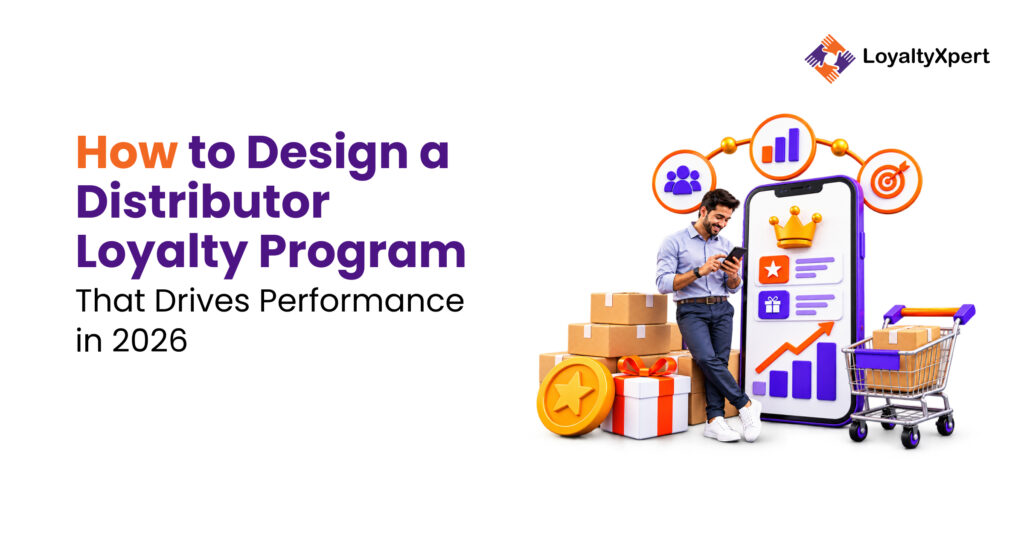
📝Summary
Manufacturers are rethinking how they reward distribution partners. This guide explains how to design a program that influences behavior instead of buying volume. It covers segmentation, incentive structure, post-launch engagement, measurement, and optimization, along with the design mistakes that quietly drain channel budgets every year.
Distributors rarely carry one brand. They stock five, ten, sometimes twenty. Your product competes for attention every single day. A distributor loyalty program decides who gets pushed first. Yet most programs still reward only one action. They pay for volume, then hope loyalty follows. Design matters far more than reward budget. The programs that perform in 2026 are built around behavior, supported by a distributor management system that makes partner activity visible.
What Is a Distributor Loyalty Program and Why Does It Matter in 2026?
A distributor loyalty program rewards distributors for defined commercial behaviors. It rewards distributors for purchases, product adoption, market coverage, and active engagement. Manufacturers use it to shape channel behavior rather than simply pay for volume. A well-designed program ties every reward to a measurable action, keeping distributor performance visible and channel growth predictable.
Channel incentives are no longer a side budget. The partner incentives management market is projected to grow from $3.98 billion in 2025 to $4.55 billion in 2026, at a 14.3% annual rate, according to The Business Research Company. Spending is climbing. Returns are not automatic. The difference sits entirely in design. A distributor incentive program that pays only for tonnage trains partners to chase discounts. A distributor loyalty program strategy built on behavior trains them to build the market with you.
Which Distributor Behaviors Should a Distributor Loyalty Program Reward?
A distributor loyalty program should reward behaviors that create long-term channel value. These include repeat orders, SKU expansion, new product adoption, market coverage, secondary sales reporting, training completion, and referrals. Each behavior links directly to revenue or retention. Rewarding volume alone ignores the actions that make volume repeatable.
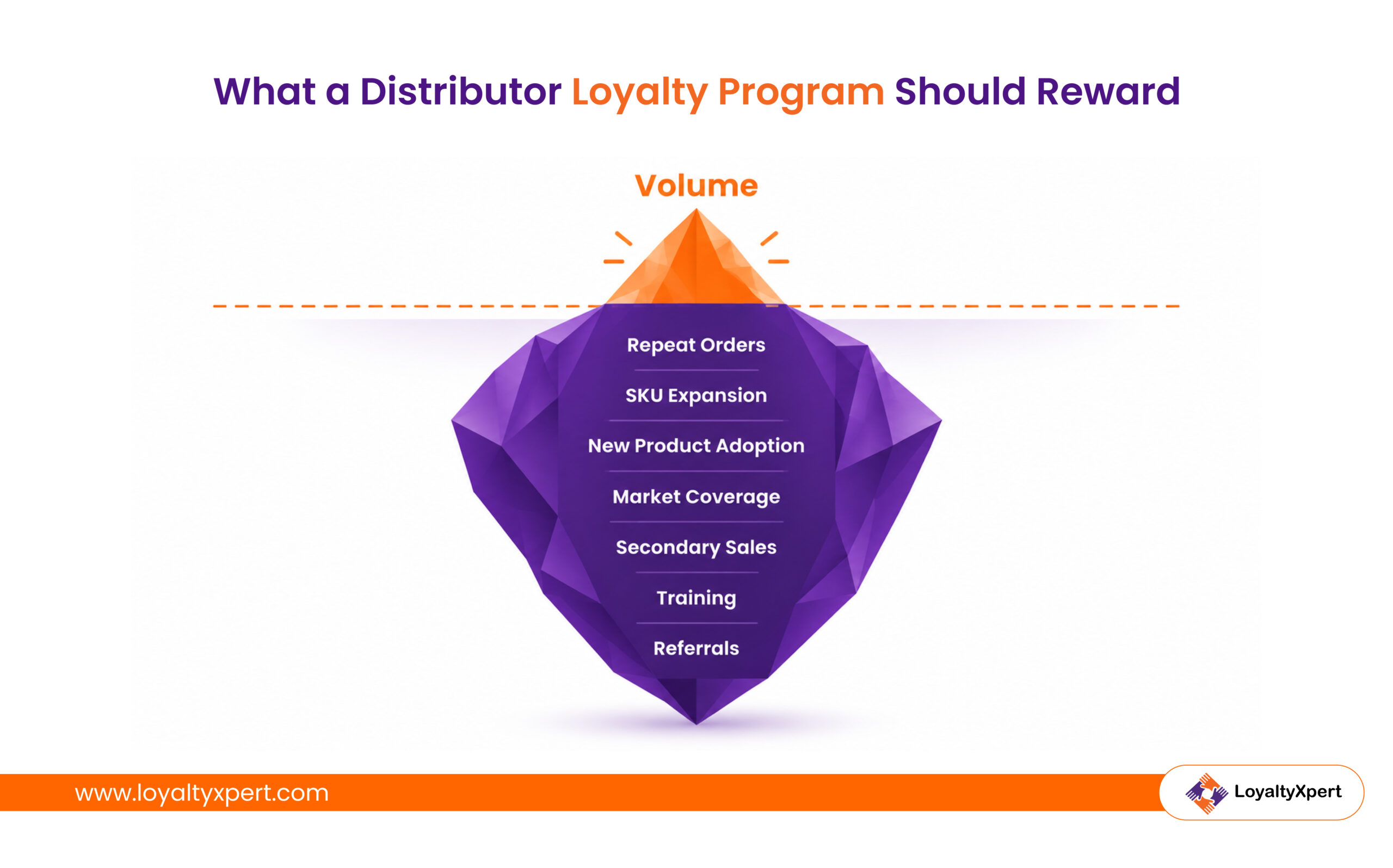
- Repeat Order Frequency — Consistent reordering signals real stock movement, not one-off buying.
- SKU Expansion — Wider baskets reduce your dependence on two or three hero products.
- New Product Adoption — Early listing of launches protects your NPD timelines.
- Market Coverage — Reward partners who open new towns, not only bigger orders.
- Secondary Sales Reporting — Downstream visibility improves forecasting accuracy across regions.
- Training And Certification — Trained counter staff sell technical products correctly.
- Referrals And Advocacy — Partner referrals lower your channel acquisition cost.
Start with this list. Points come later. Behavior-led rewards turn distributor performance management into a live process, especially when reward-program software can capture each action at the source.
How Do You Segment Distributors Before Designing the Program?
Segmentation groups distributors by value, geography, product mix, purchase frequency, and growth potential. Manufacturers segment first because one reward structure cannot motivate a small regional stockist and a multi-state partner equally. Segmented design directs budget toward partners with genuine upside, which sits at the center of distributor performance management.
| Segment | What You Assess | Reward Focus |
|---|---|---|
| Top Performers | Volume, consistency, coverage | Recognition, tiers, exclusivity |
| Growth Potential | Headroom, market size, order gaps | Stretch targets, category bonuses |
| Low Engagement | Login activity, claim frequency | Reactivation, simple quick wins |
| New Onboards | Training, first orders, catalog depth | Milestones, onboarding rewards |
Segmentation is where a distributor loyalty program strategy either earns its budget or quietly wastes it. Most manufacturers already hold this data. A distributor management system simply makes it usable.
Why Should You Reward Distributor Engagement, Not Only Sales Volume?
Engagement rewards pay for actions that happen before a sale. Training completion, product feedback, campaign participation, and survey responses all improve how well a distributor sells. A distributor loyalty program that recognizes these actions builds capability, not just transactions. Capability holds performance steady when competitors raise discounts.
Discounting is easy to copy. Any rival can add two percent tomorrow. Capability is far harder to match.
- Training Completion — Certified staff handle technical objections without escalation.
- Product Feedback — Field input shortens your product correction cycles.
- Campaign Participation — Joint promotions extend reach without extra media spend.
- Brand Advocacy — Advocates defend your pricing in a crowded market.
Price these rewards below your sales incentives. Keep the recognition high.
5 Design Rules That Make a Distributor Loyalty Program Worth Joining
Program participation depends on simple rules, visible targets, and fast rewards. Distributors abandon programs that demand paperwork, delay redemption, or hide progress. Clarity drives enrolment more reliably than reward value, because partners judge the effort long before they judge the payout. Complexity is the quiet killer of every distributor incentive program.
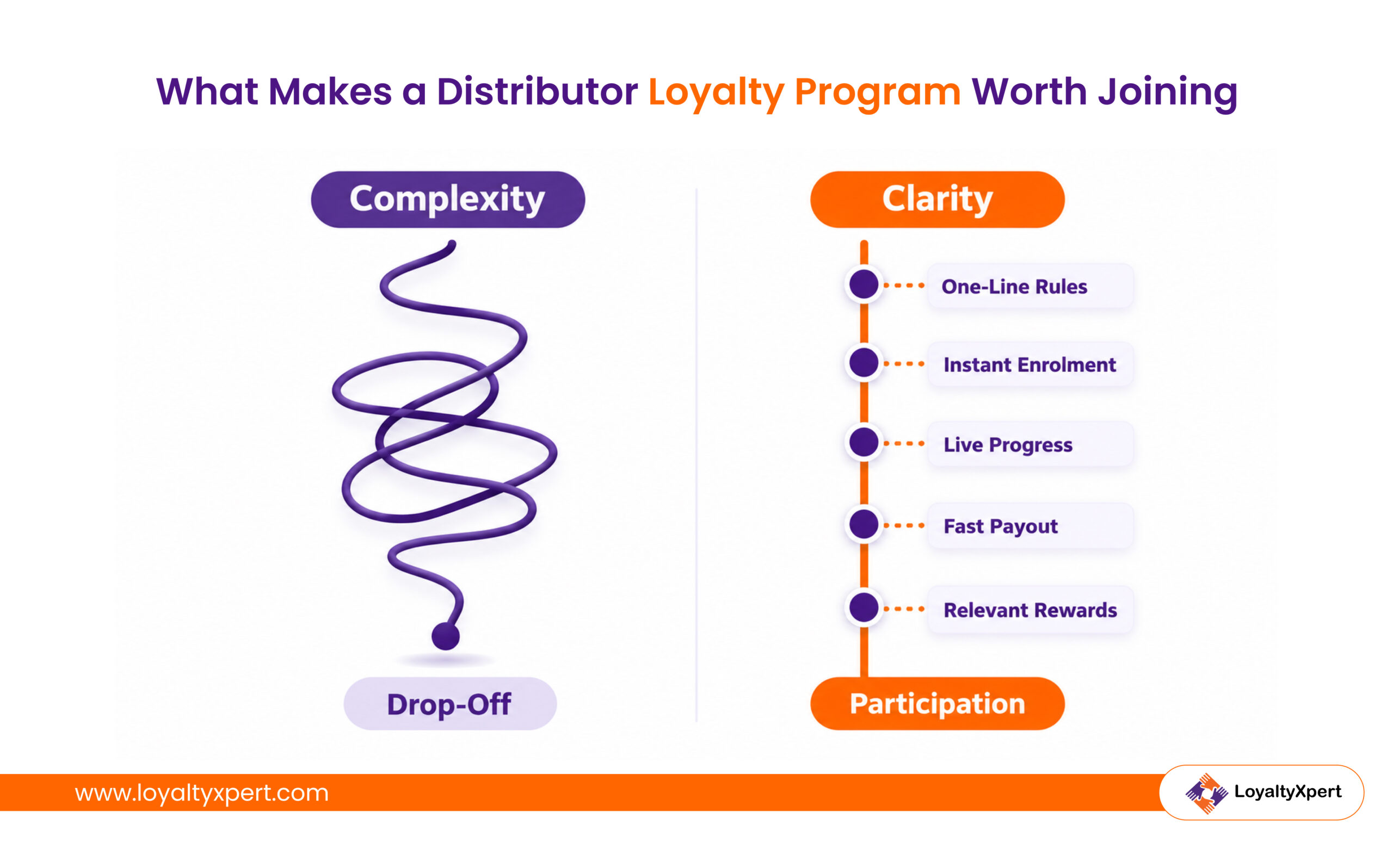
- Write Earning Rules In One Line — If a rule needs a paragraph, simplify it.
- Make Enrolment Instant — eKYC and mobile onboarding remove the paperwork excuse.
- Show Progress Live — Partners should see points, tier, and gap to target.
- Settle Rewards Fast — Delayed redemption is the fastest way to lose trust.
- Offer Relevant Rewards — Business utility usually beats consumer gifting in B2B.
Clear rules also make distributor performance management easier to audit. Modern loyalty program software for manufacturers handles all five as standard.
How Do You Keep Distributors Engaged After the Program Launches?
Post-launch engagement depends on continuous communication, refreshed campaigns, and visible recognition. Distributors lose interest when a program runs unchanged for months. Manufacturers prevent incentive fatigue with quarterly challenges, seasonal multipliers, milestone recognition, and personalized nudges tied to each partner’s real ordering pattern.
Most programs peak in month two. Enrolment looks strong. Then activity flattens out. The cause is rarely reward value. It is silence.
- Quarterly Challenges — Short, themed targets that reset attention.
- Milestone Recognition — Public credit for coverage and consistency.
- Regional Leaderboards — Healthy competition inside comparable segments.
- Personalized Order Reminders — Nudges based on each partner’s own cycle.
Personalization needs data. Your distributor management system should trigger these nudges automatically. Rotate the mechanics every quarter, but keep the earning logic stable. The best loyalty program for manufacturers and distributors adapts to scheme changes.
How Do You Measure Distributor Loyalty Program Performance?
Measure distributor loyalty programs by business outcomes, not registrations. Useful metrics include active participation rate, repeat order frequency, sales growth by segment, new product adoption, retention, market coverage, and reward cost against incremental revenue. These figures reveal whether the program changed behavior or only moved budget.
| Metric | What It Tells You |
|---|---|
| Active Participation Rate | Whether partners use the program, not just joined it |
| Repeat Order Frequency | Real stock movement across the channel |
| Sales Growth By Segment | Which tiers respond to which rewards |
| New Product Adoption | Speed of launch uptake in the field |
| Reward Cost vs Incremental Revenue | True program ROI |
| Distributor Retention | Long-term channel stability |
Secondary sales data is the hard part. A sales tracking app closes that gap and makes distributor performance management measurable rather than anecdotal. Pull every number from one source. A distributor management system that already holds order, claim, and coverage data removes reporting arguments before they start.
6 Distributor Incentive Program Mistakes to Avoid
The most common distributor incentive program mistakes are rewarding volume alone, applying identical rewards to every partner, writing complicated rules, and measuring participation instead of business impact. Manufacturers also launch nationally without piloting. Each mistake raises cost while weakening the behavior the program was built to create.
- Rewarding Only Volume — You pay for orders you would have received anyway.
- One Structure For Everyone — Identical rewards ignore segment economics completely.
- Complicated Earning Rules — Confusion reduces enrolment faster than low payouts.
- Irrelevant Reward Catalogs — Consumer gifting rarely motivates a working B2B partner.
- Silence After Launch — Programs decay without ongoing, planned communication.
- Skipping the Pilot — National rollouts magnify every design error.
Fixing these costs less than adding budget. Manufacturers comparing platforms often begin with a review of loyalty management software before finalizing their distributor loyalty program strategy.
How Do You Optimize the Program as Distributor Behavior Changes?
Program optimization follows a repeatable cycle of pilot, measure, learn, adjust, and scale. Distributor behavior shifts with market conditions, competitor schemes, new product launches, and emerging distribution channels. Manufacturers who review reward performance quarterly keep budgets aligned with current behavior instead of last year’s assumptions.
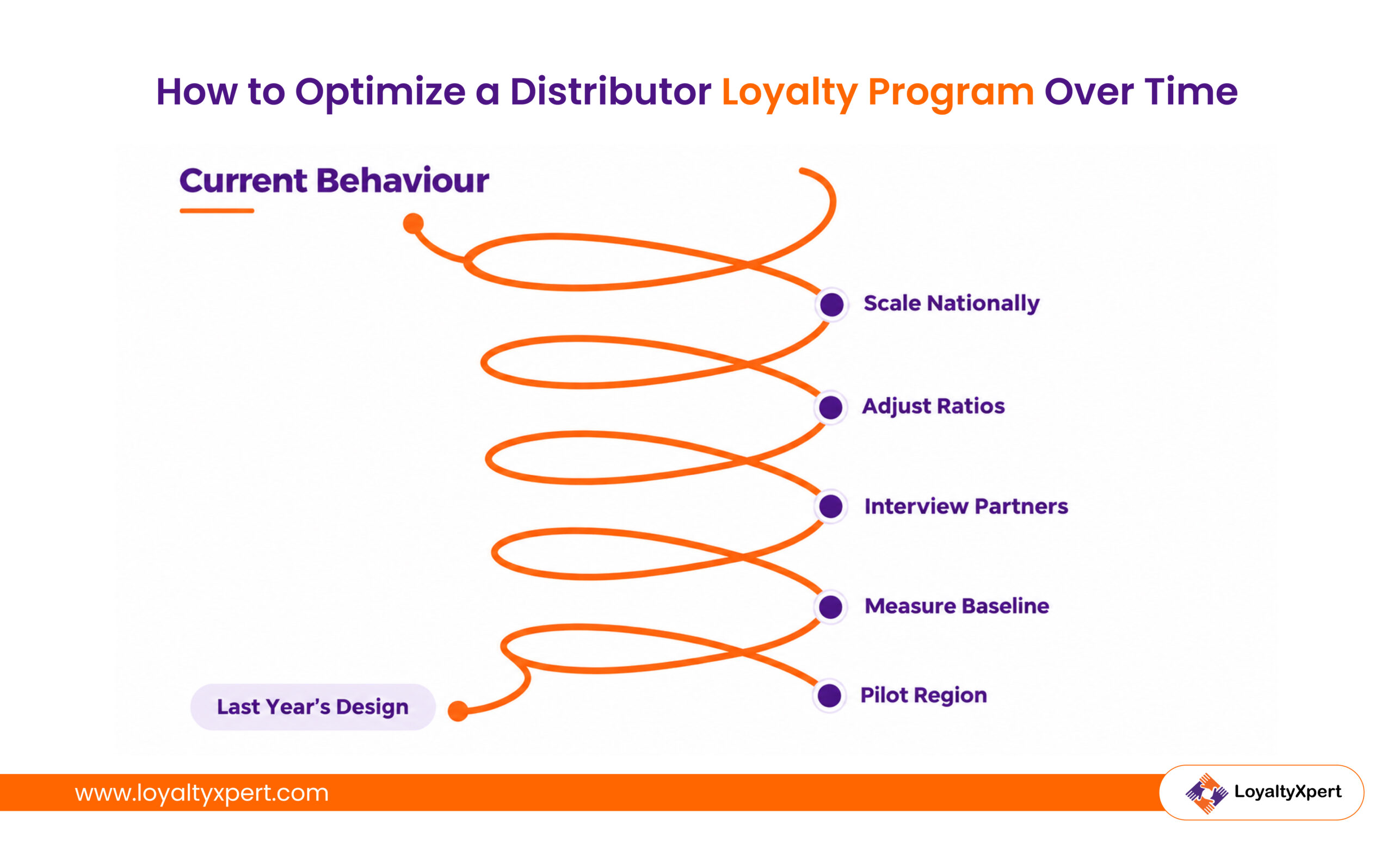
- Pilot In One Region — Test the structure on a limited distributor set.
- Measure Against Baseline — Compare order frequency and coverage before and after.
- Interview Participants — Ask distributors what actually felt worth the effort.
- Adjust Earning Ratios — Shift weight toward behaviors that moved real results.
- Scale With Guardrails — Expand nationally with clear cost ceilings in place.
Teams without in-house capability often bring in channel loyalty specialists to design the pilot. Review quarterly. Refresh annually. That rhythm keeps distributor performance management honest and keeps the distributor incentive program earning its place in the budget.
Conclusion
The strongest distributor loyalty program is not the one with the biggest payout. It is the one that consistently rewards behaviors both sides benefit from. Start with behavior. Segment before you design. Measure business impact, not sign-ups. Then optimize as your channel changes. Manufacturers running that distributor loyalty program strategy on a single distributor management system see growth that compounds, not resets, each quarter.
- Book a Demo — Walk through a live program setup built around your distributor segments.
- Contact Us — Share your current channel structure and get a design recommendation.