
 Max 11min read
If you own a furniture or hardware business, you must consider running the right carpenter loyalty program (if you aren’t running one already). That’s because carpenters are the unsung heroes in the furniture and hardware industry.
They are the main influencers in the furniture and hardware industry. Surprised? Now, every carpenter worth its salt may not be the type of influencer as listed in this article. But a majority of them (if not all) influence the purchasing decisions of end customers.
They work directly with commercial builders, real estate developers, and homeowners. They don’t just craft woodwork or install products, but more often than not, they purchase the raw materials and hardware’s themselves.
In this blog post, we will discuss why furniture and hardware brands need carpenter loyalty programs in today’s time, what are the problems they face as they deal with carpenters, and how the right carpenter loyalty program can benefit them. Apart from that we will also discuss the key components of a carpenter loyalty program and how furniture and hardware brands can design and run effective carpenter loyalty programs.
What Are Some Key Problems Furniture and Hardware Brands Face While Dealing with Carpenters?
Furniture and hardware brands (the manufacturers of plywood, laminates, medium density fiberboards, and other types of hardware such as hinges, bearings, and other architectural fittings) don’t deal with carpenters directly. However, they deal with the carpenters through some of their key channel partners such as dealers and distributors. When it comes to problems, some of them face the following common problems:
1. Supply chain disruptions and delivery delays
In the present time, supply chain disruption is one of the biggest problems for manufacturers across industries. Even though many external factors are responsible for it, it has been affecting carpenters adversely. Due to supply chain disruptions, the project timelines have been delayed and it caused massive downtime.
2. Lack of adequate product knowledge
A majority of carpenters are the masters of their craft. No doubt about it. But some may not have the adequate product knowledge. Even though this may not be true for all, it’s a common problem for the ones who are relatively new in the trade and have low exposure to different brands and products. Several carpenters aren’t formally trained. That makes it difficult for them to understand installation techniques. If they install the hardware improperly, it can harm a plywood or hardware brand’s reputation.
3. Low brand loyalty
Some carpenters prioritize short-term gains over long-term relationships with a brand. Such carpenters are highly price-conscious, and more often than not, they choose hardware or furniture fittings based on discounts, commissions, or freebies. They won’t hesitate to switch brands easily if a competitor offers slightly better margins or immediate rewards. Instead of recommending one trusted brand, they are more likely to suggest multiple brands based on the immediate benefits they receive.
4. Rewards fraud
Just imagine yourself in the shoes of a carpenter. You are expecting to be rewarded for driving up sales volume for a particular brand. But you realized that the rewards you’re supposed to get have been usurped by someone else. What would be your reaction? Disbelief? Angry? Confused? Anxious? Chances are, you will feel these emotions all at once. This is not just a hypothetical scenario. It’s a reality in all sectors, including the furniture and hardware industry. Rewards fraud (also called loyalty fraud) is prevalent in the furniture industry and hardware industry and has risen by leaps and bounds in the last decade.
Did you know?
The losses due to rewards fraud is estimated to be in the range of USD 1-3 billion every year globally, reveals a recent Reuters report.
5. Resistance to new technologies and processes
Some carpenters (in this case, the older ones in the trade) are more likely to resist new technologies and processes due to several factors. Some of it could be the fear of installation errors, the hesitation to unlearn the old things and learn new things, fear of higher costs, and more.
6. Lack of recognition and trust
In a competitive furniture industry and hardware industry, recognition isn’t optional. It’s a must. Carpenters are not machines. They’re the masters of their craft. They’re influencers and decision-makers. Yet some furniture brands and hardware brands treat them as faceless order-takers. This neglect builds resentment. Carpenters shift to rivals who give them recognition.
How the Right Carpenter Loyalty Program Helps Furniture and Hardware Brands Address the Problems?
The right carpenter loyalty program can help furniture and hardware brands address the above-mentioned problems faced by carpenters in multiple ways. Here are some of those.
1. Driving consistent engagement
A dedicated carpenter loyalty program motivates carpenters to stay connected with a furniture brand or hardware brand by rewarding repeat purchases and referrals. Unlike one-time discounts, a structured B2B loyalty program creates consistent engagement through reward points, recognition tiers, and milestone benefits.
2. Enhancing product knowledge
The latest fittings and accessories in the furniture industry and hardware industry require proper training. With an app-based loyalty program, brands can integrate learning modules, video tutorials, and certifications. Carpenters earn rewards not only for purchases but also for improving their technical skills.
3. Balancing dealer influence
Carpenters often rely on local dealers when choosing products. A smart furniture loyalty program or hardware loyalty program aligns both dealer and carpenter incentives. This dual approach encourages dealers to recommend the same brand that carpenters are rewarded for buying or installing (or both).
4. Reducing price sensitivity
Instead of chasing short-term discounts, carpenters benefit from structured rewards such as tools, branded merchandise, or vouchers through loyalty software for business. This system helps brands reduce overdependence on price cuts and build long-term loyalty.
5. Strengthening brand relationships
Carpenters value recognition as much as monetary rewards. By partnering with experienced loyalty program companies in India, brands can design personalized rewards for special occasions and milestones such as birthdays, anniversaries, years of association, numbers of projects completed. Such recognition builds deeper emotional bonds with carpenters.
6. Encouraging digital adoption
Many carpenters still operate offline. A simple app-based loyalty program makes it easy to scan invoices, earn points via SMS/WhatsApp, and redeem rewards. Over time, brands can leverage this digital platform to introduce e-catalogues, online ordering, and real-time support.
7. Treating recognition as currency
Recognition is the most powerful reward. A well-crafted B2B loyalty program turns it into a currency. Every reward, every badge, every milestone says “You matter.” In the furniture and hardware industry, where carpenters are often overlooked, this changes the game. By leveraging loyalty software for business, furniture brands and hardware brands turn carpenters into partners.
Key Components of a Carpenter Loyalty Program
Done right, a carpenter loyalty program can become the spine of a furniture or hardware brand’s growth. For that, it needs to get its component right. Here are some key components every winning furniture loyalty program or hardware loyalty program must have.
1. Seamless enrollment and onboarding
The way a furniture or hardware brand enrolls and onboards its influencers can determine the success or failure of its carpenter loyalty program. Many carpenters aren’t tech savvy. So, brands have to make the enrollment and onboarding process as simple as possible. They must leverage sophisticated app-based loyalty programs to ensure seamless enrollment and onboarding.
2. Effective reward structures
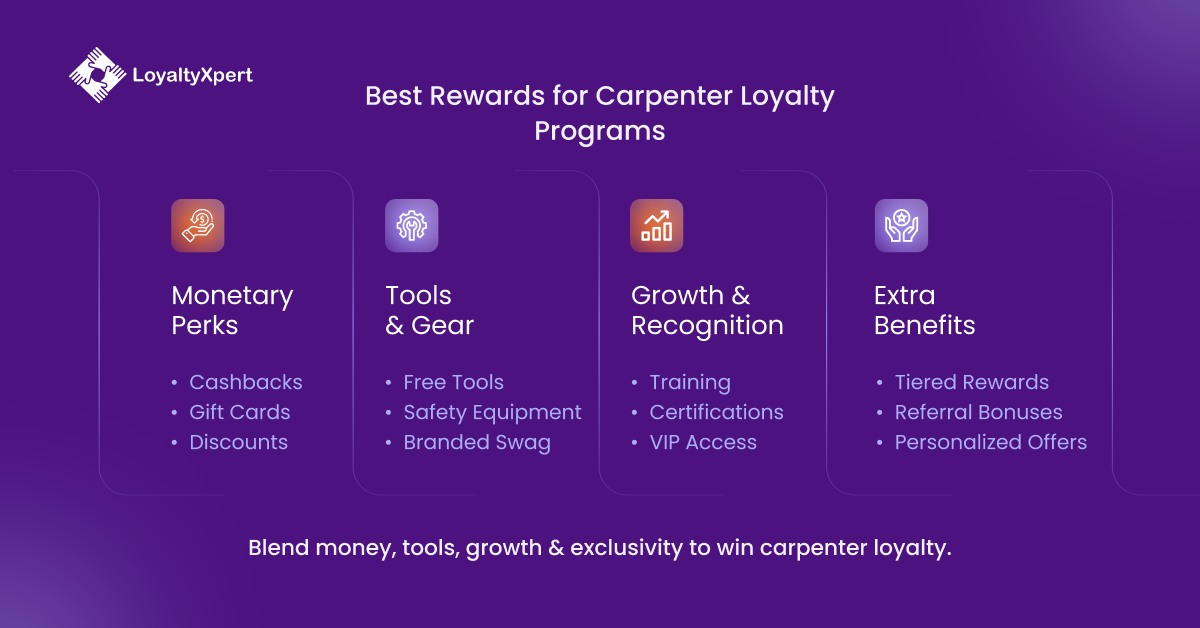
Points. Tiers. Exclusive access. Aspirational prizes. These are not gimmicks. They are rewards that motivate. They are rewards that drive carpenters to climb up the ladder, achieve the desired objectives, and carve a place for themselves in the brand’s growth story. The right furniture loyalty program and hardware loyalty program offers structured rewards that tap into this drive.
3. Personalized and localized rewards
A carpenter who is young and new in the industry won’t be motivated with the same rewards as a carpenter who has spent years or decades in the industry. The same goes for a carpenter in a tier-one city (or a metro city) versus a carpenter in a small town or a village. Their needs are different and brands need to keep this in mind. They must personalize and localize the rewards.
4. Training and education modules
New hinges. New modular fittings. New tools. The furniture industry and hardware industry never stand still. If carpenters don’t evolve, a brand’s reputation suffers. That aside, when carpenters learn, they earn. And when they earn, they influence with confidence.
5. Data-driven analytics
As the saying goes, “If you can’t measure it, you can’t control it.” Modern loyalty software for business is equipped with sophisticated data-driven analytics and reporting tools to track key performance indicators. It gives brands the power to predict sales, fine-tune promotions, and maximize return on their investments.
6. QR code generator and scanner
Here’s the weapon that changes everything. The QR code. Every invoice, every product, every reward can carry a QR code. By providing QR codes, furniture and hardware brands can accelerate the way they reward their influencers. No waiting. No paperwork. No manual processes. The entire process happens in just a few seconds.
7. Digital infrastructure and professional program management
In today’s market, a carpenter loyalty program cannot run on paper slips or manual tallies. A robust app-based loyalty program is a basic requirement. That’s why furniture and hardware brands must invest in sophisticated digital infrastructure and a company that can handle the tech aspect of the carpenter loyalty programs.
How Furniture and Hardware Brands Can Design and Run Effective Carpenter Loyalty Programs
A strategically designed carpenter loyalty program can help furniture and hardware brands in a wide range of ways. That’s why they must leave no stone unturned in designing and running effective carpenter loyalty programs. Here are some ways to do that.
1. Set clear objectives
First thing first; a furniture or hardware brand must define and set clear objectives. What are the things they want from the carpenter loyalty programs? Do they want to increase carpenter retention? Boost sales? Enhance product recommendations? Speed up adoption of new fittings? Or simply improve engagement? Getting the answers to these questions can provide clarity and help them set their prime objectives.
2. Handpick the right app-based loyalty software
Manual loyalty programs are things of the past. In today’s digital age, furniture and hardware brands must leverage the right app-based loyalty software. The right software for business can ensure transparency, instant updates, fraud prevention, and more. When looking for loyalty program companies in India or abroad, furniture and hardware brands must look at the track record, case studies, and success stories to handpick the right loyalty solutions partner for their business.
3. Choose the right loyalty model
Furniture and hardware brands need to pick the right loyalty model and structure for different segments of carpenters. They should mix financial rewards with nonfinancial ones.
4. Provide tiered rewards and recognition
Tiered rewards and recognition are extremely important for carpenter loyalty programs. That’s because they appeal to the “status needs” as per Maslow’s need hierarchy theory. For some, money isn’t the be all and end all. They like growth, progress, and achievements. And tiers and recognition are some of the most effective ways to showcase that.
5. Personalize the experience
Now that we have discussed tiers and recognition, there are carpenters that value other forms of rewards such as loyalty points and rebates. Each one has their own preference. That’s why personalization of loyalty programs is a must. It means relevance. It commands loyalty.
6. Simplify participation and ensure transparency
Simplicity is the key to an effective furniture loyalty program and hardware loyalty program. Furniture and hardware brands must see to it that their influencers can easily join the programs. They also need to ensure that the loyalty programs are as transparent as possible. Transparency is the foundation of trust. That’s the most effective way to win carpenters’ loyalty.
7. Continuously evolve
A static B2B loyalty program dies. Carpenters grow bored. Competitors outpace. In the furniture industry and hardware industry, brands must keep programs alive by rotating rewards, gamifying progress, introducing seasonal challenges, and more. A furniture brand or hardware brand that evolves its program stays ahead. Those that don’t? They vanish.
Taking Everything Into Consideration,
In today’s competitive furniture industry and hardware industry, carpenters are the main influencers who shape customer choices and influence their purchase decision.
No CTA found.
A well-designed carpenter loyalty program not only rewards their contribution but also strengthens long-term trust, ensures repeat product usage, and drives measurable sales growth.
By leveraging sophisticated loyalty software for business, furniture and hardware brands can design effective app-based loyalty programs and enhance carpenters’ loyalty.
At LoyaltyXpert, we have engineered effective carpenter loyalty programs for some highly reputable plywood and laminates manufacturers as well as brands in the hardware industry.
If you are curious to know more about our solutions, contact us today to book a free demo.