 Max 16min read
📝Summary
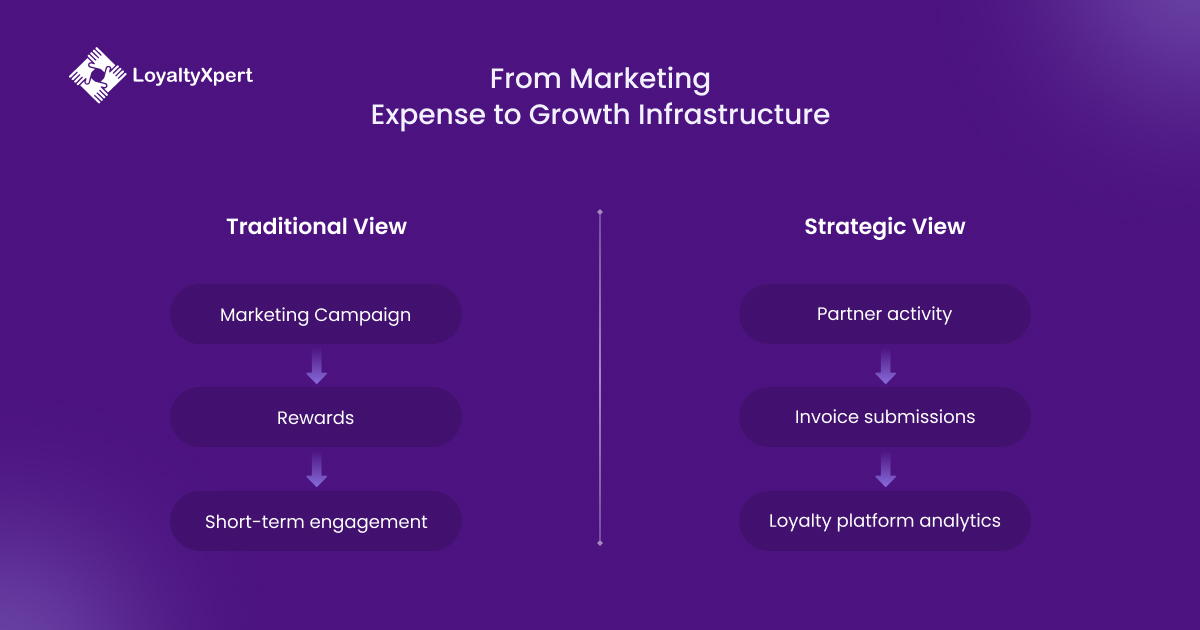
Many manufacturers still evaluate loyalty initiatives the same way they evaluate short-term marketing campaigns. A budget is approved, incentives are announced, and partners participate for a few months. Then leadership reviews the expense and asks a familiar question: Was the investment really worth it?
The confusion often starts with how the Loyalty Program Software itself is actually perceived. Instead of viewing it just as a strategic infrastructure tool, many businesses actually treat it as a campaign platform. As a result, the Loyalty Program Software Cost is compared only against the promotional budgets, not against the business outcomes it drives.
In reality, loyalty platforms do much more than distribute rewards. They shape how distributors, dealers, and retailers behave in the market. They help companies track sales behavior, control incentive distribution, and create predictable engagement across large channel networks.
This is why evaluating Loyalty Program Cost requires a broader perspective. The real discussion should focus on loyalty program software cost vs. ROI, and on how the platform impacts revenue visibility, operational control, and partner engagement.
When companies start evaluating loyalty systems through this lens, the cost conversation changes completely. What once looked like a marketing expense begins to look like a business growth infrastructure.
Loyalty Program Software Cost Is More Than The Subscription
When companies first explore loyalty platforms, the conversation usually starts with pricing. Vendors present subscription packages, feature lists, and platform tiers. At this stage, many decision-makers assume the Loyalty Program Software Cost is simply the monthly or annual license fee.
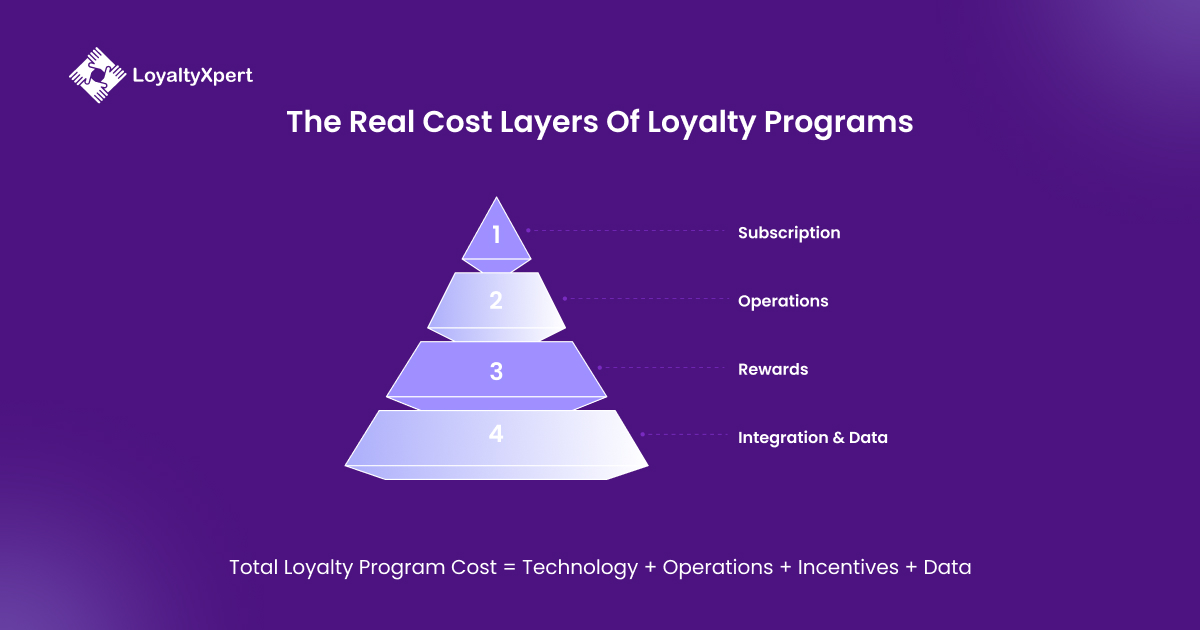
However, the actual Loyalty Program Cost goes beyond the subscription layer. Running a structured loyalty initiative involves operational processes, reward fulfillment, and data management, all of which contribute to the total cost structure.
Understanding these layers is essential before evaluating loyalty program software pricing or comparing different providers.
1. The software subscription layer
The Loyalty Program Software subscription typically covers the core technology that runs the program. This includes the partner onboarding, campaign creation, reward configuration, and reporting dashboards.
In most cases, loyalty management software pricing depends on factors such as:
- number of channel partners onboarded
- available features and automation capabilities
- level of customization required
- system integrations with ERP or CRM platforms
While the subscription is the most visible part of the investment, it represents only one portion of the total program structure.
2. Program administration and operational management
A loyalty initiative does not run on autopilot. Programs require continuous monitoring, campaign adjustments, and partner communication. Many manufacturers underestimate this operational effort when calculating the Loyalty Program Cost.
Administrative responsibilities often include:
- onboarding new channel partners
- managing reward catalogs
- reviewing incentive claims
- configuring seasonal campaigns
- responding to partner queries
Whether managed internally or through a platform provider, this operational layer contributes to the total cost of running the system.
3. Reward fulfillment and redemption logistics
Rewards are the most visible part of any loyalty program, and they also represent a significant financial component. Companies may offer various reward options depending on partner preferences and program design.
Common reward structures include:
- digital vouchers and prepaid cards
- merchandise catalogs
- travel incentives
- digital wallet rewards
When evaluating loyalty program software cost in India, companies must consider not only the reward budget but also the logistics involved in fulfillment and redemption management.
4. Data integration and reporting infrastructure
For many manufacturers, loyalty systems must integrate with internal sales data sources. Without proper integration, incentive tracking becomes slow and error-prone.
Typical integrations include connections with:
- ERP systems for invoice validation
- distributor billing systems
- CRM platforms for partner records
- sales reporting tools
Although integration adds initial setup effort, it greatly improves the accuracy of reporting and automation within the Loyalty Program Software.
5. Understanding the full cost structure
When companies evaluate loyalty program software pricing, they should think beyond the subscription and consider the broader ecosystem supporting the program.
A realistic Loyalty Program Cost includes:
- platform subscription
- operational management
- reward budgets and fulfillment
- integration and data automation
Once these layers are understood, businesses can start evaluating loyalty program software cost vs ROI in a meaningful way. The focus shifts from minimizing cost to maximizing the business value generated through better channel engagement.
Hidden Cost Driven By Incentive Leakages
Interestingly, the biggest expense in many loyalty programs is not the technology. It is the misallocation of incentives, commonly known as incentive leakage.
In simple terms, leakage happens when companies distribute rewards without actually influencing partner behavior. Incentives are paid, but the sales would have happened anyway.
This issue often becomes the largest hidden component of Loyalty Program Cost, especially in programs that rely on manual tracking or loosely defined reward rules.
1. Where incentive leakage usually comes from
Traditional loyalty programs often suffer from structural gaps that make incentive misuse difficult to detect. These gaps allow rewards to be distributed without strong verification or behavioral impact.
Common causes include:
- self-reported sales claims from partners
- manual invoice verification processes
- duplicate claim submissions
- poorly defined reward eligibility rules
When these issues exist, companies may spend far more on incentives than the actual Loyalty Program Software Cost itself.
2. Rewarding behavior that would happen anyway
Another major source of leakage occurs when loyalty programs reward existing behavior instead of encouraging new actions.
For example, companies may:
- Reward dealers who were already high performers
- Provide incentives on all products instead of strategic SKUs
- Distribute rewards without linking them to incremental growth
In such cases, the program generates activity but not real business improvement. This weakens the loyalty program software cost vs ROI equation.
3. How modern software reduces leakage
Modern Loyalty Program Software is designed to address this problem through structured automation and rule enforcement.
Advanced systems help companies reduce leakage through capabilities such as:
- SKU-level incentive configuration
- automated invoice validation
- duplicate claim detection
- partner segmentation and performance tracking
- real-time reward calculation transparency
These features ensure that incentives are distributed only when partners meet specific business objectives.
4. Why leakage control improves ROI
Once leakage is reduced, the economics of loyalty programs change significantly. Incentive budgets become more efficient, and leadership teams gain confidence in the system.
When programs are managed through the best loyalty program software for manufacturers, two outcomes typically follow:
- Incentive spending becomes more targeted
- Partner engagement becomes more predictable
At that point, the Loyalty Program Software Cost is no longer seen as an expense. It becomes a control mechanism that ensures every reward distributed contributes to measurable business growth.
Administrative Cost vs Platform Automation
Many loyalty programs look simple from the outside. Announce the scheme, allow partners to submit claims, and distribute rewards. But behind the scenes, traditional programs require a surprising amount of manual work.
Teams often spend hours verifying invoices, validating claims, preparing reports, and resolving partner disputes. Over time, these operational tasks quietly increase the Loyalty Program Cost, even when the Loyalty Program Software Cost appears reasonable on paper.
This is where a modern Loyalty Program Software platform begins to create real value. Instead of relying on spreadsheets and manual checks, companies can automate large parts of the loyalty lifecycle using a structured loyalty management platform.
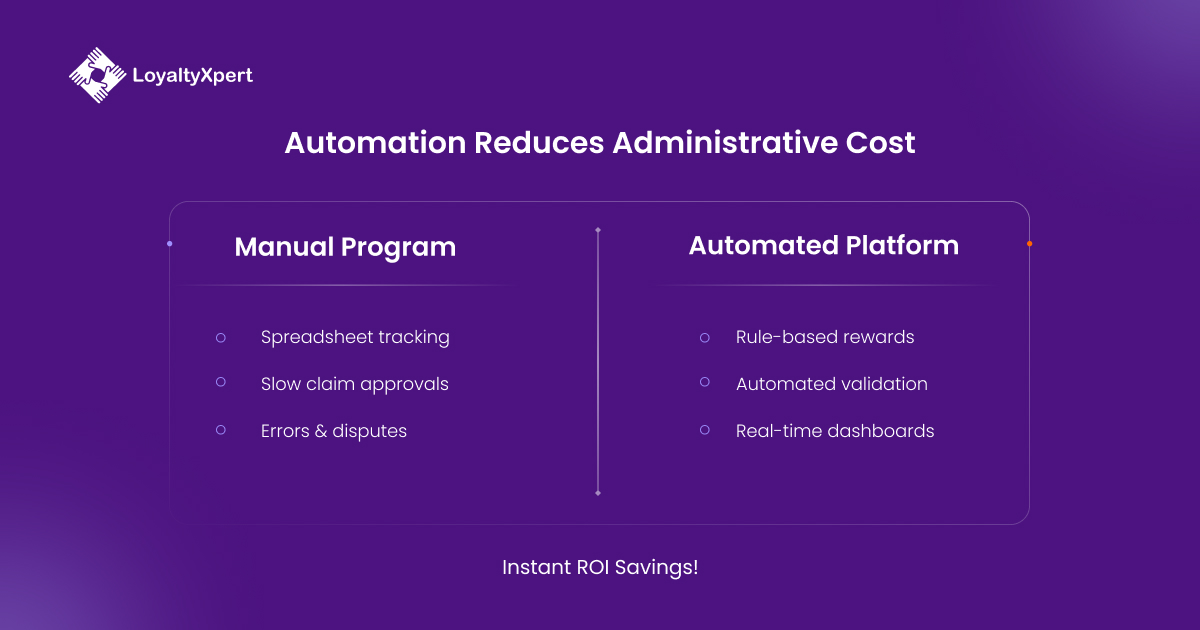
Automation significantly reduces administrative workload and improves program efficiency.
1. Common administrative tasks in traditional programs
Without automation, loyalty programs typically involve:
- manual invoice verification
- claim approval through multiple internal teams
- reward calculations performed in spreadsheets
- monthly performance reporting preparation
- partner queries and dispute resolution
These tasks may appear manageable at first, but as the partner base grows, the operational burden increases rapidly.
2. How automation changes the cost equation
A robust Loyalty Program Software system replaces many manual processes with rule-driven workflows. This helps companies manage large channel networks without increasing administrative teams.
Key automation benefits include:
- Automated claim validation through invoice uploads or ERP integration
- Rule-based reward calculations that eliminate manual errors
- Real-time dashboards instead of manual reporting cycles
- Self-service partner portals that reduce support queries
When these capabilities are built into the loyalty management platform, the operational efficiency becomes a major contributor to loyalty program software cost vs ROI.
3. Operational efficiency improves ROI
Automation does more than save time. It improves the overall discipline of the loyalty system.
With the right Loyalty Program Software, companies gain:
- faster claim processing cycles
- lower administrative overhead
- higher data accuracy
- better partner satisfaction
In other words, the Loyalty Program Cost becomes easier to control while the program itself becomes easier to scale.
The Cost of Channel Uncertainty
Many manufacturers focus heavily on incentive budgets while overlooking another major cost of channel unpredictability.
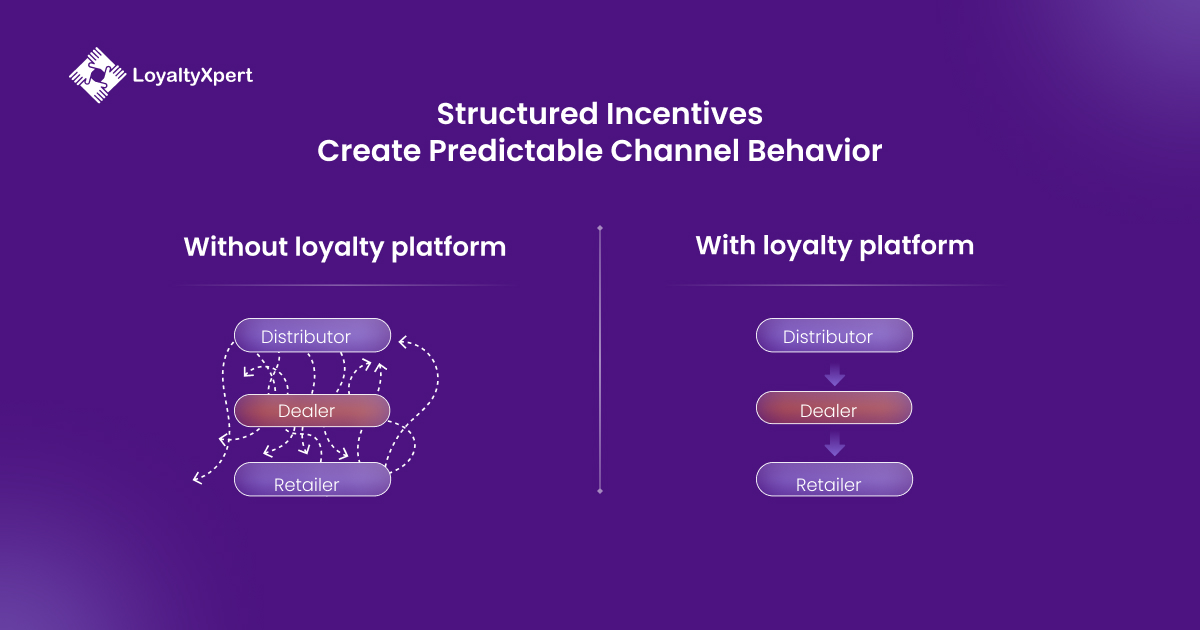
Without structured channel loyalty programs, partner behavior becomes difficult to forecast. Dealers may promote competitor brands, product focus may shift unexpectedly, and sales teams struggle to influence partner priorities.
This uncertainty creates hidden financial risks that rarely appear in traditional cost calculations.
When companies operate without structured Loyalty Program Software, they often face several challenges:
- Unpredictable partner engagement
- Inconsistent product promotion across regions
- Weak visibility into dealer participation
These issues increase the real Loyalty Program Cost because companies cannot reliably influence or forecast channel performance.
1. Why predictability matters in distribution
Distribution networks are built on relationships, but relationships alone cannot guarantee consistent business outcomes.
Manufacturers need systems that encourage partners to:
- promote priority SKUs
- maintain consistent purchase cycles
- participate in brand campaigns
- expand product coverage across markets
Well-designed Loyalty Program Software creates structured incentive frameworks that guide partner behavior.
Instead of relying on informal communication or temporary schemes, companies can use loyalty programs to build predictable engagement patterns across their channel network.
2. Loyalty platforms create behavioral stability
When incentives are clearly defined and transparently tracked, partners understand exactly how their actions translate into rewards.
This clarity improves program participation and reduces channel uncertainty. Companies benefit from:
- more predictable partner engagement
- stronger campaign participation
- better alignment between sales strategy and partner activity
Over time, this behavioral stability strengthens the loyalty program software cost vs ROI equation because incentive investments produce measurable and repeatable outcomes.
Data Visibility as an ROI Multiplier
Beyond incentives and engagement, one of the most powerful advantages of modern Loyalty Program Software is the data it generates.
Every partner interaction, such as invoice submission, reward redemption, and campaign participation, becomes part of a structured dataset. When analyzed properly, this information can provide valuable insights into channel performance.
This is why many companies now view loyalty systems not only as incentive engines but also as business intelligence tools.
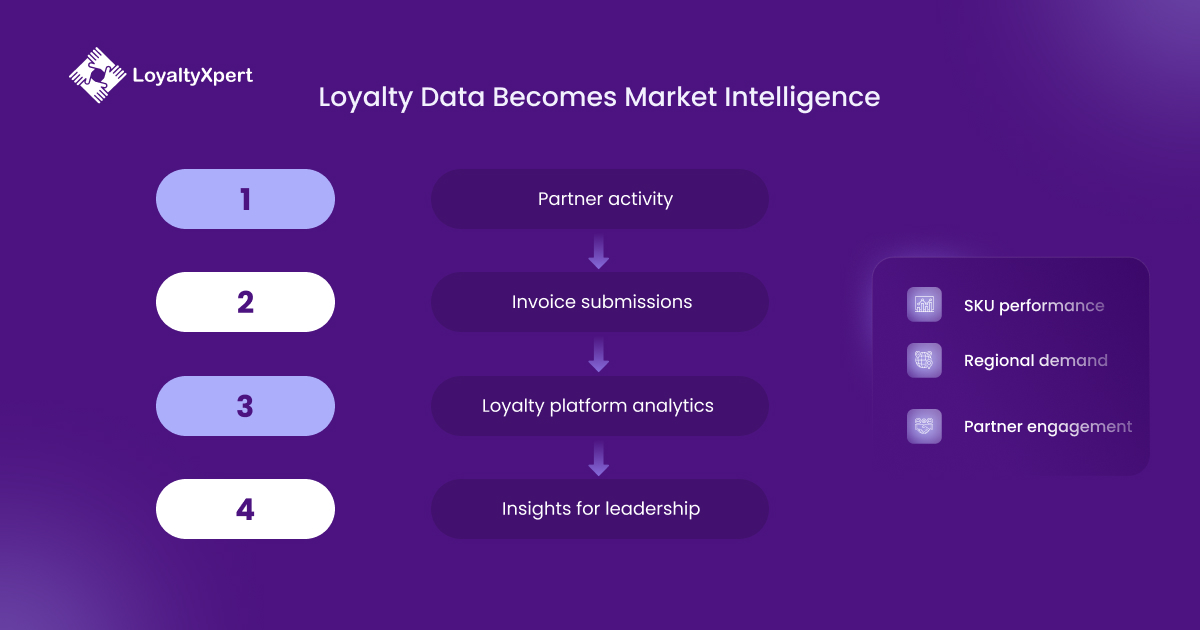
A well-designed platform captures partner behavior data that helps leadership teams make smarter commercial decisions.
1. How loyalty data supports strategic decisions
Structured loyalty data allows manufacturers to analyze patterns that are often invisible in traditional sales reports.
For example, companies can identify:
- Which SKUs receive the most incentive-driven traction
- Which regions respond strongly to campaigns
- Which partners consistently outperform peers
- Where engagement gaps exist in the distribution network
This type of analysis extends the value of Loyalty Program Software far beyond reward management.
2. Market intelligence from partner activity
With strong reporting capabilities, companies can convert loyalty program data into actionable insights.
Typical insights include:
- SKU strategy improvements based on partner purchase behavior
- regional demand patterns that influence sales planning
- partner performance segmentation for targeted engagement
These insights are particularly valuable for manufacturers searching for the best loyalty program software for manufacturers, because the system becomes a strategic data asset rather than just a rewards tool.
3. Why data visibility multiplies ROI
The real power of loyalty analytics lies in its ability to improve future decisions.
Instead of running generic campaigns, companies can design targeted programs based on real partner behavior. Over time, this improves both engagement and profitability.
This is why the discussion around loyalty program software cost vs ROI should not focus only on incentives or subscriptions. The real value often lies in the market intelligence that loyalty systems provide.
When leadership teams gain deeper visibility into partner performance, the Loyalty Program Cost begins delivering returns far beyond the original incentive budget.
Cost of Poor Program Governance
Many loyalty initiatives start informally. A scheme is announced, rewards are promised, and partners begin submitting claims. At first, everything appears manageable. But as the program grows, companies often realize that informal processes create confusion and financial ambiguity.
This is where the importance of governance becomes clear.
When loyalty programs operate without structured controls, disputes over incentives, eligibility, and reward calculations become common. Over time, these issues increase the real Loyalty Program Cost and weaken trust between the company and its channel partners.
A structured Loyalty Program Software platform introduces discipline into the system by replacing informal decisions with defined program rules. Instead of relying on manual interpretation, the platform enforces clear governance mechanisms.
1. Governance gaps in traditional loyalty programs
Without a structured system, companies often experience:
- inconsistent reward calculations
- disputes around incentive eligibility
- unclear approval responsibilities
- lack of documentation for reward decisions
These gaps not only increase operational complexity but can also create compliance challenges within the organization.
💡 Did you know?
Loyalty program fraud and incentive misuse are estimated to cost businesses over $15 billion globally every year, highlighting the need for stronger program controls.
2. How software introduces governance
Modern Loyalty Program Software helps establish a controlled program environment by embedding governance into the platform itself. Instead of ad-hoc processes, the system enforces structured rules.
Key governance capabilities include:
- rule-based reward logic that automatically applies incentive conditions
- audit trails that track every claim submission and approval
- multi-level approval workflows for sensitive reward payouts
- transparent reward calculations visible to both partners and administrators
These controls reduce internal disputes and create financial clarity across the program.
3. Governance strengthens ROI
When companies analyze loyalty program software cost vs ROI, governance is often an overlooked factor.
Strong governance improves the economics of loyalty programs by:
- preventing reward misallocation
- reducing approval delays and disputes
- improving accountability within internal teams
This is why many organizations now view loyalty platforms not just as incentive engines but as structured systems for managing partner engagement.
When governance is built into the Loyalty Program Software, the overall Loyalty Program Cost becomes easier to justify and manage.
Scalability Cost: When Programs Outgrow Spreadsheets
Many manufacturers begin their loyalty journey with simple tools. Early programs are often managed through spreadsheets, email approvals, and manual reporting. On a small scale, this approach may appear efficient.
However, as partner networks expand, these manual systems quickly become unsustainable.
When hundreds or thousands of partners participate in a program, the administrative workload increases dramatically. Tracking incentives, validating claims, and generating reports manually becomes both time-consuming and error-prone. This hidden operational burden quietly increases the Loyalty Program Cost.
This is the stage where many companies begin evaluating enterprise loyalty program software.
1. Challenges of manual program management
When loyalty programs grow beyond small pilot stages, spreadsheets start creating operational risks, such as:
- delayed claim approvals
- inconsistent reward calculations
- lack of centralized reporting
- difficulty managing multiple campaigns simultaneously
These challenges slow down the program and reduce partner engagement.
2. How enterprise platforms support scale
Enterprise-grade Loyalty Program Software is designed to support large channel ecosystems without increasing operational complexity.
Advanced platforms provide capabilities such as:
- automated partner onboarding
- real-time reward calculations
- centralized campaign management
- multi-region program configuration
These capabilities allow companies to expand their programs while maintaining operational efficiency.
For manufacturers comparing loyalty program software pricing, scalability should be a key evaluation factor. A platform that works well for 100 partners must also support 10,000 partners as the business grows.
3. Scaling without increasing administrative cost
One of the biggest advantages of enterprise platforms is the ability to scale without proportionally increasing operational resources.
With strong automation and centralized management, companies can:
- manage larger partner networks efficiently
- run multiple incentive campaigns simultaneously
- maintain accurate reporting across regions
In this context, the Loyalty Program Software Cost becomes a long-term investment that supports business expansion rather than a short-term expense.
Long-Term ROI: Channel Stability
While many organizations focus on short-term campaign performance, the most valuable outcome of a strong loyalty ecosystem is long-term channel stability.
Distribution networks thrive on consistent relationships. When partners feel recognized and rewarded, they are more likely to maintain long-term engagement with the brand. This stability reduces the constant need to recruit new partners or rebuild market relationships.
A well-implemented Loyalty Program Software platform helps companies create structured partner loyalty programs that strengthen these relationships over time.
💡Fun Fact
Around 80% of companies use loyalty program data to personalize offers and campaigns, turning loyalty systems into valuable business intelligence tools.
1. Strengthening relationships across the channel
Effective loyalty programs build stronger engagement with key stakeholders in the distribution network, including:
- distributors managing regional supply chains
- dealers responsible for local market sales
- retailers influencing product visibility and promotion
No CTA found.
When partners clearly understand how incentives are earned and rewarded, their participation becomes more consistent.
2. Reduced partner churn and acquisition cost
Acquiring new channel partners is often expensive and time-consuming. Companies must invest in onboarding, training, and relationship building before the partner begins generating significant sales.
Strong partner loyalty programs help retain existing partners by reinforcing long-term collaboration. As a result, businesses benefit from:
- Lower partner churn
- Stronger brand preference among dealers
- Reduced cost of recruiting new channel partners
These factors contribute significantly to the long-term loyalty program software cost vs ROI equation.
3. Stability creates sustainable growth
Ultimately, the value of Loyalty Program Software goes beyond campaign performance. It helps companies create a stable and predictable distribution ecosystem.
When partners remain engaged over long periods, manufacturers gain:
- consistent market coverage
- stronger product advocacy from dealers
- improved demand forecasting
This stability transforms the Loyalty Program Cost into a strategic investment that supports sustained business growth rather than just short-term incentive campaigns.
To actually learn how manufacturers should evaluate loyalty software ROI, manufacturers must look into deeper metrics. ROI evaluation is not just about campaign returns and offers, but also about the loyalty initiatives that contribute to sustained channel performance.
This is where a properly structured approach to measuring loyalty program effectiveness becomes critical. From partner retention to cost optimization, the right evaluation framework connects long-term stability with tangible ROI outcomes.
Conclusion
When businesses evaluate Loyalty Program Software, the conversation often begins with pricing. But in practice, the Loyalty Program Software Cost alone rarely determines the success of a loyalty initiative.
What truly matters is the level of control the platform provides. A well-structured system improves how companies manage incentives, monitor partner behavior, and reduce operational complexity across the channel. Over time, these capabilities have a far greater impact on business performance than the initial Loyalty Program Cost.
This is why the discussion around loyalty program software cost vs ROI should focus on outcomes such as financial discipline, operational efficiency, and clear visibility into partner activity.
Platforms like LoyaltyXpert are designed with this perspective in mind, helping manufacturers run structured, data-driven loyalty programs that support large distribution networks while maintaining transparency and control.
If you’re evaluating how loyalty technology can support your channel strategy, you can contact us to discuss your current challenges or request a demo to see how a structured loyalty platform works in practice.