 Max 10min read
If you are a manufacturer or you work in the manufacturing industry in some capacity you must have wondered (at least at some point in time) whether to use trade promotions or discounts.
Manufacturers have used several trade promotions strategies for various intermediaries (such as dealers, distributors, wholesalers, retailers, etc.) involved in the distribution process.
They have used discounts for some specific reasons. But today, many manufacturers stand at a crossroads. Some are more inclined to choose trade promotions and various trade promotion strategies. Some are tempted to choose the seemingly lucrative discounts.
But both have their unique strengths and uses. It isn’t a question of “Between trade promotions and discounts, which one is the best?” But, the right question to ask is “When to use trade promotions and when to use discounts?”
In this blog post we will discuss trade promotions and discounts in detail, the key differences between both, when manufacturers should use trade promotions, and when they should use discounts.
If you are curious to know more about trade promotions and discounts, this blog post is just for you. So, without further ado let’s dive right into it and know about the two effective promotion and retention strategies. Read on and you would be delighted to do so.
What Are Trade Promotions?
Trade promotions are tactics that are designed to encourage intermediaries to stock more of the product, allocate more to shelf space, or promote it more vigorously to customers.
The carefully planned tactics drive sales, strengthen partnerships, and preserve brand value through offers such as:
- Volume-based incentives (buy X, get Y free)
- In-store visibility investments (end-cap displays, signage)
- Loyalty rewards for consistent partners
- Bundled offers that increase overall product adoption
- Incentives such as free point of sale displays
- Bulk buying rebates
? Did you know?
Consumer packaged goods (CPG) companies around the globe invest almost 20% of their revenue annually on trade promotions, reveals a McKinsey study.
To put things in perspective, that’s approximately $500 billion annually on trade promotions!
What Are Discounts?
The reduction in the normal or marked price of a product or service. These are unarguably the most common form of promotional strategy that almost everyone, even a small child, knows about it.
The main objective of discount strategies for manufacturers is to attract customers, increase sales, or clear inventory. There are at least five types of discounts:
Percentage discount: As the name suggests, this cuts a certain percentage off from the original price.
Fixed-amount discount: Quite self explanatory. This deducts a specific monetary amount from the original price.
Quantity discount: This discount is applicable only when someone purchases a certain quantity of items.
Promotional discount: This discount is offered as part of a special promotion or sale.
Cash discount: This is an immediate price reduction for paying with cash or using specific coupons.
Key Differences Between Trade Promotions and Discounts
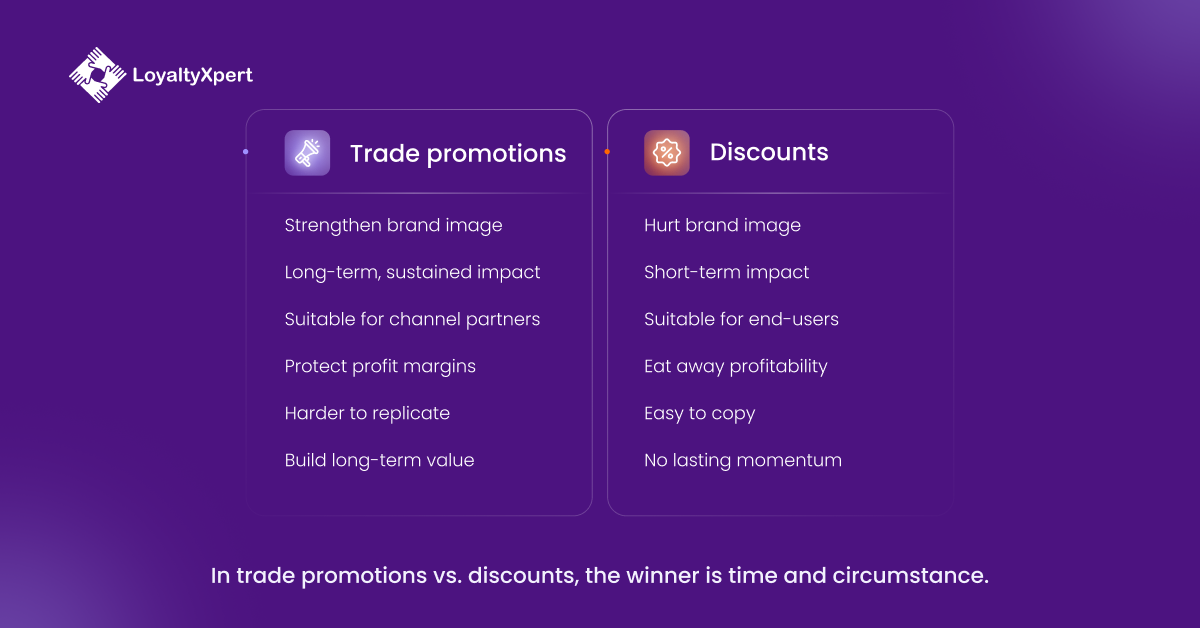
As we have already discussed above, trade promotions and discounts have their unique advantages and disadvantages. In the contest of trade promotions vs discounts, here are some key differences to know.
1. Impact on brand
Discounts: While they generate quick interest, discounts can harm brand perception over time. Customers begin to associate the brand with “cheap deals” instead of quality or uniqueness. This erodes value.
Trade promotions: Instead of lowering the price, trade promotions add value for distributors, retailers, and even the end customer. They position the manufacturer as a partner that supports growth, rather than one that constantly cuts prices. Over time, this strengthens the brand’s reputation in the marketplace.
2. Timeframe
Discounts: Their effect is immediate but short-lived. Once the promotional period ends, sales often drop back to normal levels. Sometimes, even lower because buyers wait for the next discount.
Trade promotions: These are designed for sustained impact. Whether it’s a loyalty program for distributors or shelf-space investments, the benefits build over weeks or months. They create a foundation for repeat business and long-term sales momentum.
3. Target audience
Discounts: These are primarily focused on the end customer. The idea is simply to lower the price, attract more buyers. But this ignores the vital role of distributors and retailers in selling the products.
Trade promotions: Focused on the intermediaries (such as distributors, wholesalers, and retailers). By incentivizing them with rewards, rebates, or exclusive schemes, manufacturers secure better relationships and ensure their products are actively promoted to consumers.
4. Sustainability
Discounts: Easy to implement but dangerous to sustain. The more discounts a manufacturer offers, the less effective they become. Competitors can quickly copy them, leading to a “race to the bottom” where no brand truly wins.
Trade promotions: More versatile and repeatable. A manufacturer can design new campaigns, rotate incentives, or adjust mechanics without harming price perception. Because they don’t rely on cutting the product’s sticker price, trade promotions are inherently more sustainable over the long term.
5. Profit Margins
Discounts: These directly affect profitability. A 10% discount may look small. But across thousands of units, it eats away the profit margins. Worse, once customers get used to lower prices, raising them back feels like punishment.
Trade promotions: Instead of cutting prices, promotions encourage higher volumes and stronger sell-through. Margins stay intact, and the incremental lift comes from increased orders.
6. Customer behavior
Discounts: They condition shoppers to wait. Customers who see frequent discounts begin to delay purchases, expecting the “next sale.” This creates inconsistent demand.
Trade promotions: By incentivizing retailers and distributors, manufacturers drive consistent shelf presence. This leads to more stable sales patterns and repeat consumer purchases driven by better visibility.
7. Competitive edge
Discounts: These are easy to copy. The moment a manufacturer slashes prices, competitors can match or undercut. What looked like a win turns into a zero-sum race to the bottom.
Trade promotions: These are harder to replicate. Retailer partnerships, loyalty rewards, and exclusive visibility deals create barriers that competitors can’t break overnight.
8. Long-term value creation
Discounts: These are quick to spur demand but they leave little behind. Once the campaign ends, so does the momentum. The brand equity takes a hit after that.
Trade promotions: They build ecosystems. Over time, they foster loyal distributors, stronger retailer partnerships, and a brand that commands respect.
When Manufacturers Should Use Trade Promotions?
We have already discussed some of the basic differences between trade promotions and discounts. Now, let’s discuss the key instances when manufacturers should use trade promotions to derive the maximum benefits. Here are some scenarios in which best trade promotion tactics work like magic.
1. When launching a new product line
When manufacturers come up with a new product line, they may have to face a little (or a lot of) hesitation from intermediaries due to the risk involved. It’s a bet, after all. If the product line clicks, it will be a roaring success. If it doesn’t, then it would phase out from the market. This is where manufacturers can offer trade promotions to motivate channel partners to stock, display, and sell the new products to end customers.
2. While entering a new market or region
Well, this is the extension of the first point. Just as manufacturers launching new products are better off using trade promotions, the same goes for those entering new markets and regions. When manufacturers foray into a new territory, trade promotions can help them lure channel partners, secure shelf space, and grab eyeballs faster than discounts ever could.
3. To boost the sales of slow-moving products
Not all slow-moving products carry a negative connotation. Some are slow-moving by default, while some are by design. Sometimes, the more premium a product is compared to its counterparts, the more slow-moving it is. Slashing prices and offering discounts will only dilute its brand value. But trade promotions will enhance its sales.
4. To achieve more prominent and premium placement
“What trade promotions have got to do with the way a manufacturer’s product(s) get placed by channel partners?” The question may come to your mind. The answer is, “a lot.” Even though discounted products may look very attractive to the eyes, it can be repelling on a psychological level. It may raise a lot of questions on quality and other aspects. But trade promotions, on the contrary, commands a premium tag and enjoys a prominent placement.
5. To strengthen channel loyalty
We have already discussed this in the beginning and we will talk about it in detail now. Trade promotions are great to strengthen channel loyalty. That’s because the different aspects of trade promotions keep partners engaged and committed to a brand.
When Manufacturers Should Use Discounts?
Now that we have already discussed when manufacturers should use trade promotions, let’s now discuss when they should use discounts. Here are some instances where discounts can prove to be both tactical and strategic measures.
1. To clear excess or obsolete inventory
Before manufacturers must introduce their new stock to the market, they must clear the excess and older ones. Discounts are the easiest and fastest way to clear the stock that’s nearing expiry, outdated, or clogging warehouses.
No CTA found.
2. To clear seasonal stock
A lot of manufacturers make certain products for specific occasions or seasons. Think of an apparel brand launching its range of summer collections. A toy maker trying to clear its holiday-specific stock as quick as possible. Likewise, there are a lot of examples. When manufacturers face difficulties, discounts can help them in clearing the stock before it’s too late.
3. For introductory trial of new products
If we take a walk down the memory lane, a handful of our favorite daily-use products carried a massive discount when they were newly introduced in the market. Can you remember? Indeed, discounts can be extremely effective to drive trials for new products in highly competitive categories.
4. Stimulating sales in off-seasons and low-demand periods
Many sectors witness off-seasons or slow months during specific times of the year. During those times, discounts can generate a temporary lift and keep sales flowing. However, a word of caution though, the discounts in the lean period shouldn’t be so low that it eats up the profit margins.
5. Countering competitor pricing attacks
We have already discussed how discounts could be a zero-sum race to the bottom. But it could be the only recourse in a time when all or a majority of competitors resort to aggressive price cuts. In such cases, controlled discounts can help manufacturers in defending market share without losing loyal buyers.
Final Thoughts,
In the battle of trade promotions vs. discounts, the real winner is time and circumstance. Trade promotion strategies are best in certain instances. Discount strategies for manufacturers are suitable in specific situations.
The onus lies on manufacturers to know which strategy to use, when to use, how to use either in different circumstances.
This blog post elucidates when and how manufacturers can use trade promotions and discounts both strategically and tactically.
At LoyaltyXpert, we have helped many manufacturers strike the right balance between trade promotions and discounts through our sophisticated loyalty software.
If you are curious to know more about how choosing the right loyalty platform can help contact us today and book a free demo.