 Max 10min read
Let’s imagine a hypothetical scenario. You want to play a high-stake game. A game where you need to make an upfront payment of a few hundred dollars. Or maybe a few thousand dollars.
However, as you set out to play, you get to know that the odds of losing are much higher than the odds of winning. What would you do in such a situation? You must find out ways to minimize the risks and optimize for success, right?
Now, let’s take a real-world scenario. You are a manufacturer or a B2B company. You want to run a loyalty program. And you learn this. The probability of failure is much higher than the probability of success.
Did You Know?
More than three-quarters of loyalty programs are likely to fail within the first two years due to poor strategy, lack of engagement, and weak value propositions.
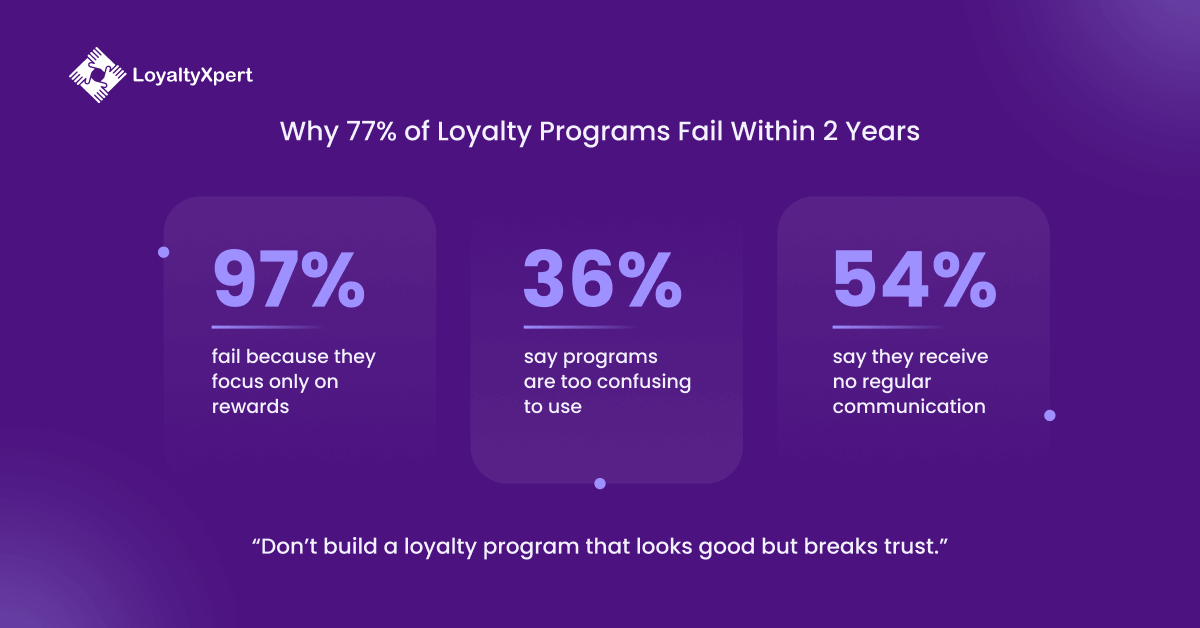
That’s right. As per a study, 77% of point-based loyalty programs fail in the first two years.
However, that’s not all. Another study found that 97% of loyalty programs fail because they focus on transactional rewards
In this blog post, we will discuss why loyalty programs fail as well as seven loyalty rewards program tips using which businesses can make their loyalty programs successful.
Reasons Loyalty Programs Fail
In today’s time, starting a loyalty program is effortless. But making it successful is extremely difficult. A majority of loyalty programs fail for a number of reasons such as:
1. Not Leveraging the Right Technology
When businesses don’t leverage the right technology such as a dedicated loyalty program software or a dedicated loyalty app, then the chances of loyalty program failure increases. In the present age, technology is not optional but a must-have for successful loyalty programs. Choosing the right technology stack for B2C and B2B loyalty program strategies can mean the difference between success and failure.
2. Lack of Clear Objectives and Value Proposition
Now, even as manufacturers and B2B companies manage to handpick the best technology tools for their loyalty programs, the lack of clear objectives won’t allow the loyalty programs to succeed. That’s why starting with clear objectives is indispensable. At the same time, organizations should also think about “how to improve loyalty programs?” As Simon Sinek, the author of Start With Why, said, “a why without how has little probability of success.”
3. Overly Complicated Structure
Did you know that many customers find loyalty programs too complicated? Yes, that’s right. According to recent data, 36 percent of customers don’t understand how to earn or redeem rewards. Also, 54 percent of the respondents don’t receive regular communication. Whether it’s B2C or B2B loyalty program strategies, if the structure is complicated then the loyalty programs can never be successful.
4. Poor Customer Engagement
When customers interact and transact with a business, they want to feel that they are heard and acknowledged. Whether it’s a loyalty program or customer service, effective engagement is critical for success for any customer-facing activity. As per a stat, 68 percent of customers expect loyalty programs to focus on building relationships rather than just transactional rewards. However, many businesses fail to ensure effective customer engagement. And that causes loyalty programs to fail.
5. Failure to Differentiate from Competitors
Can you take a guess how many businesses run loyalty programs? As per several studies, nine out of every ten businesses run loyalty programs. But many of them fail because they fail to differentiate from competitors. Standing out from competitors isn’t just an option. It’s a necessity for today’s businesses intending to increase customer retention.
6. Inconsistent Program Execution
Many manufacturers and B2B companies succeed in formulating channel partner and B2B loyalty program strategies. But when it comes to executing them, they falter. As Jeff Haden, a popular columnist and editor at Inc. Magazine, said, “strategy is important but execution is everything.”
7. Neglecting Data and Personalization
When crafting loyalty programs, contemporary businesses and manufacturers should tailor the programs for their channel partners. That’s where data, mainly zero-party and first-party data, is extremely useful. As per a stat, 78 percent of businesses consider first-party data is extremely valuable for personalization.
Effective Ways to Ensure Success of Loyalty Programs
Now that we have discussed the reasons loyalty programs fail, let’s discuss some effective loyalty rewards program tips using which businesses can ensure the success of their loyalty programs.
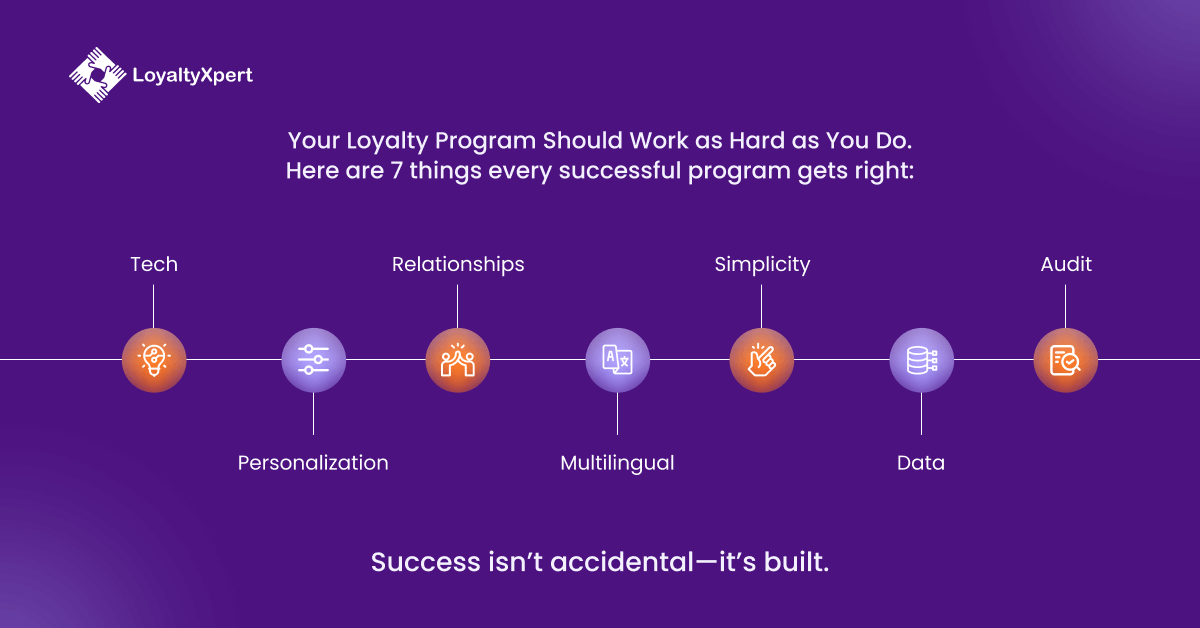
1. Handpick the Right Technology Tool
In the digital age, the sure-shot way to remain competitive is by leveraging sophisticated technology. Manufacturers and businesses can streamline their loyalty programs by selecting the right digital loyalty app and software that can help them design tailored rewards programs for customers and channel partners. While shortlisting loyalty program software, look for some key features such as:
- Multi-tier loyalty program support
- Real-time analytics and reporting
- Customer Relationship Management (CRM) integration
- Multi-language and mobile-friendly interface
- Application Programming Interface (API) access
2. Personalize Loyalty Programs
Can any loyalty program be successful without personalization? Think of a brand that enjoys diehard loyalty from its customers. What comes to your mind? That’s right, Apple. The brand’s focus on personalization is a great example of how it can be instrumental in making meaningful connections with customers. Personalization is the future. At LoyaltyXpert, we focus on personalization. The customization capabilities of our loyalty software can tailor experiences based on role, region, even language.
3. Strengthen Relationship with Channel Partners and Buyers
A loyalty program can never be successful until and unless the business running it has strong relationships with its buyers and channel partners. Relationships are the foundation of business success. So, before worrying about the success of loyalty programs, businesses should strengthen relationships with channel partners and buyers. A great company should focus on strengthening relationships with buyers and channel partners. It also should invest quality time and resources on dealer and distributor engagement.
4. Go Multi-lingual for Diverse User Base
Manufacturers in certain industries such as ceramics, electrical, paint, plywood, and plumbing aren’t confined to just one location. They have presence in different states as well as countries. That’s the reason they must consider providing multi-lingual support for a diverse user base such as electricians, painters, carpenters, and plumbers. Loyalty software providers, such as LoyaltyXpert, design sophisticated solutions that can provide multi-lingual support for a diverse user base.
5. Keep Loyalty Programs Simple and User-friendly
Successful loyalty programs are remarkably simple and user-friendly. They use clear language and they don’t try to be clever. They avoid conditions that feel like traps. If you intend to increase customer retention and ensure that your loyalty programs are successful, you must keep them as simple as possible and try to reduce friction. Evaluate your loyalty program once every three months and, if possible, refresh once a year. This would help you stay aligned with evolving customer expectations, market trends, and technological advancements.
6. Use Buyers’ Data to Make Informed Decisions
Manufacturers and B2B brands must leverage all the relevant data that’s available at their disposal. Sophisticated loyalty software solutions come equipped with real-time analytics and reporting tools, which can help businesses to get all relevant information. That would help them fix what isn’t working. That would also enable them to test a new reward, view the real-time performance, and change it if it doesn’t work.
7. Audit What’s Working and Get Rid of What’s Not
Regular audits are indispensable for successful loyalty programs. Identify what’s working and driving engagement and what’s not. Improve on the aspects that work well and get rid of those that don’t. That would not only save a lot of time but also eliminate a lot of unnecessary expenses. Businesses must ensure loyalty program best practices by focusing on relevance.
Metrics to Track and Measure Loyalty Program Success
Now that you have the strategies to make your loyalty programs successful, you can use some key metrics to track and measure how your loyalty programs are performing in real-world conditions. Here are some of the most essential metrics to monitor:
1. Enrollment Rate
This refers to the percentage of users who join the loyalty program. It can be calculated by dividing the number of users who have enrolled in the loyalty program by the total number of eligible users multiplied by 100.
No CTA found.
Enrollment Rate = (Number of Enrolled Users ÷ Number of Eligible Users) × 100
2. Engagement Rate
This refers to the percentage of members that participate and engage with the program by logging in, earning points, redeeming rewards, or participating in promotions. It can be calculated by dividing the number of active members by the total number of enrolled members, then multiplying by 100 to express it as a percentage.
Engagement Rate = (Number of Active Members ÷ Total Enrolled Members) × 100
3. Reward Redemption Rate
This measures the proportion of accumulated points or credits that are actually used. It is calculated by dividing the number of points (or rewards) redeemed by the total number of points (or rewards) earned, then multiplying by 100 to express it as a percentage.
Reward Redemption Rate = (Points Redeemed ÷ Points Earned) × 100
4. Retention Rate
This measures the number of loyalty program members that stay active in the program over time. It’s calculated by dividing the number of active members at the end of a period by the number of active members at the start of the period (excluding new joiners), then multiplying by 100 to get a percentage.
Retention Rate = (Members Retained ÷ Members at Start of Period) × 100
5. Cost-to-Reward Efficiency
This measures how efficiently a loyalty program converts its operating costs into valuable outcomes like customer retention, increased spend, or stronger engagement. It helps determine whether the program’s benefits justify its expenses. It is calculated by dividing the total cost of running the loyalty program by the total value generated (e.g., increased revenue, customer lifetime value, or cost savings), often expressed as a ratio.
Cost-to-Reward Efficiency = Total Program Cost ÷ Total Value Delivered
6. Point Issuance Ratio
This refers to the rate at which loyalty points are distributed relative to customer spending or desired actions. It’s calculated by dividing the number of points distributed by the value of purchase or action. It sets the foundation for how valuable and motivating your loyalty program will feel.
Point Issuance Ratio = Number of Points Given ÷ Value of Purchase or Action
7. Customer Lifetime Value
This is the total net profit a business can expect to earn from a customer over the entire duration of their relationship. It’s calculated by multiplying the average purchase value with the purchase frequency with the customer lifespan.
CLV = Average Purchase Value × Purchase Frequency × Customer Lifespan
Taking Everything Into Consideration,
A loyalty program won’t succeed just because a business invests a lot of money on it. It would succeed when it’s useful, clear, and simple.
In today’s time, it’s extremely easy to start a loyalty program. But it’s very difficult to make it effective and successful. There’s a whole lot of art and science behind that.
And that’s where the expertise of a reliable and reputable loyalty solutions provider makes all the difference. Manufacturers and B2B brands must make sure that they handpick the right loyalty program solutions provider such as LoyaltyXpert.
At LoyaltyXpert, we have helped many businesses turnaround their loyalty programs with our innovative and cutting-edge solutions.
If you are curious to know more about our solutions, then contact our team of experts and book a free demo.