
 Max 9min read
Most manufacturers sell through layers, not to a single audience. Distributors sell to dealers. Dealers sell to retailers, contractors, and electricians. Every layer shapes volume, yet a standard loyalty program gives each partner one undifferentiated balance.
That design leaves three gaps. The company funds downstream rewards centrally, not the partner who owns the relationship. Nobody can trace who rewarded whom. Finance then chases TDS records at year-end.
A dual wallet loyalty program closes these gaps at the architecture level. It separates what a partner earns for themselves from what they hold for their network. Below, we explain how a dual-wallet loyalty system works, where loyalty points and cash fit, and what tax demands it creates.
What Is a Dual Wallet Loyalty System?
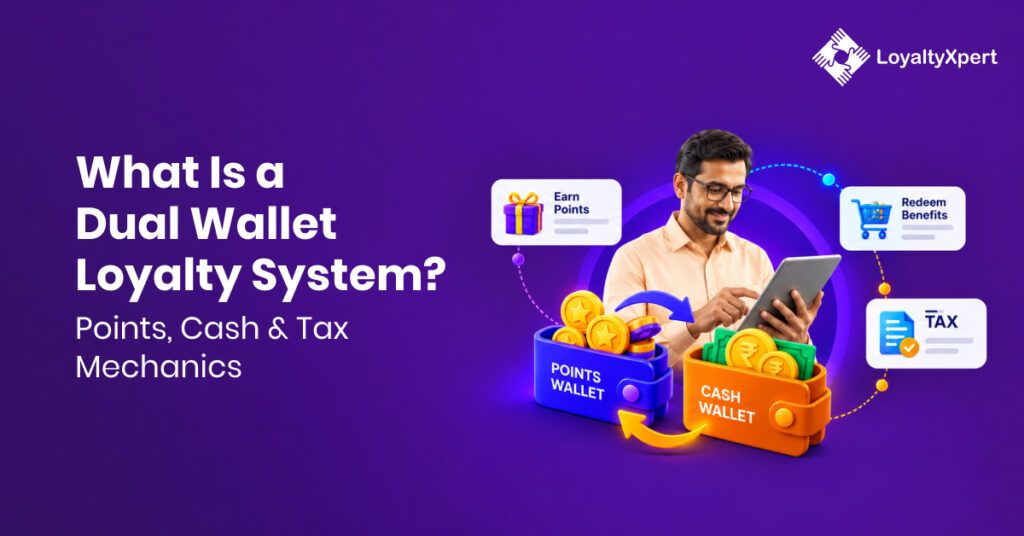
A dual wallet loyalty system is a channel reward architecture that gives each partner two separate balances. The Primary Wallet holds points the partner earns and redeems for themselves. The Secondary Wallet holds allocation points the partner cannot redeem, but passes to dealers, retailers, or influencers below them.
Single Wallet vs. Dual Wallet: 4 Structural Differences
| Question | Single-Wallet Program | Dual Wallet Loyalty System |
|---|---|---|
| Who funds dealer rewards? | The brand, centrally | The distributor’s Secondary Wallet, within brand-set limits |
| Can partners redeem every point? | Yes | Only Primary Wallet points |
| Can you trace the reward path? | Rarely beyond the first tier | Yes, from brand to final recipient |
| When is the budget controlled? | After spend, in reconciliation | Before a single point moves |
End-user groups, such as painters, never receive a Secondary Wallet. Admins mark them when they configure the Dual Wallet, which keeps the hierarchy intact.
Give distributors a reward pool they control. Keep every limit yours.
How Does a Dual Wallet Loyalty Program Work Step by Step?
A dual wallet loyalty program works through a fixed sequence of crediting, allocation, approval, and redemption. The brand credits both wallets through product or invoice rules. Distributors approve downstream purchases, which moves points from their Secondary Wallet to the buyer. Partners then redeem Primary Wallet balances for cash, vouchers, or merchandise.
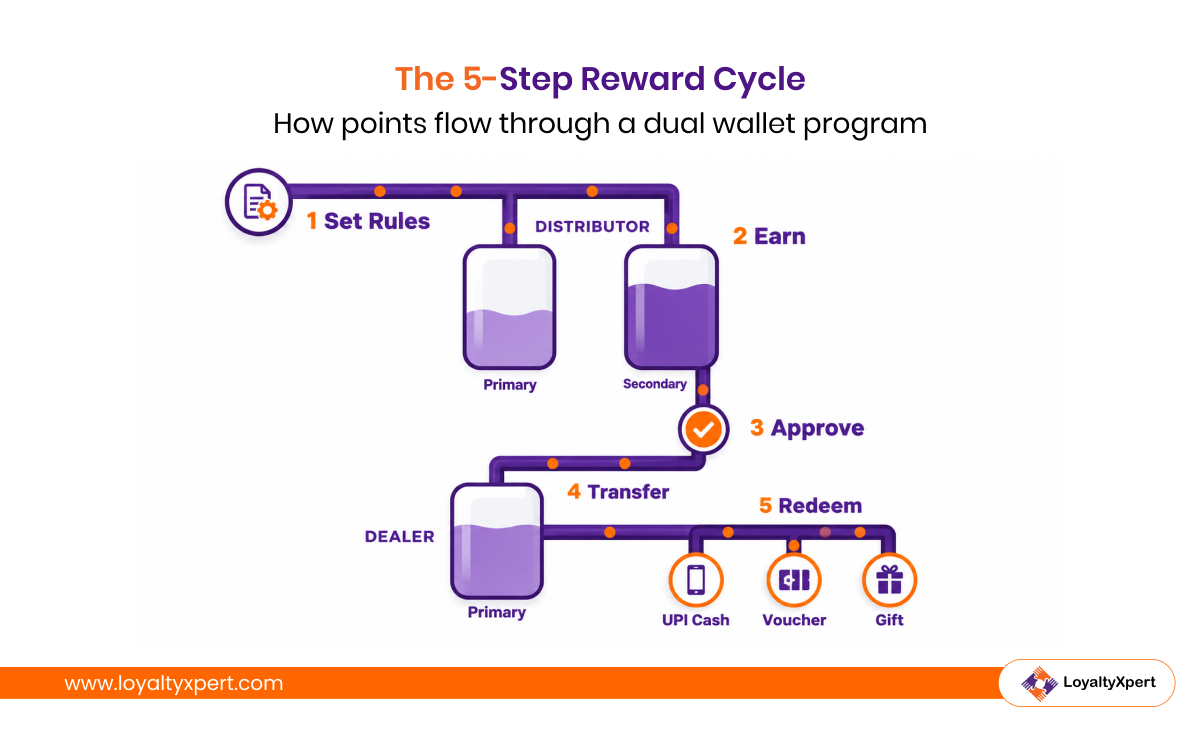
The 5-Step Reward Cycle
- The brand sets earning rules, with separate Primary and Secondary Wallet values by partner group, SKU, and region.
- Partners earn through verified invoices or by scanning a product QR code that works only once.
- A dealer submits a purchase, and the distributor approves it in the partner app.
- The system debits the distributor’s Secondary Wallet and credits the dealer’s Primary Wallet.
- Partners redeem Primary Wallet points as UPI cash, vouchers, or catalogue products through a loyalty points redemption module.
Invoice rules also include start and end dates, so quarter-end schemes lapse automatically. In a dual wallet loyalty system, campaigns become rule changes, not spreadsheet exercises.
What Is the Difference Between Loyalty Points and Cash Rewards?
Loyalty points and cash are two reward currencies with different cost and control profiles. Points are a deferred liability the brand governs through conversion value, expiry, and catalogue. Cash, usually paid through UPI or bank transfer, is an immediate expense partners understand instantly. A dual wallet loyalty program with points and cash uses each where it fits.
| Factor | Loyalty Points | Cash Rewards |
|---|---|---|
| Cost recognition | Liability until redemption or expiry | Expense at payout |
| Brand control | High: value, expiry, catalogue | Low once paid out |
| Tax event | Usually at redemption | At credit or payment |
| Best fit | Tier progress, long-cycle targets | Contractors, electricians, fast retail schemes |
The comparison between loyalty points and cash comes down to control versus immediacy. A distributor with a large order book responds well to points tied to tier-based loyalty status. A carpenter often prefers a UPI credit they can spend the same day.
See Dual Wallet mapped to your own distributor and dealer network.
Since points convert to cash at a brand-set rate, one Primary Wallet serves both. That is why a dual wallet loyalty program with points and cash rarely needs separate schemes per tier. Automated expiry rules also clear stale liability without write-offs.
How Do Dual Wallet Rewards Flow Through Multi-Tier Distribution?
Dual wallet rewards flow downward through the same hierarchy that moves product. The brand credits a distributor, the distributor allocates to dealers, and dealers pass rewards to retailers or influencers. Each tier keeps its own Primary Wallet earnings, while Secondary Wallet allocations stay ring-fenced for the next tier down.
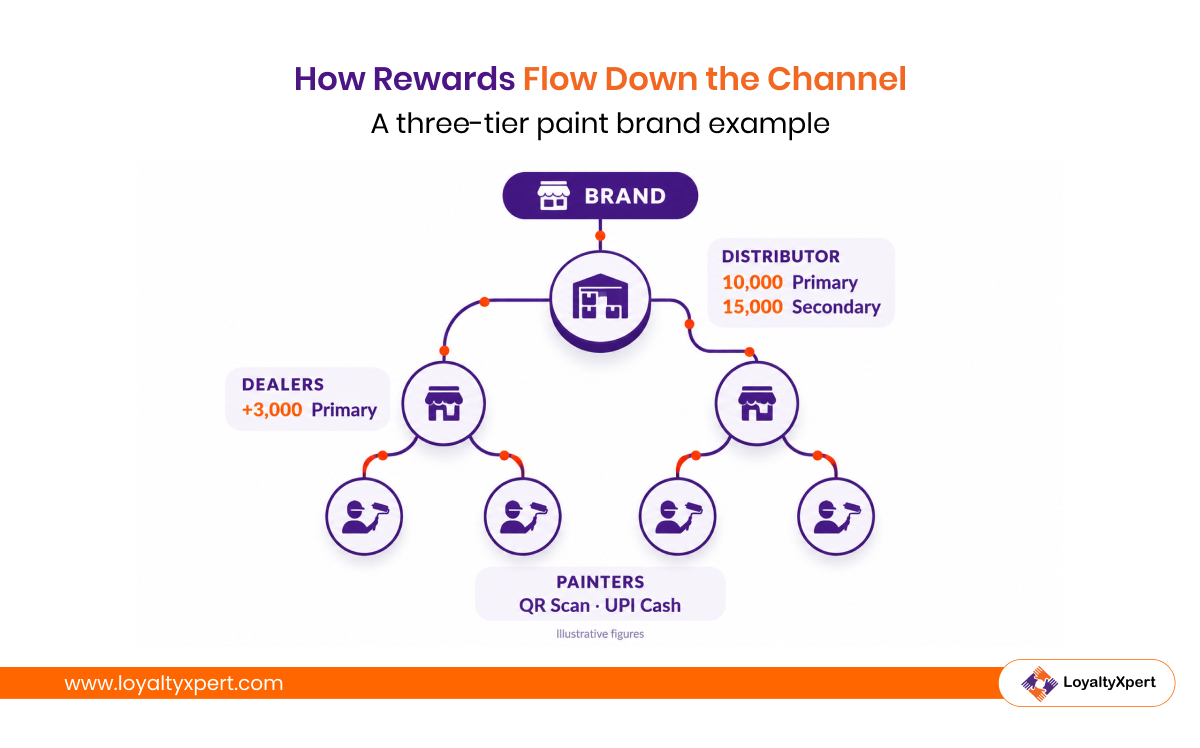
A Worked Example From a Paint Brand
Take a paint manufacturer running a three-tier channel loyalty program. The figures below are illustrative, not benchmarks.
The brand credits a distributor 10 Primary and 15 Secondary points per ₹1,000 of stock. A ₹10 lakh purchase adds 10,000 points to the redeemable balance and 15,000 points to fund dealers.
A dealer then buys ₹2 lakh of stock from that distributor. On approval, 3,000 points move from the distributor’s Secondary Wallet to the dealer’s Primary Wallet, leaving 12,000 to allocate.
Painters at the bottom tier scan QR codes on each can and cash out through UPI.
What Changes for the Brand
Distributors start treating dual wallet rewards as a sales tool, not a perk. Every approval also records which dealer bought, from whom, and when. That surfaces secondary sales the brand never invoices directly.
How Does Dual Wallet Loyalty Software Track Every Transaction?
Dual wallet loyalty software tracks transactions by recording every credit, debit, transfer, and redemption against a specific wallet, partner, and trigger. Each entry links to the invoice or QR scan behind it. Admins see balances in real time, while partners see their own two wallets inside a mobile app.
A dual wallet loyalty system only works if three audiences trust the same numbers. This is where dual wallet loyalty software earns its cost.
The Partner App
Distributors, dealers, and retailers see both balances, pending approvals, and redemption status in one app. They can trace dual wallet rewards back to the purchase that earned them. That alone cuts most “where are my points” calls.
The Admin Console
Channel managers credit or debit either wallet, run bulk uploads, and edit rules in a SaaS console. Every manual adjustment carries a transaction ID and timestamp.
The Reporting Layer
Loyalty reports split activity by wallet, partner, and status. Failed transaction reports, monthly partner ledgers, and distributor-wise allocation reports give finance a reconcilable trail. Every movement of loyalty points and cash payouts sits in one auditable ledger.
Every dealer approval can give you secondary sales data you’ve never had.
Because every Secondary Wallet debit needs an approver, partners cannot quietly redeem points meant for their network. That closes a common loyalty fraud gap.
How Does TDS Apply to Dual Wallet Rewards in India?
TDS on dual wallet rewards falls under Section 194R, which moved to Section 393 of the Income-tax Act, 2025, effective April 1, 2026. Brands deduct 10% on business benefits to a resident partner once that partner’s yearly total crosses ₹20,000. The rule covers cash incentives, vouchers, gifts, and trips.
Every redemption in a dual wallet loyalty program with points and cash therefore needs a tax check. Under CBDT Circular 12/2022, common reward types behave differently.
| Reward Type | When TDS Applies | How Brands Usually Handle It |
|---|---|---|
| UPI or bank cash payout | At credit or payment | Deduct 10% and pay the net amount |
| Gift voucher or catalogue product | Before handover | Collect TDS from the partner, or bear it and gross up |
| Invoice discount or rebate | Usually at redemption | At credit or payment |
4 Tax Mechanics Finance Teams Should Map Early
- The ₹20,000 threshold is cumulative per partner per year. Once crossed, TDS applies to the entire value, not just the excess.
- Partners without a valid PAN face a higher 20% rate, so capture PAN during onboarding.
- In a dual wallet loyalty system, the holder cannot redeem Secondary Wallet points. Many finance teams treat them as allocations, not benefits. Confirm this with your tax advisor.
- Skipping TDS can trigger a 30% disallowance of the expense, plus interest and penalties.
Quarterly returns now run on Form 140. The cleanest setup collects PAN at onboarding and automatically deducts TDS on each qualifying payout, so every partner keeps an audit-ready record.
Why Do B2B Brands Choose a Dual Wallet Loyalty Program?
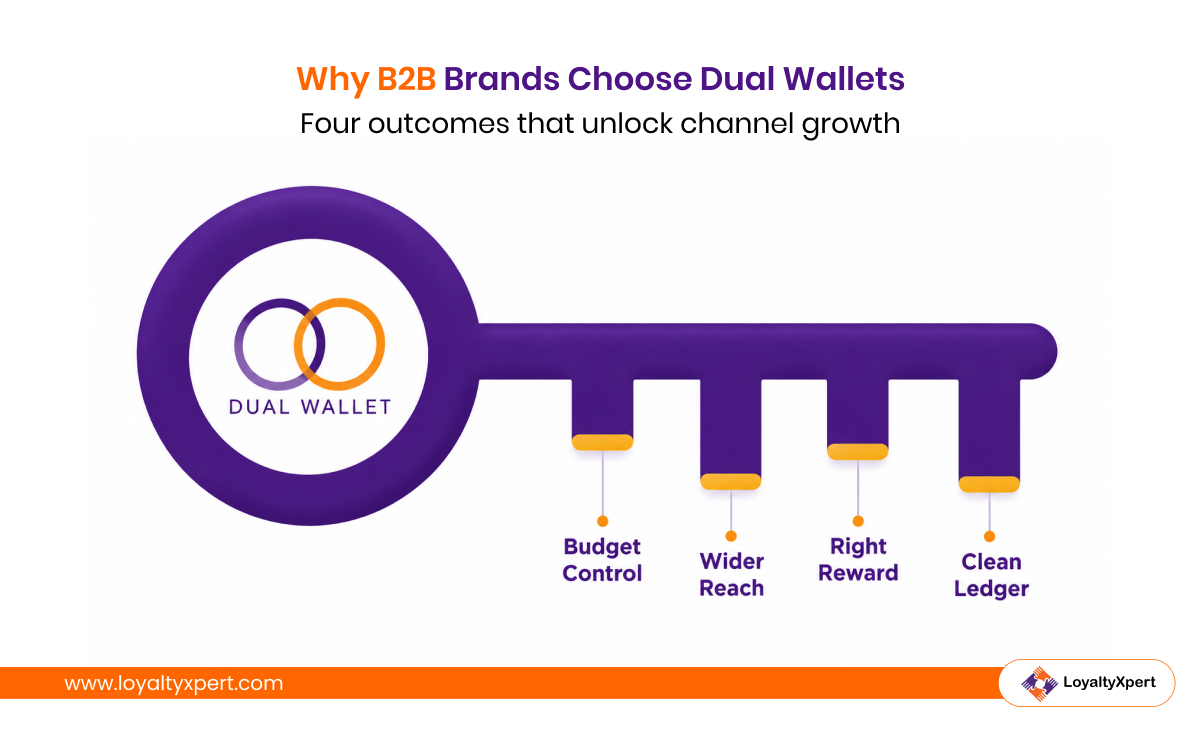
B2B brands choose a dual wallet loyalty program to reward every channel tier without losing budget control. The structure turns distributors into reward managers and traces every point. Finance also gets clean data for TDS and liability reporting.
Mordor Intelligence (2026) projects B2B loyalty platforms to grow at a 17.52% CAGR through 2031. That makes B2B the fastest-growing solution segment.
Budget Control Before Points Move
A dual wallet loyalty system lets brands cap Secondary Wallet allocations by distributor, product, or region. Spend stays inside the plan.
Reach Beyond the First Tier
Retailers, contractors, and influencers the brand never invoices now earn through the network. No separate influencer loyalty program is needed for each trade.
Right Reward, Right Tier
A dual-wallet loyalty program with points and cash lets each tier redeem in the form that works for it. Distributors chase tier status, while electricians take UPI credit.
Cleaner Financial Reporting
Dual wallet loyalty software consolidates liability, breakage, and TDS into one dated ledger instead of spreadsheets.
How to Choose Dual Wallet Loyalty Software for Your Channel?
Choosing dual wallet loyalty software starts with your channel map, not a feature list. The right platform mirrors your hierarchy, sets wallet rules without code, supports both loyalty points and cash payouts, automates TDS, and gives partners a simple mobile app in their own language.
| Capability | Question to Ask the Vendor |
|---|---|
| Hierarchy mapping | Can approver groups mirror our distributor, dealer, and retailer tiers? |
| Allocation limits | Can we cap how much each distributor passes downstream? |
| Payout range | Does the dual-wallet loyalty program, with points and cash, support UPI, vouchers, and catalog gifts? |
| Compliance | Does it track each partner’s yearly threshold and deduct TDS automatically? |
| Partner adoption | Is the app multilingual and simple enough for retailers? |
| Integrations | Does it sync with our ERP or dealer management system? |
Good dual wallet loyalty software should pass a live test. Ask the vendor to run one invoice through your hierarchy, from approval to redemption, with TDS applied. How it handles dual wallet rewards there tells you more than any feature grid.
Is a Dual Wallet Loyalty System Right for Your Business?
A dual wallet loyalty system fits any manufacturer that sells through two or more tiers. It funds downstream rewards, traces every point, and keeps tax compliance inside the platform.
If your partners split between loyalty points and cash, and finance needs a clean TDS trail, the architecture pays for itself. LoyaltyXpert brings both wallets, eKYC, TDS automation, and a partner app into one loyalty program software platform.
- Book a Demo — See both wallets and TDS reports on your own channel structure.
- Contact Us — Map your distributor and dealer hierarchy with our team.
- Reward Program Software — See how points, cash, and catalogue rewards work together.
- Explore LoyaltyXpert — Tour the full channel loyalty platform.