 Max 10min read
📝Summary
Most channel programs fail during execution, not design. This guide walks manufacturers through loyalty program implementation end-to-end. You will learn how to set a commercial goal, select the right partner tiers, design reward behaviors, model point economics, run a pilot, and measure results after launch. Practical, sequenced, and built for Indian channel realities.
Manufacturers rarely struggle with the idea of a channel program. They struggle with loyalty program implementation. The concept gets approved in a boardroom. Then it stalls somewhere between IT, sales, and finance. Dealers enroll slowly. Points get disputed. Redemptions pile up as an unbudgeted liability. The program quietly dies in month seven.
This guide fixes that sequence. It treats a channel program as an operational rollout, not a marketing campaign. Every stage below has a decision, an owner, and a way to check whether you are ready for the next one. If you are still comparing platforms, LoyaltyXpert’s loyalty program software is built specifically for this kind of multi-tier channel rollout.
What Is Loyalty Program Implementation for Manufacturers?
Loyalty program implementation is the structured process a manufacturer follows to turn a channel loyalty concept into a working program. It covers goal setting, partner selection, behavior design, reward economics, platform configuration, onboarding, pilot testing, launch, and measurement. Implementation decides whether dealers participate. Reward value alone rarely does.
The market context is worth noting. Mordor Intelligence values the global loyalty management market at USD 16.44 billion in 2026, growing to USD 32.52 billion by 2031 at a 14.62% CAGR. Adoption is not the differentiator anymore. Execution is.
Here is what separates the two approaches.
| Dimension | Program That Stalls | Program That Scales |
|---|---|---|
| Starting Point | Reward catalogue | Commercial goal |
| Partner Scope | Everyone, day one | Segmented tiers |
| Earning Logic | Purchase value only | Multiple behaviours |
| Onboarding | Paper forms, branch visits | Mobile, digital KYC |
| Budget Model | Points issued | Points redeemed |
| Review Cadence | Annual | Monthly, first quarter |
Why Should Manufacturers Start With Business Goals, Not Rewards?
Business goals shape every later decision in loyalty program planning. A manufacturer chasing secondary sales visibility builds a very different program from one fighting dealer churn. Define the commercial outcome first. Then work backward into behaviors, point values, and reward tiers. Clear goals prevent expensive redesigns after go-live.
Most manufacturing programs serve one of four goals. Pick one as primary.
- Secondary Sales Visibility — You need to see what moves past the distributor, not just what you dispatch.
- Partner Retention — Your dealer churn is high, and competitors are buying loyalty with discounts.
- Range Expansion — Partners buy two SKUs from a catalog of forty.
- Brand Preference at the Influencer Level — Electricians, carpenters, and plumbers decide the specification on site.
A program built for all four does none of them well. Choose the primary goal, then let the other three ride as secondary outcomes. Manufacturers who already run a manufacturing loyalty program often rebuild it for exactly this reason; the original scheme was never anchored to a single commercial outcome.
How Do You Identify the Right Participants for a B2B Loyalty Program?
Participant selection determines the cost and the impact of a B2B loyalty program. Manufacturers should map every tier that influences a sale — distributors, dealers, retailers, and site-level influencers. Each tier behaves differently and responds to different incentives. Segment by revenue contribution, geography, product mix, and purchase frequency before assigning any reward value.
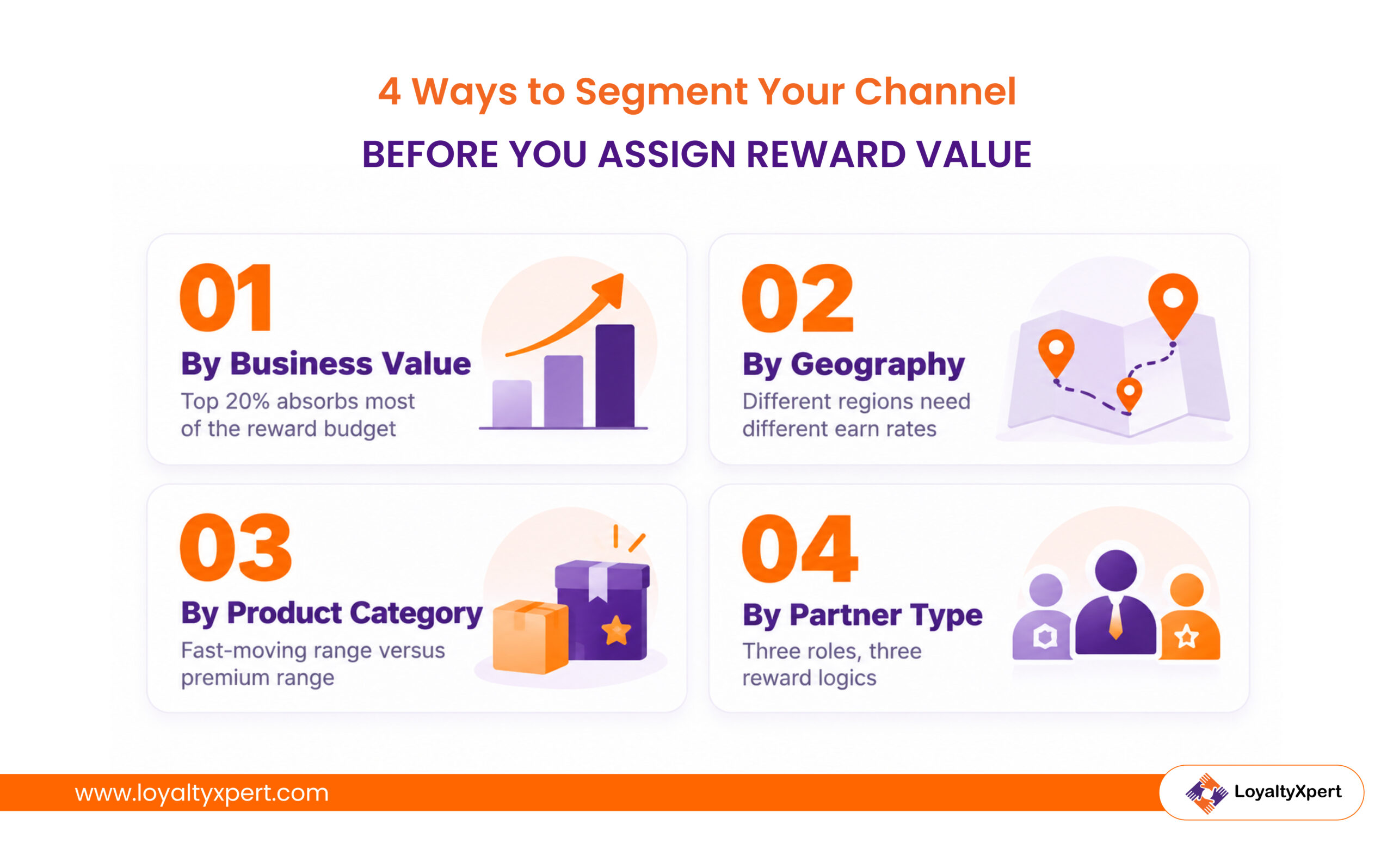
4 Ways to Segment Your Channel Before Launch
- By Business Value — Rank partners by annual contribution. Your top 20% will absorb most of the reward budget. Design for them deliberately, not accidentally.
- By Geography — A dealer in Coimbatore and one in Ludhiana need different languages, different redemption catalogs, and often different earn rates.
- By Product Category — A partner buying only fast-moving SKUs needs a different earning structure from one carrying your premium range.
- By Partner Type — A distributor manages inventory risk. A retailer manages shelf space. An influencer manages specification. Three roles, three reward logics.
Manufacturers running layered networks often pair this with a distributor management system so partner hierarchy and reward eligibility stay in sync.
Which Partner Behaviors Should a Distributor Loyalty Program Reward?
Behavior design turns a distributor loyalty program into a growth instrument. Purchase volume is the obvious trigger. Manufacturers should also reward range expansion, product registration, training completion, referrals, timely reporting, and campaign participation. Every rewarded behavior must map to a measurable commercial outcome. Otherwise, the points budget funds activity instead of growth.
| Rewarded Behavior | Business Outcome It Drives |
|---|---|
| Repeat purchase | Order frequency, predictable demand |
| Range expansion | Higher share of partner wallet |
| Product registration | Warranty data, end-user visibility |
| Training completion | Better specification at site level |
| Referrals | Low-cost network expansion |
| Timely sales reporting | Accurate secondary sales data |
| Campaign participation | Faster new-product adoption |
Weight these carefully. If range expansion is your goal, a new SKU should earn two or three times the points of a repeat SKU. Flat earning teaches partners nothing. A tier-based loyalty program structure lets you vary earning power by partner level without running separate schemes.
How Do You Build Reward Economics That Survive Full Participation?
Reward economics define how much margin a manufacturer returns per rupee of channel sales. Fix the point value, the earn rate, and the redemption cost before any partner enrolls. Model the worst case honestly: full enrollment, full participation, full redemption. A program that only works at low engagement is a broken program waiting to be discovered.
Work through these five numbers before approval:
- Point value in rupees. One point should have a single, fixed monetary meaning across the network.
- Earn rate as a percentage of invoice value. Most Indian manufacturing programs land between 0.5% and 2%.
- Expected redemption rate. Budget at 70–80%, not the 40% your first model will suggest.
- Breakage and expiry policy. Decide when unused points lapse, and communicate it before launch, not after.
- Cost of the reward catalog. UPI transfers, vouchers, and merchandise carry very different fulfillment margins.
Most B2B loyalty program budgets break in year two, not year one. Year one looks affordable because enrollment is partial and partners are still learning to redeem.
Manufacturers often underestimate point liability in year two. Automated loyalty expiry alerts keep that liability moving rather than accumulating on the balance sheet. Redemption mix matters too, and a flexible redemption catalog protects you from vendor concentration risk.
How Can Manufacturers Make Enrollment Simple for Channel Partners?
Enrollment friction ends programs faster than weak rewards do. Manufacturers should support mobile onboarding, regional language interfaces, and digital KYC verification. Partners need to join in minutes, not across three branch visits. Point earning should work through QR scans or invoice uploads. Every additional form field measurably reduces enrollment completion.
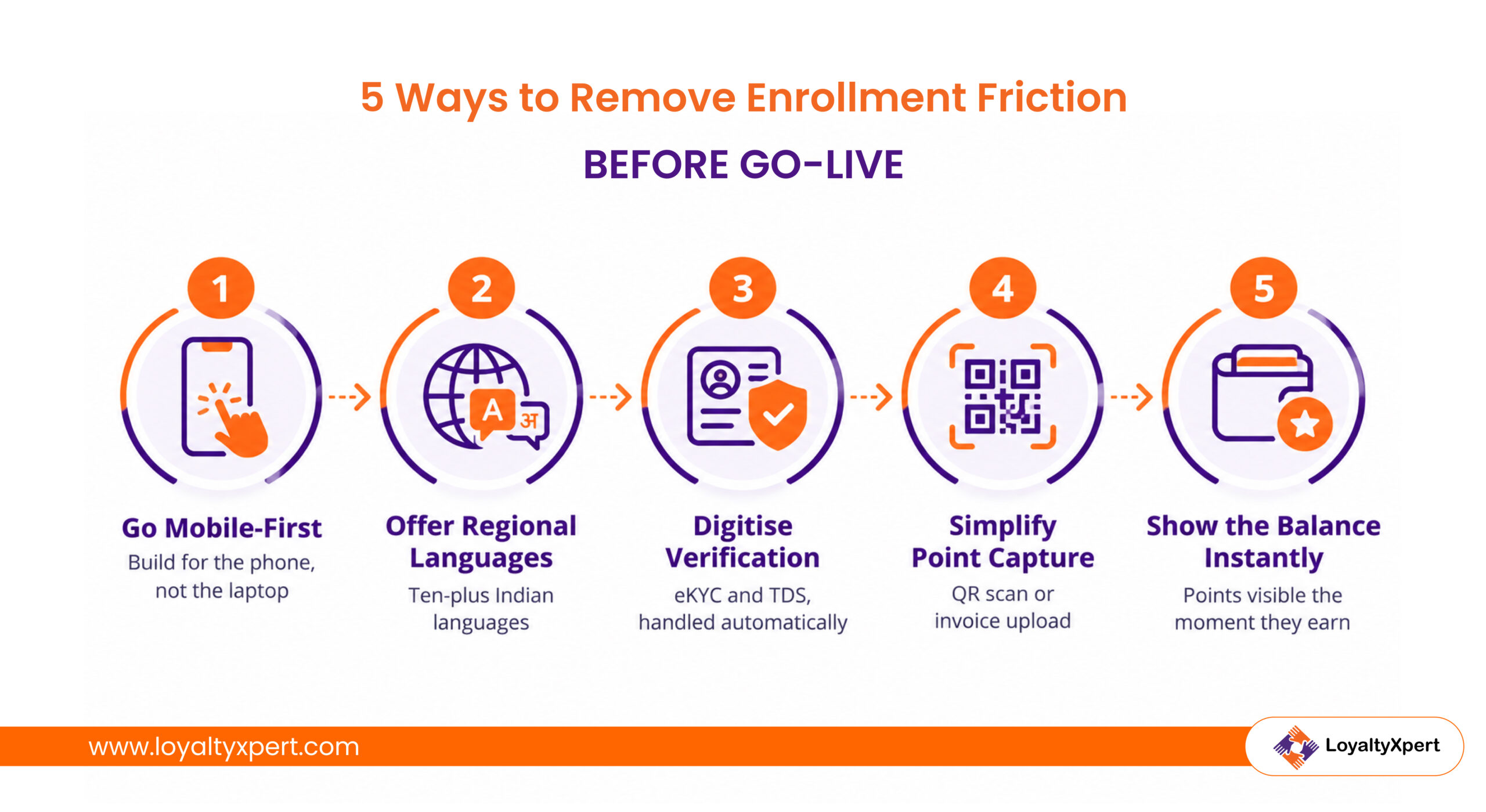
5 Ways to Remove Friction Before Go-Live
- Go Mobile-First — Your dealer’s accountant may use a laptop. Your carpenter has only a phone. Build for the phone.
- Offer Regional Languages — A multilingual loyalty platform supporting ten-plus Indian languages lifts enrollment in tier-two and tier-three markets sharply.
- Digitise Verification — eKYC and TDS management handle compliance automatically and keeps reward payouts audit-ready.
- Simplify Point Capture — QR code scanning suits packaged goods. Invoice upload suits bulk categories like pipes, plywood, and ceramics.
- Show the Balance Instantly — Partners who cannot see their points assume the program is not working.
What Does a Complete Loyalty Program Implementation Roadmap Look Like?
A loyalty program implementation roadmap runs through nine sequenced stages, from business goal to continuous optimization. Each stage carries an owner, a deliverable, and a decision gate. Manufacturers who skip stages usually pay later, through weak enrollment, disputed point claims, or reward liability nobody budgeted for.
- Define the Business Goal — One primary commercial outcome, stated as a number with a deadline.
- Map Partner Behavior — Document how each tier currently buys, reports, and influences specification.
- Design the Program Structure — Set tiers, earning rules, and qualification thresholds.
- Model the Reward Economics — Lock point value, earn rate, and redemption budget with finance.
- Configure the Platform — Integrate with your ERP or Tally, set up partner hierarchy, and load the catalog.
- Prepare Communication and Onboarding — Build training material, regional-language collateral, and a support escalation path.
- Run a Controlled Pilot — Two regions, mixed partner tiers, live rewards, six to eight weeks.
- Execute the Full Launch — Roll out region by region with field sales on the ground. A staged loyalty program launch contains problems locally instead of network-wide.
- Measure and Optimize — Review monthly for the first quarter, then quarterly.
Stages five and six are where timelines slip most. Budget more time there than feels necessary. Comparing platform capability against this roadmap is easier with a structured view of the best loyalty management software for manufacturers.
How Do You Pilot a B2B Loyalty Program Before Full Rollout?
A pilot tests the program with a small, representative partner group before network-wide rollout. Run it for six to eight weeks. Select two regions, include every partner tier, and keep the reward catalog live and real. Measure enrollment, earn rate, redemption speed, and support ticket volume. Fix what breaks, then scale.
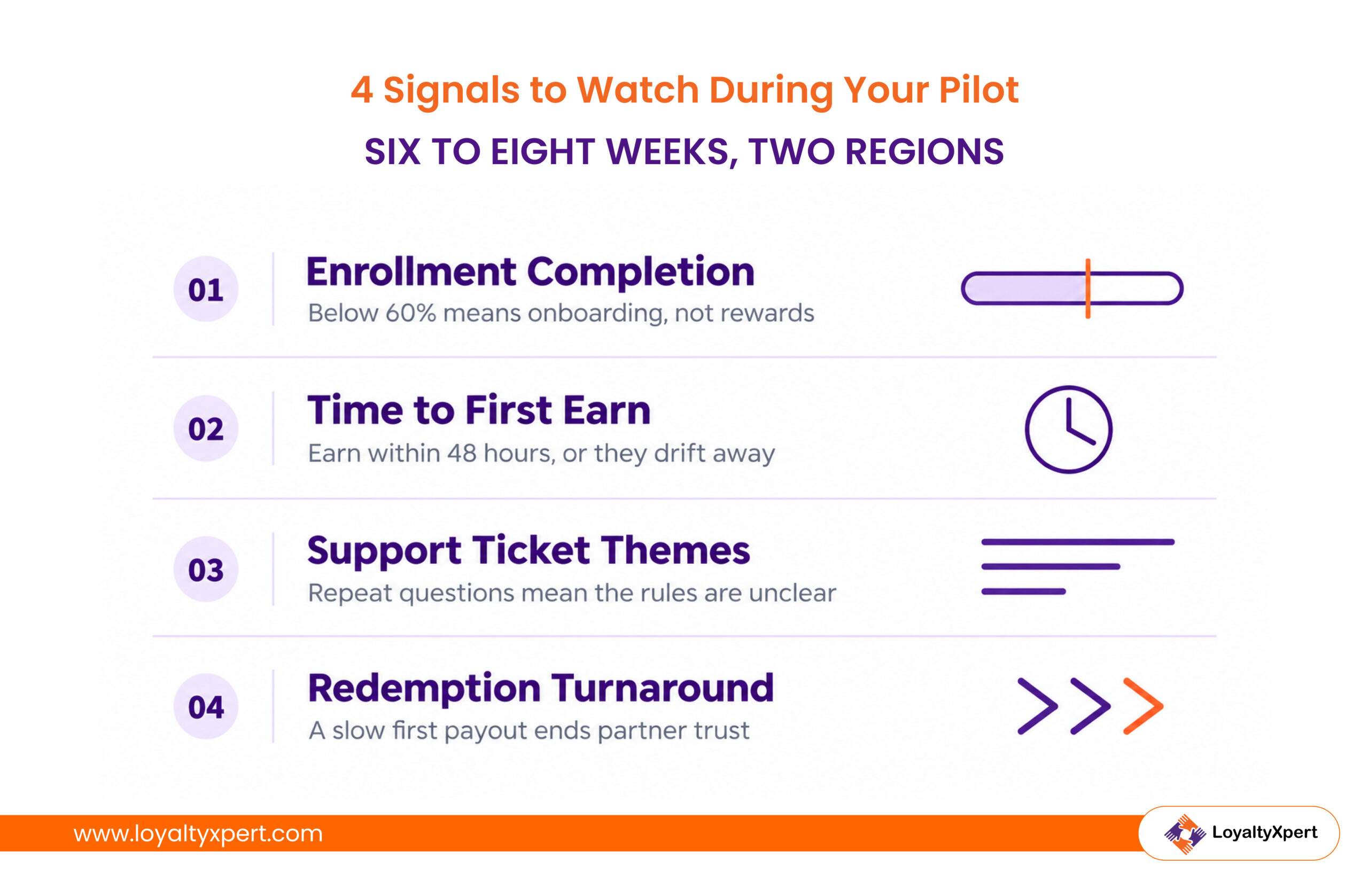
Watch four signals during the pilot:
- Enrollment Completion Rate — Below 60% means your onboarding flow has a problem, not your rewards.
- Time to First Earn — Partners who earn within 48 hours of joining stay active. Those who wait two weeks usually do not return.
- Support Ticket Themes — Repeated questions about point calculation mean your earning rules are too complex to explain.
- Redemption Turnaround — A delayed first redemption destroys trust permanently. Fix fulfillment before scaling.
Treat the pilot as the final rehearsal for your loyalty program launch. Every gap you close across two regions costs a fraction of what the same gap costs across the full network.
Get a loyalty program designed around your channel structure, not a template.
What Should Manufacturers Measure After a Loyalty Program Launch?
Post-launch measurement tracks whether the program changed partner behavior, not whether partners enjoyed it. Track enrollment rate, active participation, repeat purchase frequency, range expansion, redemption rate, and outstanding point liability. Review monthly through the first quarter. Compare participating partners against a matched non-participating control group for honest attribution.
| Metric | What It Tells You | Healthy Direction |
|---|---|---|
| Enrollment rate | Onboarding quality | 70%+ of target network |
| Monthly active partners | Real engagement | Real engagement |
| Repeat purchase frequency | Core goal impact | Above control group |
| SKUs per partner | Range expansion | Increasing quarter-on-quarter |
| Redemption rate | Reward relevance | 70–80% |
| Point liability | Financial exposure | Flat or falling |
Reporting depth matters here. Dealer-wise, zone-wise, and SKU-wise loyalty reports turn these numbers into decisions, not dashboards nobody opens.
5 Mistakes That Derail Loyalty Program Planning
Manufacturers repeat the same five errors across industries and network sizes. Each one is avoidable during design. None is easy to correct after partners have already enrolled and started earning points against published rules.
- Launching Without a Control Group — You will never prove ROI. Hold back 10% of comparable partners.
- Over-Complicating Earning Rules — If a dealer cannot calculate their points mentally, they will distrust the number.
- Ignoring the Influencer Tier — The carpenter or electrician often decides the brand. Rewarding only the dealer misses the decision point entirely.
- Treating Launch as the Finish Line — A loyalty program launch is the start of optimization, not the end of the project.
- Skipping Sales Team Alignment — Field sales must explain the program on the ground. Train them before partners hear about it.
Manufacturers evaluating vendors against these risks will find useful comparison criteria across the top loyalty program software platforms and a broader view of loyalty program software for businesses of different sizes.
Conclusion
Set one commercial goal. Segment your network honestly. Reward behaviors that move the business, not just invoices. Model the economics at full participation. Pilot in two regions. Then scale with your field team behind you.
Manufacturers who follow that order build programs partners actually use. Those who start with the reward catalog usually rebuild within a year. A loyalty program software earns its budget through sequencing, not through a richer catalog.
Ready to move from planning to execution?
- Book a Demo — Walk through a live channel program configured for your partner tiers and product categories.
- Contact Us — Discuss reward economics, ERP integration, and rollout timelines with our team.
- Explore Loyalty Program Software — See how earning rules, tiers, and redemption work on a single platform.
- Become a Partner — Join the LoyaltyXpert partner network and deliver channel loyalty at scale.