Automated Loyalty Programs: Benefits and Tips For 2023 and Beyond

When the concept of modern loyalty programs first began in the 18th century, it entailed manual disbursal of rewards, coupons, and tokens. It also involved manual record-keeping of the collection and allocation of rewards. When a business deals with just a handful of customers, it may not seem like a big deal. But when it deals with hundreds or thousands of customers, running and managing loyalty programs manually can be a nightmare.

The advent of automated loyalty programs in the late 1980s came as a boon for many contemporary businesses. It not only automated various processes but also eliminated various inefficiencies associated with manual reward programs.

This blog post discusses several benefits of automated loyalty programs and some useful tips that’ll help you create effective loyalty programs for your business. Read on and thank us later.

Benefits of Automated Loyalty Programs

As automated loyalty programs require no manual intervention in terms of operation and management, they offer a wide range of benefits. Here are some of them.

1. Time-saving

In business, time is more valuable than money. Automating loyalty programs will enable you to save a lot of time on manual tasks. The time saved can be used in more productive activities, such as:

  • Designing new products
  • Creating more innovative loyalty strategies
  • Focusing more on sales and marketing campaigns

2. Minimum errors

Manual tasks not only consume a lot of time but also are more prone to human errors. After all, as the saying goes, “To err is human.” But automating loyalty programs minimize the chances of human errors and enhances efficiency.

3. Cost reduction

Now, by costs, we don’t mean the “time is money” adage. Of course, you save a lot of time by automating loyalty programs. Hence, you save a lot of time as well. But you also save a lot of operating costs. Come to think of it, you will need to have dedicated staff to manage loyalty programs manually. You will also save on several other costs such as stationery bills and storage space, which may look insignificant in the beginning but can snowball over time.

4. Fraud detection and elimination

Let’s face it: loyalty frauds are a huge concern for businesses all around the globe. As per a Forter Fraud Index report, loyalty program frauds have increased by 89 percent year-on-year in 2021. Many brands are levelling up their loyalty technologies and taking every possible step to detect and eliminate fraud. In such a scenario, running and managing loyalty programs manually is akin to battling heavily armed mercenaries with sticks and stones. Manual loyalty programs are more susceptible to fraud compared to their automated counterparts. But choosing a reliable and sophisticated loyalty program platform can help you identify loyalty fraud on time and take a step to get rid of it.

5. Easy collection and syncing of customer data

Automated loyalty programs make the collection of customer data extremely easy. While enrolling in automated loyalty programs, customers will have to fill in relevant personal information such as:

  • Name
  • Age
  • Gender
  • Geographic location
  • As well as, some other demographic information

An Accenture survey found that 83 percent of customers are willing to share their data with brands if they receive personalized experiences. You can communicate the same in your loyalty platform and use the data to provide personalized experiences to your customers. Apart from that, automated loyalty programs also enable easy integration of customer data across your tech stack.

6. Collect reviews and social proofs

In business, non-paid reviews and recommendations play a huge role in influencing purchasing decisions. Various studies have found that a majority of customers trust word-of-mouth reviews and recommendations from their friends and family. This is where automated loyalty programs can help businesses collect customer reviews and social proof.

Automated loyalty programs make it extremely easy for customers to leave reviews. The automated platform can be easily integrated into customers’ online shopping process. It will enable them to review and rate the products and services. By leveraging automated loyalty programs, you can send reminders to customers to rate their purchases and leave reviews. This makes the process of leaving social proofs and reviews extremely efficient.

? Suggestion Read: Robust, Fully Automated, And Cost-Effective Loyalty Program For Digisol

Tips For Creating Automated Loyalty Programs

In the digital age, creating an automated loyalty program or automating an existing one is extremely easy. You just need to have a clear goal and the right tools. Here are some useful tips to get you started.

1. Determine your purpose

Before creating an automated loyalty program, determine your purpose. Why do you want to automate your loyalty program? If you don’t have one already, find out why you want to create one in the first place. Is it to retain more of your existing customers? Is it to save time and money? Is it to prevent loyalty fraud? Or is it a mix of all? Once you find the answers to the questions, you will be clear about what features and tech you need in your loyalty platform.

2. Choose between in-house and hiring an expert

If you want to create an automated loyalty program, you have two options. The first is to build it from the ground up in-house. Even though it gives you total control, it’s quite expensive and can take a long time to see the results. The second option is to leave it to an expert with years of experience in designing and creating high-quality and cutting-edge automated loyalty programs. It’s far more cost-effective and can give you faster results once you select the right service provider.

3. Select a reputable and trustworthy loyalty software provider

Choosing the right loyalty software can automate and structure your loyalty programs and enable your customers to earn and redeem their rewards quite effortlessly. That’s where selecting a reputable and reliable loyalty solution provider with years of experience can make all the difference. The best way to find a reliable loyalty solution provider is to search the web and compare the offerings, prices, and reviews of various loyalty software providers. Some of them provide free demos, which will make it easier for you to use the software for a while and make an informed decision.

4. Add rewards, create tiers, and monitor real-time analytics

After partnering with a loyalty software provider, you will have your platform ready as per your specifications and requirements. After that, you just need to market your loyalty program, add several rewards, and create various tiers for your members. After doing that, you just have to manage your program and see if it is getting you the desired results. The real-time analytics and reports will keep you updated and keep an eye on various aspects of your reward program.

In sum

As the name suggests, automated loyalty programs are digital loyalty programs that don’t need any manual intervention to run and manage loyalty rewards. By automating your loyalty programs, you can save a lot of time, eliminate human errors, reduce operating costs, detect and prevent loyalty fraud, collect and sync customer data, and garner reviews and social proofs.

At LoyaltyXpert, we have helped many businesses around the world automate their loyalty programs. If you want to automate your existing loyalty programs or create brand-new automated rewards programs, then contact us to book a free demo today.
7 Reasons Why Your B2B Businesses Needs A Loyalty Program

The loyalty of customers and business partners is critical to the survival and success of every business. For B2C companies, the loyalty of customers is indispensable for their growth and sustenance. For B2B companies, the loyalty of their clients and channel partners can make all the difference between success and failure.

In the B2B space, the potential to leverage loyalty programs is much higher than in the B2C space. Corporate clients and B2B buyers purchase in bulk quantities and spend much more money compared to individual customers. But despite that, many traditional B2B businesses fail to tap the potential of loyalty programs.

This blog post discusses seven reasons why B2B businesses must focus on creating and running effective loyalty programs as much as B2C companies, if not more. Read on to know the seven reasons why B2B companies must have well-designed loyalty programs in place.

Here are seven reasons why B2B businesses can benefit from a loyalty program:

1. Enhance retention

The very purpose of a loyalty program is to make customers and business partners stick with a brand. B2B loyalty programs do just that. Various studies have shown that buyers spend more and make repeat purchases when part of a brand’s loyalty program. B2B buyers and corporate clients are no different.

Enhance Retention

Another thing that B2B loyalty programs do effectively is that they help in closing the loop on customer feedback. As per recent data, B2B companies that close the loop on all customer feedback enhanced their retention rates by 8.5 percent.

2. Differentiate your loyalty programs

A joint study conducted by Google and CEB found that 86 percent of B2B companies found no considerable difference between competing businesses’ products. When products aren’t differentiated, it can be difficult to communicate a competitive advantage.

Differentiate your loyalty programs

As per B2B International, four out of every five B2B buyers don’t prioritize price when making a buying decision. That means when B2B companies position price as their unique selling proposition (USP) and compete with each other on prices then they don’t appeal to most B2B companies. 

That’s why B2B companies need to differentiate their loyalty programs and be extremely targeted in their marketing endeavors to attract buyers.

 3. Enhance customer engagement

Customer engagement is one of the major objectives of loyalty programs. When B2B companies design effective loyalty programs, they manage to engage clients and win their loyalty. 

A study conducted by B2B International found that when B2B companies have well-defined and high-quality loyalty programs in place then a majority of clients are fully engaged.

Enhance customer engagement

Right B2B loyalty programs such as tiered incentives enhance customer engagement right from the very beginning and encourage clients and business partners to buy more. After engaging customers, B2B loyalty programs build robust relationships with customers and create a strong sense of belongingness.

4. Enhanced profit margins

As per a study conducted by Forrester Research, a mere two percent increase in customer retention has the same effect on profits as a 10 percent cost cut. According to another study, increasing the retention rate by five percent can enhance profitability by 20 to 125 percent!

Enhanced profit margins

As B2B loyalty programs enhance customer retention, they also have a huge impact on a business’s profit margins. Apart from profit margins, B2B rewards programs contribute to a 30 percent growth in market share as well as a 32 percent increase in total revenue.

[pafe-template id=”10457″]

5. To collect data and customize rewards

B2B loyalty programs are a goldmine of valuable data. Leveraging data effectively can enable B2B companies to understand their clients better and create more tailored and relevant rewards and experiences for them.

To collect data and customize rewards

A Dimensional Research survey, in which many B2B marketers participated, revealed that seven out of every ten respondents said that they leverage historical information, big data, and predictive analytics to enhance their marketing effectiveness.

6. Referrals

Did you know that recommendations from friends and peers influence over 90 percent of B2B buying decisions? And did you know that nearly 85 percent of B2B buyers start the purchasing process with a referral?

Referrals

Referrals are extremely crucial for B2B companies. By having a strong B2B loyalty program in place, you can encourage and motivate your channel partners and prospects to engage with your brand.

7. Enhance average customer lifetime value (LTV)

Customer lifetime value is the worth of a customer to a business over a specific period. If you keep a customer for a long time or reduce the customer churn rate and make them buy repeatedly, then the average customer lifetime value increases.

Enhance Customer Lifetime value

B2B loyalty programs can greatly enhance the lifetime value of channel partners and clients. Increased customer retention, engagement, and referrals lead to increased customer lifetime value.

By and large

Well-designed B2B loyalty programs are extremely valuable for B2B companies. Apart from forging robust relationships between B2B brands and their clients, they can enhance retention, engagement, profitability, and more.

At LoyaltyXpert, we have created well-crafted and high-quality B2B loyalty programs and channel loyalty programs for many B2B brands. We have also helped them retain and engage more B2B buyers and business partners as well as register higher sales and revenue. If you are looking for a reputable and trustworthy B2B loyalty solution provider, contact us today to know how we can help or to book a free demo.

Building A Loyalty Program Help You Acquire And Use Customer Data

“Data is the new oil.” The famous quote of British mathematician Clive Humby is so true in the digital era. When businesses collect accurate information, refine and structure it, then they can derive a lot of value from the available data. Collecting the right data can mean the difference between success and failure.

When it comes to collecting data from customers, businesses use a wide range of techniques. Some of them buy data from data brokers (data service providers), while some collect data directly from their customers and business partners.

Out of several ways, leveraging loyalty programs to collect zero-party and first-party data is extremely innovative and impactful. Why’s that? Well, let’s take a look at these stats.

A survey conducted by Accenture taking 8000 customers from all over the globe found that 83 % of them are willing to share their data with brands if they receive personalized experiences. That’s a huge number! Imagine the amount of data any business can collect if it simply tells its loyalty program members to provide some key data to receive customized rewards.

Another customer experience survey conducted by Genesys taking 5,000 participants found that almost 40 % are willing to share their data if they are monetarily compensated. And a fifth of the participants is willing to share their data if they get discounts. This also perfectly aligns with the loyalty programs’ purpose, which is to reward customers for their loyalty.

In this blog post, we have discussed the types of data businesses can collect by using their loyalty programs. Also, how businesses can convince their customers to share their relevant personal information. Read on to gain more insights.

Types of data businesses can collect using loyalty programs

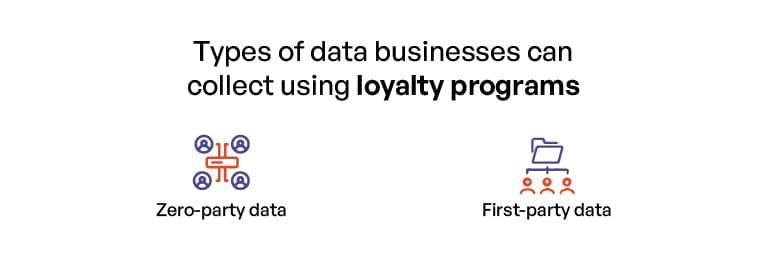
By using loyalty programs, businesses can collect two types of data:

Collect customer data through loyalty program

1. Zero-party data: It’s the data that a customer shares willingly with a brand. The data can cover a wide array of topics ranging from how satisfied they are with the products and services as well as their purchase plans.

2. First-party data: It’s the data that a business collects from its customers through its website, mobile application, and point of sale. Some of the first-party data are time spent on the website, click-through rate, bounce rate, customer’s website behavior, purchase history, and more. It’s considered an accurate and reliable type of data and it comes with minimum privacy concerns.

Note: A new study found an interesting thing about data and personalization. As per the research, seven out of every ten customers are okay with personalization only if it involves first-party data. To put it another way, customers don’t want brands to collect data on them from third parties!

[pafe-template id=”10457″]

How to collect relevant customer information using loyalty programs?

When it comes to collecting relevant personal information of customers, businesses can use some smart techniques to gain key data and use it to strengthen customer loyalty.

collect relevant customer information using loyalty programs

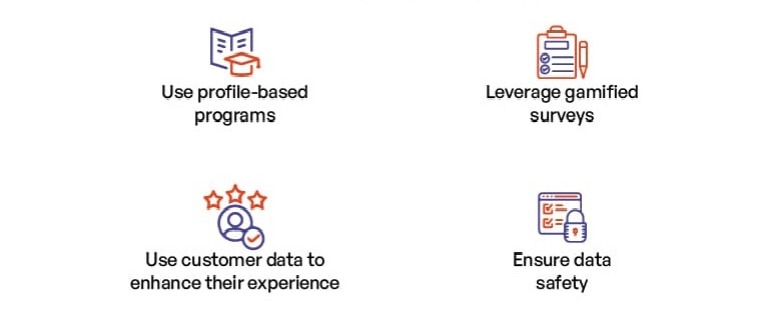
1. Use profile-based programs 

Over the last few years, many businesses are creating profile-based loyalty programs. By doing so, they get their customers to fill up their respective profiles with relevant information. Customers with incomplete profiles don’t get to be a member of the loyalty program till they have provided all the required information.

2. Leverage gamified surveys

Another excellent way of collecting relevant customer data is by using gamified surveys. In this, businesses use game elements to make their surveys interesting and engaging, which encourages their customers to participate in the studies. Recent studies show that gamification increases engagement by 50 percent.

3. Be transparent and tell your customers that you are using their data to enhance their experience

As per a Salesforce study, three out of five customers are willing to provide relevant personal data if businesses are transparent about how they will use the data and it benefits the customer. If you plan to collect customer data to customize your loyalty programs, then you must tell your customers, channel partners, and influencers about it at the outset.

4. Ensure data safety

After telling your customers why you want to collect their data, you must give them the confidence that their data is safe with you. After all, a majority of customers value privacy over personalization when it comes to sharing their data. The only way to do this is by ensuring data safety and taking all possible steps to prevent data theft. 

This is where selecting the right loyalty program software as well as a reliable and reputable solution provider can be extremely beneficial. Equipped with many advanced features, sophisticated loyalty software can reinforce data security.

All in all,

Collecting customers’ and business partners’ data is a crucial process for every business. It not only enables them to know their customers, channel partners, and influencers in a much better manner, but also it helps them to create effective retention strategies. This is where loyalty programs can be immensely helpful. They not only automate manual data collection but ensure that customers and business partners provide all relevant information.

At LoyaltyXpert, we have helped a wide range of businesses create effective loyalty programs. In addition to that, we also helped them acquire all the necessary data from their customers and business partners. If you’re interested to know how loyalty programs can help you collect high-quality customer data, contact us today to get a free demo.

5 Myths About Loyalty Programs That Marketers Need to Burst in 2023

Beware of false knowledge, “It’s more dangerous than ignorance.” The statement of George Bernard Shaw is extremely relevant for those business owners and marketers who have many misconceptions about loyalty programs. By harboring the myths, they not only forego the benefits of loyalty programs but remain far behind the curve.

At LoyaltyXpert, we believe that an engaging and effective loyalty program is a necessity rather than a luxury. Every business must leverage sophisticated loyalty programs and reap the benefits.

In this blog post, we have dispelled five common myths about loyalty programs so that you can make informed choices while running and managing loyalty programs.

#Myth 1: Loyalty programs are expensive

Many business owners and marketers see loyalty programs as an expense instead of an investment. A majority of them think that to set up loyalty programs they need to incur heavy upfront costs and hire a separate team to manage and run their loyalty programs.

Loyalty program are expensive

But that’s not true. SaaS-based digital loyalty programs are not at all expensive and they won’t require any upfront costs. All businesses need to do is find a reliable loyalty solution provider that will enable them to run and manage well-designed loyalty programs.

A Bain & Company research found that a 5% increase in customer loyalty can enhance the average profit per customer by nearly five times. Another study revealed that well-performing loyalty programs enhance revenue from customers who use them by 15 to 25 percent every year.

#Myth 2: Loyalty programs are complicated

Some people think that loyalty programs, digital loyalty programs, in particular, are extremely complicated. For instance, A study conducted by KPMG found that more than two-thirds of millennials who participated in it said that they find it difficult to join most loyalty programs and earn points from them. Likewise, some businesses think that digital loyalty programs are extremely difficult to run and manage.

But the truth is the opposite. Digital loyalty programs are much simpler and easier to run and manage compared to traditional loyalty programs. 

Loyalty program are complicated

Unlike the latter, which involves the manual creation of excel sheets or card-based loyalty vouchers, businesses don’t have to build the former from scratch. They just need to partner with a reliable solution provider and use sophisticated loyalty program software to manage their B2B and B2C digital loyalty programs at the click of a button.

#Myth 3: Loyalty programs aren’t attractive to young customers

With so many choices and options than ever before, young customers experiment with different brands. But that doesn’t mean that they aren’t loyal to their favorite brands. Young customers comprise mostly millennials (people born between 1981 and 1996) and Gen Z (people born between 1995 and 2012). Collectively, they account for a majority of sales.

Loyalty program aren't attractive to young customer

A study conducted by Rare Group in 2019 found a relation between loyalty programs and purchasing frequency. 

  • More than 80 percent of Gen Z customers said that they’re more likely to increase their purchase frequency if they like the brand’s loyalty program. 
  • Another study by KPMG found that 87 percent of millennial customers in the U.S. are enrolled in at least one loyalty program. They are most actively engaged with that program.

#Myth 4: Loyalty programs = offer and discounts

Loyalty programs are much more than offers and discounts. If you look at successful companies that have strong and effective loyalty programs in place, you won’t find any of them using offers and discounts to retain customers. That’s because offers and discounts carry a negative connotation. 

Loyalty programs = offer and discounts

An article titled ‘The Dark Side of Discounts’ cited many studies that revealed discounts not only reduce the efficacy of products but also cause suspicion in the mind of customers as well as dissatisfaction.

Trustworthy loyalty solution providers who have the expertise and experience in creating and deploying high-quality loyalty programs know that offers and discounts don’t matter to discerning customers. They focus on providing value and they work closely with brands to offer exceptional user experience and customer satisfaction.

#Myth 5: Successful brands don’t need loyalty programs

From Apple to Zappos, take any successful company. What do they have in common? Well, many things actually. 

  • Amazing products 
  • Exceptional customer service
  • Strong brand value
  • and of course, excellent loyalty programs

Despite existing for decades and delighting millions of customers year after year, all these iconic companies can’t afford to overlook their loyalty programs, not even for a day.

Successful brands don’t need loyalty programs

All successful brands know that the cost of attracting a new customer is five times more than the cost of retaining an existing customer. As they continue to grow, they reinvent its customer retention strategies and loyalty programs to keep its customers loyal.

If you think that you don’t need a customer loyalty program or a B2B loyalty program just because your customers love your products or services (and you register desired sales and revenue), then you should think again.

Taking everything into account

Now that we have busted these five misconceptions about loyalty programs, we hope that you’ll not be apprehensive about running effective and high-quality loyalty programs. In the present age, creating and managing high-quality loyalty programs is indispensable for every business.

At LoyaltyXpert, we create tailored and well-designed customer loyalty programs, channel loyalty programs, and influencer loyalty programs for all kinds of businesses. If you’re considering implementing successful loyalty programs, contact us for a free demo.

Top 8 Best Digital Loyalty Programs Solutions in India

Digital loyalty programs are fast replacing traditional loyalty programs due to their wide range of benefits. They are not only fast, efficient, cost-effective, and eco-friendly, but they are extremely useful in the digital age where a majority of customers would like to engage with loyalty programs using their smartphones, as confirmed by a CodeBroker study.

With more than 659 million smartphone users, India ranks second in the world when it comes to smartphone usage. With so many people using smartphones in the country, businesses of all sizes and types must digitize their B2C and B2B loyalty programs.

By leveraging digital reward programs, some brands made transferring and redeeming loyalty points much easier for their customers and channel partners. This blog post discusses the eight best digital loyalty programs in India that have resulted in higher engagement and retention.

Best Digital Reward Programs in India

1. PVR Privilege

Launched by PVR Cinemas in 2017, PVR Privilege is publicized as India’s first fully digital loyalty program. The digital rewards program offers the members of the PVR Cinemas loyalty program a wide range of enhanced benefits and best-in-class redemption opportunities.

PVR Privilege

Members are rewarded on every transaction they make at PVR Cinemas or the company’s website. They get free Privilege salted popcorn and five percent of PVR Privilege Points for every Rs. 100 they spend on tickets as well as food and drinks. Apart from that they also get vouchers and invitations to special screenings.

2. TimesPoints

When it comes to one of the best digital reward programs in India, TimesPoints is extremely well-known. The digital loyalty program of Mumbai-based media conglomerate The Times Group rewards customers when they spend time on its digital partners’ platforms such as The Times of India, NewsPoint, The Economic Times, Maharashtra Times, Navbharat Times, and many others.

times points logo

Customers earn points for the time they spend on Times Group’s apps or websites. TimesPoints credits points in customers’ digital wallets, which they can trade to avail of benefits such as discounts, gifts, and deals. They can get benefits by reading articles as well as watching, liking, commenting, and sharing photos and videos. Customers can redeem the points across more than 200 brands such as Amazon, Paytm, Myntra, Shoppers Stop, and more.

3. PAYBACK 

PAYBACK is among India’s largest multi-brand digital loyalty programs with more than 100 partner brands including affiliate brands such as Amazon, Flipkart, Myntra, and more. The unique coalition digital loyalty program is designed to engage members and provide their reward points on online shopping, vouchers, coupons, as well as on digital payments.

DIGISOL-full-Logo-Horizontal-Original

The wide range portfolio of partner brands covers more than 80% of popular consumer spending areas with its partners being some leading brands in various sectors ranging from entertainment, financial services, hospitality, payment cards, retail, travel, and more. With a such broad range of partners, the program is accepted at more than 12,000 Points of Sale (POS) across over 100 cities.

4. HDFC Platinum Times Card

HDFC Platinum Times Card is a co-branded loyalty program card by the HDFC Bank and Times Internet. The co-branded initiative comes with several entertainment and lifestyle benefits related to dining, movies, and shopping. The digital reward program is extremely popular in the basic category. With an affordable fee, it offers a wide range of benefits across different categories, including dining, shopping, entertainment, etc.

HDFC Bank

Members get ten reward points for each spend of Rs 150 on dining during the weekdays and three reward points for every dining spend of Rs 150 on weekends. They can redeem the digital loyalty points through the product catalog by logging in to their net banking account. The card offers several additional benefits as well.

[pafe-template id=”10457″]

5. Citi Rewards 

Citi Rewards is a digital reward program from Citibank India. Under the program, customers can earn loyalty points for every payment they make using a Citi credit card at online shopping sites, retail outlets, hotels, and travel bookings, paying fuel bills at gas stations, and more. Customers can also transfer their reward points to frequent flyer programs and avail of benefits for premium merchandise.

Citi Bank Logo

For every payment made with Citi Credit Card at petrol stations, customers earn rewards points. They can then attractive travel options and much more.

6. InterMiles 

InterMiles program, formerly known as JetPrivilege, is a co-branded digital reward program of New Delhi-based airline Jet Airways and Abu Dhabi-based carrier Etihad Airways. The digital loyalty program rewards its customers for flying with the airlines, booking hotel rooms across the globe, shopping in select stores, and more.

Intermiles

Under the program, members can collect InterMiles that are saved in their account and redeem the points for exclusive deals, free travel, lounge access, free stays, free fuel, and more than 2500 merchandise options.

7. Digisol Cash Karo

Digisol Cash Karo is the digital loyalty program of Digisol Systems Ltd, a reputable provider of IT networking solutions. The Bangalore-based company launched the digital reward program to increase sales and build transparency and trust with its channel partners.

Digisol

By using the Digisol Cash Karo app, Digisol’s channel partners and influencers can scan the QR code on select Digisol products and the loyalty points will be credited to their digital wallet. Apart from retaining channel partners, the digital loyalty program empowers electricians and technicians as well.

Suggested Read: Robust, Fully Automated, And Cost-Effective Loyalty Program For Digisol

8. Berger Paints’ eSambandh

Berger Paints’ eSambandh loyalty program is a digital loyalty program for its contractors. The digital reward program consists of a wide range of benefits and incentives. The program provides a high degree of price transparency and gains contractors’ confidence.

Berger Paints

The paint maker provides additional discounts and benefits as well as credit facilities. The B2B loyalty program also enables contractors to order various paints, coatings, and paint tools and get the items delivered to their preferred location.

Summing up,

Contemporary customers are extremely tech-savvy and prefer doing transactions over their smartphones over any other mode of communication. Digital loyalty programs are extremely helpful for present-day businesses in engaging and retaining customers.

At LoyaltyXpert, we have helped many B2C and B2B businesses digitize their brand and channel loyalty programs. If you’re looking to know more about digital loyalty programs, give us a call or book a free demo today.
5 Benefits of Digital Loyalty Programs That Can Grow Your Business

The traditional card-based B2C and B2B loyalty programs, which were introduced commercially in the 18th century, underwent a sea change between the 2000s and the 2010s. The transformation was a result of the rapidly changing digital landscape and the growing popularity of smartphones and mobile applications.

By leveraging the right technology, businesses could enroll their customers and channel partners into their digital loyalty programs easily, monitor their rewards and points, and prevent loyalty fraud. The wide-ranging benefits of digital loyalty programs accounted for their massive growth.

As per a report released by US-based market research firm Fact.MR, digital loyalty programs market is projected to reach USD98 billion by 2032, growing at a compound annual growth rate of 8.4 percent.

At LoyaltyXpert, we create high-quality digital loyalty programs for many types and sizes of businesses. In this blog post, we have discussed some of the major digital loyalty program benefits.

1. Better understanding of customers

Digital loyalty programs can help businesses gain a better understanding of their customers. Now, the question comes “How?”Better understanding of customers

Well, by tracking and analyzing customers’ behavioral and purchase data, digital loyalty programs provide companies with valuable insights into customer behavior and preferences. By doing so companies will not only monitor and map customers’ journeys in real-time but also respond to their queries and communicate with them if the need arises. As per SalesForce’s State of Connected Customer report, 64 percent of customers expect brands to interact with them in real time.

Businesses can use customer data to customize rewards and offers. You can discover how customers use loyalty programs and how they redeem loyalty points by using digital loyalty programs.

2. Tailored experiences

As per a new stat, four out of every five customers say that they are more likely to buy from a brand if it offers tailored experiences. Another study found that 87 percent of US-based customers are willing to have their activities tracked if the brand provides them with customized rewards and experiences. What’s more interesting is that a report released by PwC found that more than 80 percent of customers are ready to share their personal information for such experiences.

Tailored Experience

The data and insights you gain by leveraging digital loyalty programs can help you in tailoring customer experiences. You can customize rewards and offers based on customer preferences, which creates a more personal shopping experience.

3. Boost in customer retention rate

As digital loyalty programs can be used to provide personalized experiences, they can account for an increase in customer retention rate. Recent data reveal that nine out of every ten customers will buy again from a brand if they receive a positive experience.

Boost in customer retention rate

A McKinsey research found that digital loyalty programs can retain tech-savvy customers by engaging and incentivizing them suitably. As per the report, brands that focus on enhancing customer experience report at least 10 percent higher customer retention. The same study found that three out of every five customers spend more money on a brand after signing up for a digital loyalty program.

[pafe-template id=”10457″]

4. Enhanced customer lifetime value

Customer lifetime value (LTV) is an extremely important metric for businesses as it helps them to calculate the average sum of money a customer will spend on a business over a specific period. New research reveals that when a business achieves a seven percent growth in brand loyalty, the customer lifetime value can increase by 85 percent.

What’s more interesting is the connection between emotionally-connected customers and LTV. A study conducted by London-based market research and data analytics firm YouGov found that emotionally-connected customers have a 306 percent higher LTV compared to satisfied customers. As digital programs improve customer retention and loyalty, they can enhance customer LTV.

5. Higher purchasing frequency

Did you know that customers are 14 percent more likely to increase purchase frequency with a brand that has a top-performing digital loyalty program? A study conducted by McKinsey revealed that. The study also found that, apart from driving higher purchase frequency (also known as basket value), top-performing digital loyalty programs can enhance purchase frequency can enhance purchasing size, and increase revenue by 15 to 25 percent every year. 

Higher purchasing frequency

Another study conducted by Rare in 2019 found that 80 percent of Gen Z customers (customers born between 1995 and 2012) said that the quality of loyalty programs is directly related to their purchasing frequency. About three-quarters of Gen X (customers born between 1965 and 1981) and half of Baby boomers (those born between 1946 and 1964) said that they are more likely to increase their purchase frequency, because of loyalty programs. To enhance purchase frequency, you can leverage customized loyalty programs so that your loyal customers will buy more from you in a single visit.

All in all

Digital loyalty programs not only make it easier for customers to engage with your brand using their choice of devices but they also help you understand your customers better, create tailored experiences for them, enhance LTV, as well as increase basket size and value. Digital loyalty programs are extremely easy to create and run.

At LoyaltyXpert, we create all types of digital loyalty programs starting from brand loyalty programs, channel loyalty programs, and influencer loyalty programs for all sizes of businesses. If you are looking to run digital loyalty programs, then contact us today to book a free demo.

Why You Must Rethink Traditional Loyalty Schemes?

As per a Bond Brand Loyalty report, an average customer is enrolled in more than 14 different loyalty programs at any given time. In such a situation, it becomes extremely difficult to command a strong sense of loyalty. It becomes even more so when digital loyalty programs and channel loyalty programs are regarded just as a scheme and not as a way to strengthen strong bonds with customers and business partners.

Many businesses view their loyalty programs just as schemes. But they fail to realize that customer loyalty is crucial for every business. It’s indispensable for maintaining a positive and strong relationship with customers. American entrepreneur Joseph D. Mansueto once said, “Once you create a loyal customer base, it’s tough for a competitor to take that away.” The quote proves why loyalty schemes must evolve with changing needs of customers and channel partners.

At LoyaltyXpert, we have helped many businesses make a paradigm shift from viewing their customer loyalty programs just as schemes to potent tools for building and sustaining longstanding relationships. In this blog post, we have described how businesses can rethink their B2C and B2B loyalty programs to engage with customers and channel partners and keep them loyal for a long time.

Reinventing loyalty schemes

Faced with so many options, contemporary buyers and decision-makers do not like run-of-the-mill stuff, including loyalty programs. Even if a business has high-quality products or services, it cannot retain its customers for long if it relies on mediocre loyalty programs.

Loyalty Scheme

Apart from that, running a loyalty scheme is not easy in the present era. It takes time, effort, and dedication to create a successful loyalty program. That’s why you must rethink and reinvent your loyalty schemes before it’s too late.

Rethinking traditional loyalty point-based schemes

Traditional points-based schemes are not flexible enough to meet the rapidly evolving needs of customers and channel partners the way that new technologies can. A study conducted by Deloitte found the changing attitudes of customers and business partners toward traditional loyalty schemes.

In the study, about half of customers said that they like points-based loyalty schemes, while 47% of customers redeem their loyalty points and take advantage of all offers they receive through loyalty schemes.

Traditional loyalty point

But when it came to the experience a brand offers, more than half of customers said that the experience and brand communication is just as important as the loyalty scheme benefits while the same number of customers said that they would like the option of personalized rewards based on their purchase history.

The same research also found that when the customers were asked about their attitude toward loyalty schemes, about 42% of them said that they need more than points to buy from a brand. Even as participation rates in loyalty schemes were high, a majority of customers regarded being rewarded for their loyalty as the norm and not a differentiator. All these stats demonstrate why a loyalty program needs to go beyond point-based rewards.

[pafe-template id=”10457″]

Traditional loyalty schemes can become a financial liability

Traditional financially-driven loyalty schemes are an effective way to reward customers and channel partners for their loyalty. But they can become a financial liability for businesses. Many businesses don’t identify the true costs of traditional loyalty schemes.

The major costs associated with traditional loyalty schemes are the costs of offering rewards such as points, discounts, free products, and more. When customers and channel partners redeem their points and avail of the offers they are eligible for under the loyalty schemes, the redemption costs may put enormous pressure on a business’s balance sheet.

Loyalty scheme become financial liability

Traditional loyalty schemes can be difficult to manage and may require considerable resources to run. Furthermore, businesses must also consider the cost of administering and marketing the loyalty scheme as well as the cost of any customer service issues that may arise. All these costs can accumulate quite fast and make it extremely unviable for a business to maintain the program in the long run.

However, on the other hand, reinventing traditional loyalty schemes can help businesses manage their costs and encourage their customers and business partners to buy more from them. By automating and streamlining their loyalty programs, businesses can reduce the costs associated with their traditional loyalty programs and run more cost-effective and efficient programs.

All in all,

For loyalty programs to be successful, they have to be more than just schemes. They must show your customers and channel partners how valued they are and you’re willing to walk the extra mile for them. That’s why traditional loyalty schemes must be reinvented to attract and retain contemporary customers and channel partners.

At LoyaltyXpert, we have helped a wide range of businesses across industries to rethink and reinvent their traditional loyalty programs. We can equip you with the right solutions so that you can do the same. If you’re curious to know how we can help, then call us today or book a free demo.

How Loyalty Programs Drive Retention and Upselling Strategies?

You know that B2C and B2B loyalty programs can help you retain your customers. But did you know that you can leverage your digital loyalty programs to upsell and cross-sell?

As per recent data, two out of every five businesses, or 42 percent to be precise, use loyalty programs to upsell and cross-sell their products or services.

What’s more interesting, big brands such as Starbucks use their loyalty programs to upsell their offerings. Upselling and cross-selling are massive parts of the structure of Starbucks Rewards.

An upsell usually happens when an existing customer is convinced to purchase more than they initially planned. Effective upselling tactics not only generate higher revenue but also result in brand loyalty to varying degrees.

As a sizable number of businesses and several big brands are already leveraging their customer and channel loyalty programs to retain their clients and upsell their products or services, you should do the same to remain competitive and maximize customer lifetime value.

At LoyaltyXpert, we have helped many businesses across a wide range of industries to retain and upsell by using high-quality loyalty programs. In this blog post, we have discussed the various ways loyalty programs enhance retention and upselling strategies. Read on to gain valuable insights.

Relationship between loyalty programs and retention rate

Loyalty programs can be extremely effective to retain customers, influencers, and channel partners and keep them engaged for a long time. But personalized ones have been shown to greatly increase customer retention. By providing customized and exclusive rewards and experiences, they increase the probability of retaining existing customers manifold.

A recent stat revealed that loyalty programs can drive more than half of a business’s customer base to increase spending. Another stat found that just eight percent of the most loyal customers of a business contribute to nearly half of its revenue.

Personalizing upsell programs has been found to enhance the retention rate

It’s one thing to use loyalty programs to upsell but it’s a different ball game altogether to personalize upsell programs. Businesses that personalize their upsell programs easily enhance customer, influencer, and channel partner retention.

Businesses can personalize their upsell programs by offering exclusive or customized rewards on the products and services they’re targeting to upsell to their existing and previous customers. By doing so, they increase customer lifetime value. Apart from that, by personalizing upsell programs businesses can efficiently monitor customer behavior and customize their offerings as per customers’ preferences. Businesses that reward repeat purchases entice their customers to stick with them for a long time.

Frequent upsells increase customer spending

A study conducted by Adobe found that frequent upsells encourage loyal clients to spend 67 percent more than new ones. By providing customers and business partners with higher-quality options, upsells can encourage customers to increase their average order size as well as spend more on the products and services they value the most.

By offering valuable rewards on their upselling programs, businesses not only encourage to buy more frequently but also increase their spending amount. Customers who purchase more premium items spend more as they know that they will get handsome rewards for their purchases.

[pafe-template id=”10457″]

Data-driven upselling and retention strategies prove to be highly effective 

Businesses that use sophisticated loyalty programs to enhance their upselling and retention strategies have massive advantages over their counterparts that use traditional or no loyalty programs. That’s because the former gets all valuable data and insights in one place. And, by using the data they can make data-driven decisions.

The data, which businesses can efficiently use, include demographic characteristics such as age, gender, location, education, and occupation as well as behavioral traits and purchase. By leveraging that, businesses can predict which customers will favorably respond to their upsell campaigns.

Product recommendations via digital loyalty programs

We have already discussed how sophisticated loyalty platforms can access valuable data to make data-driven decisions. The same insights can be used to make product recommendations. By analyzing user behavior, product recommendation engines can show relevant products and services to users. The more advanced a loyalty platform is, the more relevant the product recommendations are. That’s why it’s not surprising that businesses that use highly sophisticated loyalty software, register more upsells and higher retention.

All things considered,

Upselling plays a crucial role in creating better relationships with customers and is far easier than selling to new customers. As per recent data, the probability of selling products and services to existing customers is between 60 and 70 percent, while it’s just 5 to 20 percent when it comes to new prospects.

At LoyaltyXpert, we craft sophisticated digital loyalty programs for all types and sizes of businesses across industries. We have helped many of our clients to retain and upsell by leveraging loyalty programs. We can do the same for you. To know how we can help, contact us or book a free demo today.
Loyalty Programs Trends: Understanding Buyer Behavior Data

Can loyalty programs help in understanding buyer behavior? The answer to the question is a resounding “Yes!”

By collating and analyzing generated through digital loyalty programs, more particularly B2B loyalty programs, B2C loyalty programs, and channel loyalty programs, businesses can understand the buying behavior of their customers.

Apart from buying behavior, the data obtained by digital loyalty programs can provide key insights into the tastes and preferences of customers and business partners. Businesses can use the data to identify the products and services that are most popular among customers and the most effective loyalty rewards.

At LoyaltyXpert, we have helped many businesses leverage B2B loyalty programs, B2C loyalty programs, and channel loyalty programs to understand buyer behavior data. In this blog post, we have detailed the ways you can leverage a sophisticated digital loyalty program to understand customer behavior data. Read on to gain valuable insights.

How a digital loyalty platform can help businesses to benefit from buyer behavior data?

Smart businesses leverage their digital loyalty programs to collect, analyze, and monitor buying behavior data. By doing so, they can benefit in a wide number of ways.

1. Segment your customers and business partners

Buyer behavioral data can help businesses to segment their customers as per various demographic factors such as age, gender, location, education, and profession as well as other parameters such as spending habits and consumption patterns.

After segmenting their customers, businesses can create different buyer personas and create a clear image or representation of their perfect customer. After that, they can align their marketing and sales campaigns to target their ideal customers and attract them.

 2. Offer personalized and relevant rewards

Businesses that leverage loyalty programs to collect, analyze, and understand their customers’ and business partners’ data are better equipped to offer tailored and relevant rewards

A study conducted by Accenture found that 54 percent of buyers are willing to share personal information and buying behavior data to get customized offers.

3. Re-engage existing and previous customers

A recent study found that eight out of every ten customers who have stopped buying from a brand said that the business could have done something to engage with them. Now, come to think of it, what could a company do to retain its old customers? Re-engage with them, of course. The question is “how?” That’s where data comes into play.

Businesses that collect, analyze, and understand buying behavior data can re-engage with their existing and previous customers as well as business partners far more effectively than businesses that don’t leverage data.

4. Recommend relevant and useful products

By collecting, analyzing, and understanding buying behavior data, businesses can recommend relevant and useful products to their customers and business partners.

Buyer behavior data can help businesses understand what their clients need and what they are looking for. Based on that, businesses can make highly relevant and targeted product recommendations. The targeted recommendations can enhance engagement between businesses and their clients.

[pafe-template id=”10457″]

5. Create timely promotions                             

For businesses, creating timely promotions is extremely important. Businesses that track and analyze sales data to understand the exact time at which promotional codes are redeemed are well-equipped to create time-sensitive promotions.

By creating time-sensitive promotions, you can incentivize desired actions and grow your business by leaps and bounds. Apart from that, data-driven promotional strategies can help you effectively personalize your marketing content, and messages, as well as retarget previous customers.

6. Map out the customer journey

Customers’ and business partners’ interactions with loyalty programs provide extremely valuable insights into customer experience and customer journey. Companies that use their loyalty programs to collect and analyze data can easily map out the customer journey and understand the customer experience they provide. Apart from that, they can use the insights to enhance both the customer experience and customer satisfaction.

A study conducted by the Aberdeen Group revealed that businesses that mapped out customer journeys registered 56 percent higher revenue from cross- and up-sells and 3.5 times more revenue from customer referrals.

7. Forecast trends

Businesses can leverage the data they obtain from their digital loyalty programs to predict their customers’ and business partners’ future buying habits. That’s where a sophisticated digital loyalty platform can come in extremely handy as it can provide accurate data crucial to forecasting timely trends.

The trends can help you to gain a competitive advantage and design effective strategies to retain your customers as well as acquire new ones. Apart from revealing time-based trends, you can use your customers’ referral and loyalty program activities to maximize conversions across all sales and marketing initiatives.

All in all,

As the famous saying goes, “data is the new oil.” A business that knows how to leverage buying behavior data, as well as other available information, can leave its competitors behind. This is where a sophisticated loyalty platform can help in tapping into the vast repository of data.

At LoyaltyXpert, we created high-quality loyalty programs for many businesses and helped them tap into the data goldmine by using our sophisticated loyalty platform. If you want to understand buying behavior by leveraging loyalty programs, contact us or book a free demo today.
Emotional Loyalty – The Value of Emotion Driven Engagement

The concept of loyalty programs has been around for many years. The traditional approach to loyalty programs was based on providing discounts, coupons, or points-based systems to encourage customers to return to a business. 

However, today’s customers expect more from businesses, and their preferences have evolved. In response to this change, companies have started shifting towards emotion-driven loyalty programs. 

In this blog post, we will discuss the rise of emotion-driven loyalty programs, their significance, and how LoyaltyXpert’s B2B channel loyalty program solution can help manufacturing companies create an emotional connection with their customers.

What is Emotion Loyalty Program?

Emotion-based loyalty programs are designed to create a deep emotional connection between customers and brands These programs go beyond traditional offers like discounts and points to create a personalized and unique experience. Emotion-based loyalty programs focus on the customer experience and how they feel when interacting with your brand

Emotional rewards are used in emotion-driven loyalty programs to establish this connection. These rewards can take many different forms, including special access to events, highly personalized experiences, and unexpected gifts. 

The important thing to remember is that these rewards value more about the emotional bond they strengthen than they do their monetary worth. 

Why are Emotional Loyalty Programs Becoming More Popular?

Emotion-driven loyalty programs are becoming more popular for a number of reasons. Traditional loyalty programs with rewards-based incentives are, first and foremost, losing their effectiveness. Many customers are looking for something more meaningful than just discounts and points because they are overloaded with the number of loyalty programs they have signed up for.

Second, emotion-driven loyalty programs give businesses a way to stand out in a crowded market. Brands can differentiate themselves from the competition by developing a special emotional connection with their customers.

Finally, loyalty programs that are based on emotions can cultivate long-lasting loyalty. Even when there are less expensive or more convenient alternatives, customers are more likely to stick with a brand when they have an emotional connection to it.

How Do I Make a Program for Emotional Loyalty?

  1. Think about the emotions of your clients: You must understand the emotions of your customers in order to develop an emotional loyalty program. What beliefs, values, and feelings do they crave? What are the pain points? What are they curious about? By understanding the feelings of your customers, you can design emotional rewards that will appeal to them.
  2. Find your brand’s core values: Your emotional loyalty program needs to be consistent with your brand values if you want to develop an emotional bond with your customers. What values does your brand promote? These values should be reflected in and emphasized in the minds of your customers by your emotional loyalty program.
  3. Create emotional rewards: You can develop emotional rewards that connect with your customers once you have a firm understanding of their feelings and the principles underlying your brand. These rewards can come in a variety of packages, including invitations to private events, unique experiences, and unexpected gifts. The secret is to design incentives that go beyond monetary value and forge a deep emotional bond with your clients.
  4. Communicate your emotional loyalty programme: Lastly, you need to let your customers know about your emotional loyalty programme. Make sure they are aware of the emotional benefits they can experience and how to obtain them. You can develop a strong emotional connection with your customers and grow your business by effectively communicating your emotional loyalty programme.

[pafe-template id=”10457″]

How LoyaltyXpert’s B2B Loyalty Program Solution Can Help Manufacturing Companies?

LoyaltyXpert’s B2B channel loyalty program solution is an ideal way for manufacturing companies to incentivize and reward their channel partners for their loyalty and performance. The solution offers a range of emotional rewards that can help create a lasting emotional connection with the channel partners.

The solution provides exclusive access to events, personalized experiences, and surprise gifts, which can make the channel partners feel valued and appreciated. Such rewards can motivate them to continue performing and maintain their loyalty to the business.

The solution also provides several tools and features to make communication and engagement with channel partners easier. The user-friendly interface, real-time tracking and reporting, and the ability to personalize rewards and communications can make it easy for businesses to connect with their channel partners on an emotional level.

In Conclusion

Emotion-driven loyalty programs are becoming a crucial tool for businesses to create a long-term emotional connection with their customers. LoyaltyXpert’s B2B channel loyalty program solution provides businesses with a unique way to incentivize and reward their channel partner.