 Max 9min read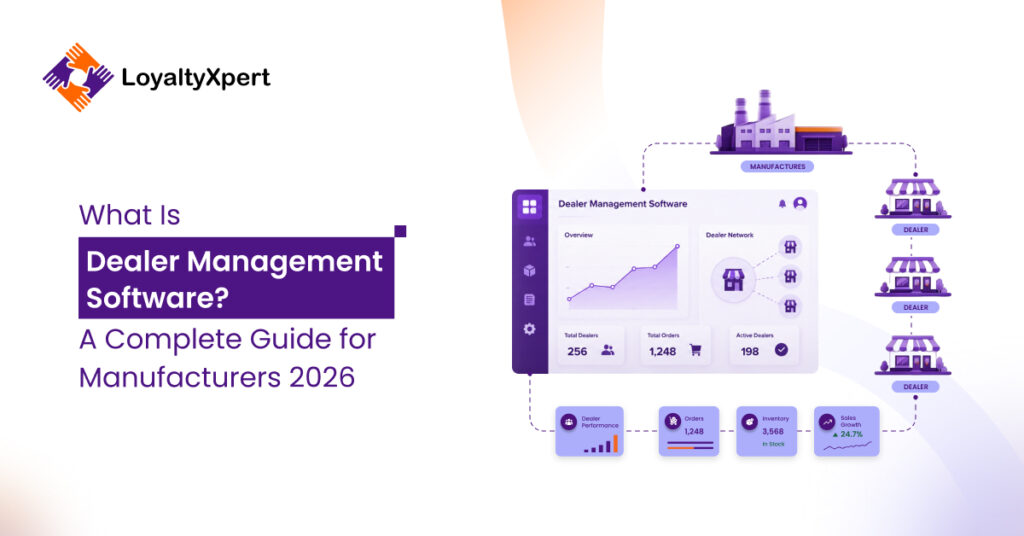
📝Summary
Manufacturers now manage hundreds of dealers across regions. Spreadsheets and phone calls cannot handle that scale. This guide explains dealer management software in plain terms. You will learn what it is and how it works. You will see must-have features, benefits, and industries. A buyer’s checklist helps you pick the right dealer management solution.
A dealer calls your area manager about the new scheme. The manager digs through a week-old email thread. He quotes the wrong slab rate. The dealer places that order with your competitor.
One small moment. One lost order. Now multiply it across 800 dealers and 12 states.
That is what manual channel management actually costs. Not inefficiency on a slide. Real orders, walking out the door daily.
Meanwhile, dealer expectations have changed completely in 2026. Dealers want app-based ordering and instant clarity on schemes. They want rewards credited the moment invoices upload. Whoever makes their day easier wins their counter.
Dealer management software exists for exactly this reason. It puts your entire channel on one platform. This guide explains how, in plain language.
What Is Dealer Management Software?
Dealer management software is a centralized digital platform for manufacturers. It manages the complete dealer lifecycle in one place. The system handles onboarding, orders, schemes, claims, and communication. It replaces spreadsheets, calls, and scattered follow-ups. Every team works from one accurate source of truth.
Think of it as a command center for your channel. Your sales head sees live dealer performance on a dashboard. Your dealers place orders through a mobile application. Your finance team approves claims with full documentation attached.
The market reflects this shift toward digitization. Manufacturers everywhere now treat dealer management software as core infrastructure, not an optional tool.
One important distinction deserves attention here. A CRM tracks customers. An ERP tracks internal operations. Dealer management software tracks your channel partners. Each system serves a different master.
Why Do Manufacturers Need Dealer Management Software in 2026?
Manufacturers need dealer management software because manual channel management breaks at scale. Fragmented communication, slow onboarding, and inconsistent pricing hurt dealer trust. Delayed orders and invisible performance data hurt revenue. A unified system removes these friction points. It gives manufacturers control and dealers convenience.
Did You Know? Future Market Insights projects the dealer management system market to reach USD 15.8 billion by 2035. That marks steady growth of around 5.3% every year.
That growth reflects a practical reality. Manufacturers adopt this software to remove daily friction. Here are the five channel problems it solves immediately:
- Fragmented Communication – Scheme updates get lost across calls, emails, and messages. Dealers act on outdated information and lose trust.
- Manual Dealer Onboarding – Paper-based KYC and verification stretch onboarding into weeks. New dealers stay unproductive during that entire period.
- Inconsistent Pricing and Schemes – Different regions quote different prices without central control. Dealers notice the gaps and question your fairness.
- Delayed Order Processing – Orders are processed via phone calls and manual entries. Errors creep in, and fulfillment slows down.
- Zero Dealer Visibility – Leadership cannot see who sells what and where. Decisions rely on gut feeling instead of data.
Each problem looks small in isolation. Together, they quietly drain margin and dealer goodwill. Solving them requires a system, not more staff.
How Does Dealer Management Software Work?
Dealer management software works as an end-to-end channel workflow. It connects dealer onboarding, ordering, claims, engagement, and reporting. Dealers interact through a mobile or web application. Manufacturers control everything from a central administration panel. Data flows automatically between both sides in real time.
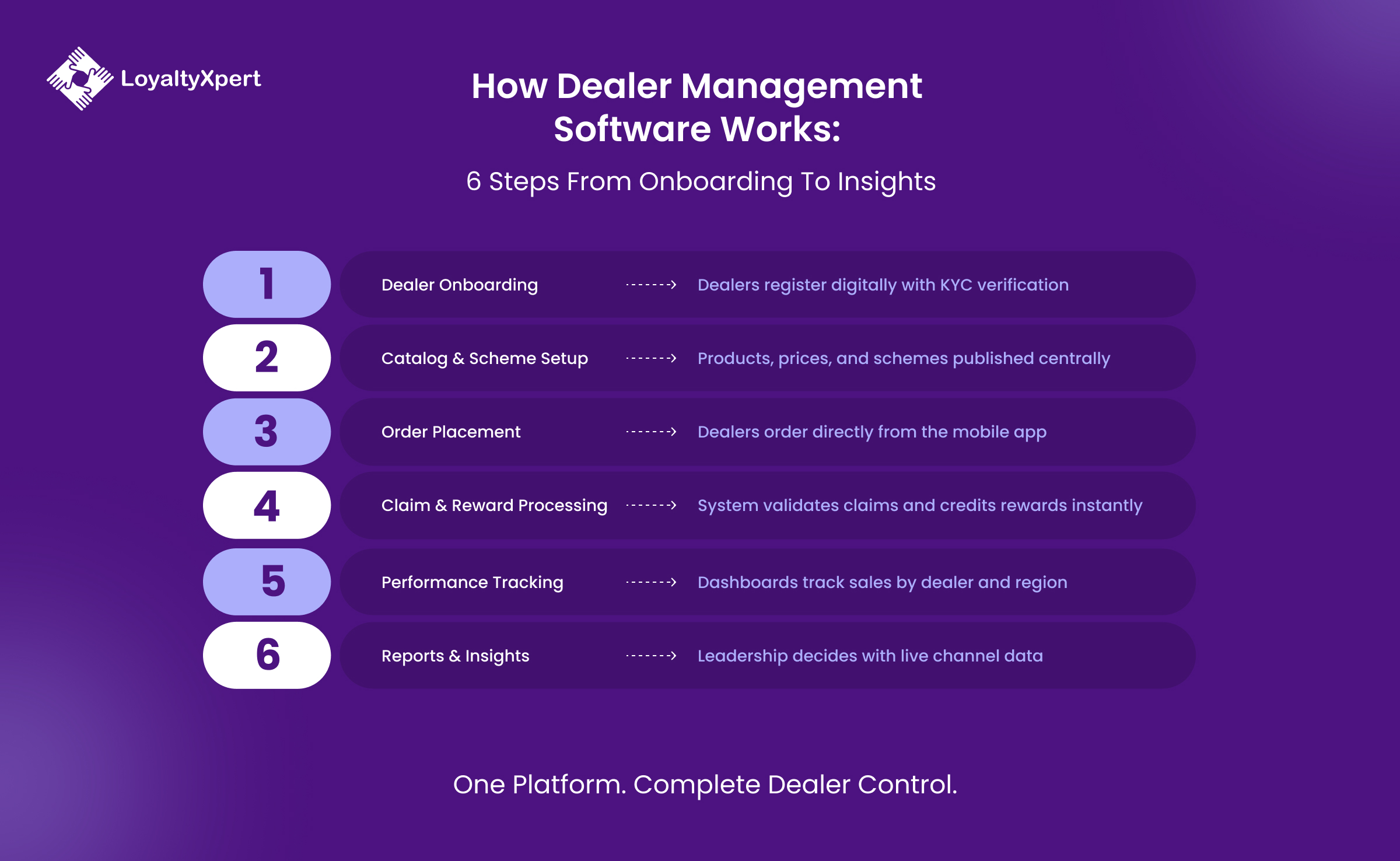
Here is the typical workflow, step by step:
- Dealer Onboarding and Verification – Dealers register digitally with KYC documents. The system verifies details and assigns role-based access.
- Catalog and Scheme Configuration – The manufacturer publishes products, prices, and incentive schemes. Every dealer sees accurate, region-specific information.
- Order Placement and Approval: Dealers place orders directly in the application. Approval workflows route each order to the right person.
- Claim and Reward Processing – Dealers submit invoices or scan QR codes. The system validates claims and automatically credits rewards.
- Performance Tracking – Dashboards track primary and secondary sales by dealer. Managers spot slow movers before quarters end badly.
- Reporting and Insights – Automated reports reveal trends across products and regions. Leadership makes decisions backed by live channel data.
The entire cycle runs without manual intervention. Your team steps in only for exceptions.
What Are the 9 Must-Have Features of a Dealer Management Platform?
A strong dealer management platform must cover nine core capabilities. These include digital onboarding, order management, and inventory visibility. Claim management, document storage, and mobile access come next. Analytics, integrations, and role-based access complete the list. Missing features create gaps that dealers feel daily.
Use this table as your feature evaluation reference:
| Feature | What It Does | Why It Matters |
|---|---|---|
| Digital Dealer Onboarding | Automates registration, KYC, and verification | Cuts onboarding from weeks to days |
| Order Management | Captures, routes, and tracks dealer orders | Removes errors from manual order entry |
| Inventory Visibility | Shows stock levels across the channel | Prevents stockouts and dead inventory |
| Claim Management | Validates and settles dealer claims digitally | Stops fraud and speeds up payouts |
| Document Management | Stores agreements, invoices, and certificates centrally | Keeps audits fast and disputes rare |
| Mobile Accessibility | Gives dealers a dedicated mobile application | Keeps audits fast and disputes rare |
| Analytics and Dashboards | Tracks sales, engagement, and scheme performance | Turns raw channel data into decisions |
| ERP and CRM Integrations | Syncs data with existing business systems | Eliminates duplicate entry across departments |
| Role-Based Access Control | Restricts data by role and region | Protects sensitive pricing and dealer information |
Notice what these nine features share. Each one removes a daily friction point. A platform missing even two creates gaps. Dealers feel those gaps before you do. So evaluate against this list, not vendor brochures.
How Does Dealer Engagement Software Strengthen Channel Relationships?
Dealer engagement software strengthens relationships by making dealers feel valued. It delivers personalized communication, timely incentives, and skill-building content. Engaged dealers push your brand harder at the counter. They stay loyal even when competitors offer discounts. Engagement converts a transactional network into a committed one.
Management keeps operations running. Engagement keeps dealers choosing you. Both matter equally.
Strong engagement rests on four pillars:
- Personalized Communication – Send scheme announcements segmented by region, tier, or product. Relevant messages get read; generic blasts get ignored.
- Incentive and Reward Programs – Reward purchases, targets, and referrals with points. A structured guide to dealer loyalty program design helps here.
- Training and Product Education – Share product videos, catalogs, and certifications in-app. Trained dealers sell with more confidence.
- Recognition and Gamification – Publish leaderboards and celebrate top performers publicly. Recognition costs little and motivates enormously.
Dealers who feel seen behave differently. They share market intelligence and defend your shelf space. That loyalty compounds year after year.
What Are the 6 Benefits of Dealer Management Software for Manufacturing?
Dealer management software for manufacturing delivers six measurable benefits. It raises operational efficiency and dealer productivity. It accelerates decision-making with real-time channel visibility. It reduces manual work, errors, and claim fraud. Together, these gains translate directly into higher channel sales.
Let us break each benefit down:
- Higher Operational Efficiency – Automation handles onboarding, orders, and claims. Your team focuses on strategy, not paperwork.
- Improved Dealer Productivity – Dealers order, track, and claim without waiting. Less friction means more selling time.
- Faster Decision-Making – Live dashboards replace month-old spreadsheet reports. Managers correct course within days, not quarters.
- Complete Channel Visibility – Every transaction leaves a digital trail. You finally see secondary sales clearly.
- Reduced Manual Work and Errors – Automated validation catches duplicate and inflated claims. Finance teams recover hours every single week.
- Increased Channel Sales – Engaged, well-served dealers sell more consistently. A structured dealer loyalty program for dealers multiplies this effect.
These benefits stack on each other. Efficiency funds engagement. Engagement drives sales. Sales justify the investment many times over.
Which Industries Benefit Most From Dealer Management Software?
Industries with layered distribution networks benefit the most. These include building materials, paints, adhesives, and electricals. Automotive, FMCG, industrial equipment, and consumer durables follow closely. Any manufacturer selling through dealers gains from centralization. Deeper networks see faster and larger returns.
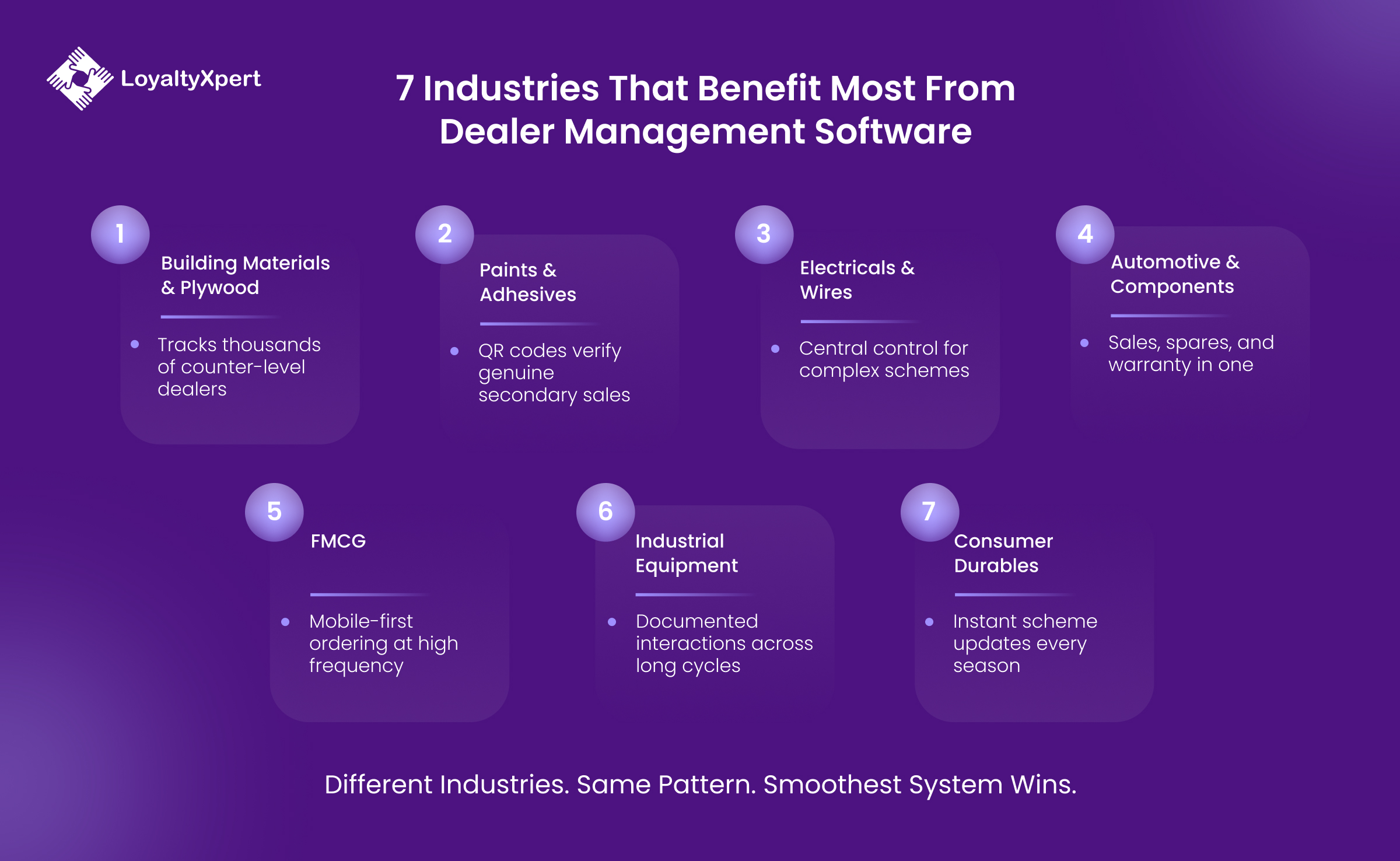
Here is how the software fits each industry:
- Building Materials and Plywood – Manufacturers track thousands of counter-level dealers. Invoice-based claims suit bulk, non-barcoded products.
- Paints and Adhesives – QR-code scanning verifies genuine secondary sales. Influencers like painters join the same ecosystem.
- Electricals and Wires – Scheme complexity runs high across product lines. Central configuration keeps every dealer aligned.
- Automotive and Auto Components – Dealers manage sales, spares, and service claims. Warranty workflows integrate into one system.
- FMCG – High-frequency ordering demands mobile-first simplicity. Real-time stock visibility prevents lost sales.
- Industrial Equipment: Long sales cycles require documented dealer interactions. Performance data guides territory planning.
- Consumer Durables – Seasonal schemes change fast and often. Instant communication keeps dealers ready.
Different industries, same underlying pattern. Dealers reward whichever brand runs the smoothest system. Many manufacturers pair the software with a channel loyalty program to achieve greater impact. Operations keep dealers efficient; loyalty keeps them yours.
How Do You Choose the Right Dealer Management Solution?
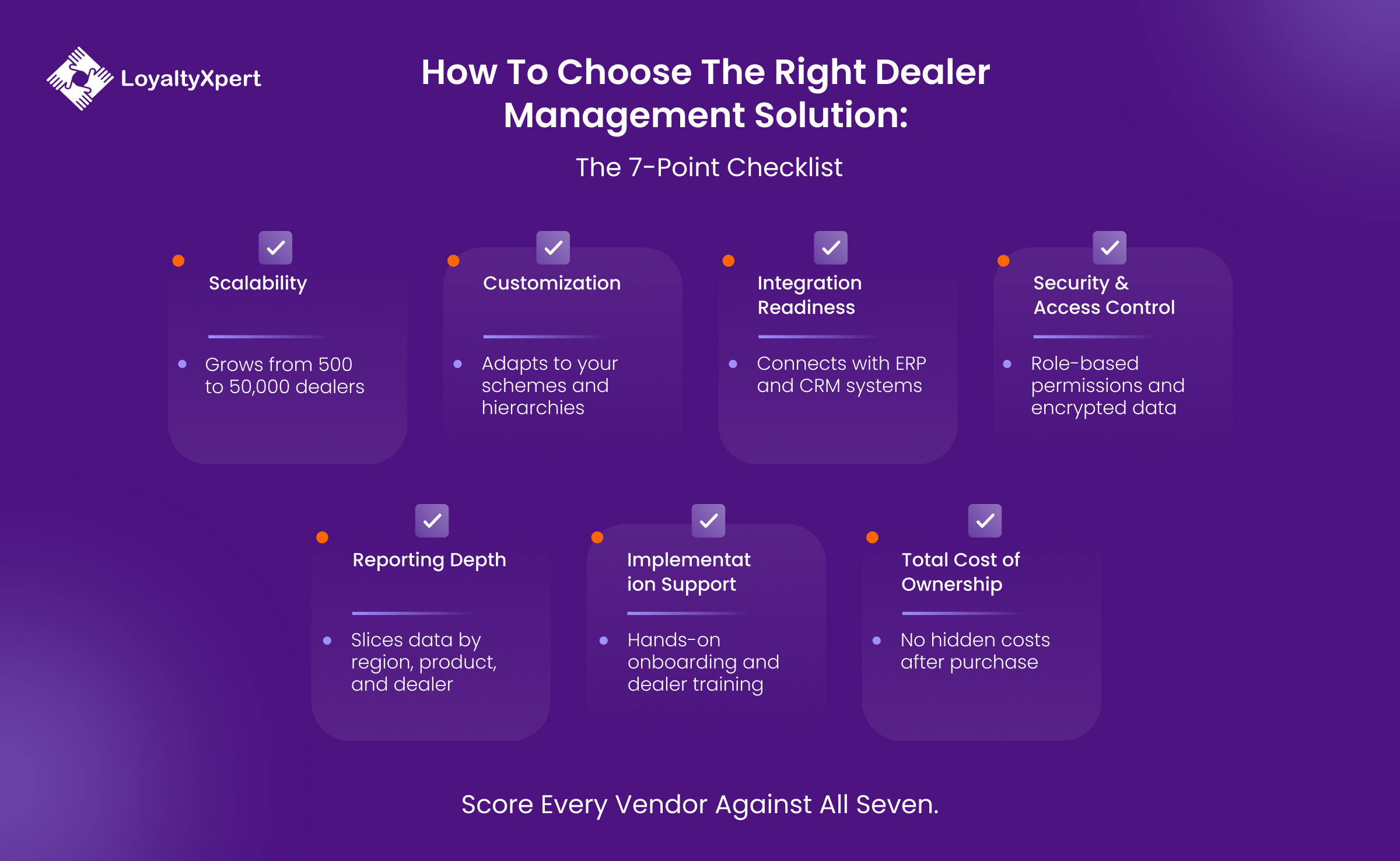
Choose a dealer management solution by testing seven factors. Check scalability, customization depth, and ERP or CRM integration. Verify security standards, reporting capabilities, and implementation support. Then calculate the total cost of ownership honestly. The right vendor scores well on all seven.
Run every shortlisted vendor through this checklist:
- Scalability-Can it scale from 500 to 50,000 dealers? Ask for proof, not promises.
- Customization – Does it adapt to your schemes and hierarchies? Rigid platforms force painful workarounds later.
- Integration Readiness: Does it integrate with SAP, ERPs, and CRMs? Pre-built connectors save months of development.
- Security and Access Control – Does it offer role-based permissions and data encryption? Your pricing data deserves serious protection.
- Reporting Depth – Can leadership slice data by region, product, and dealer? Shallow reports waste good data.
- Implementation and Support– Does the vendor offer onboarding assistance and training? Adoption fails without hands-on support.
- Total Cost of Ownership – Count licenses, implementation, integrations, and support together. Cheap software with hidden costs stays expensive.
Vendors serving dealer management software for B2B businesses should demonstrate channel-specific expertise. Ask how they handle a channel partner loyalty program within the same platform. Combined capability beats stitched-together point tools.
Score each vendor against all seven factors. The pattern becomes obvious quickly.
Conclusion
Dealer networks decide how far manufacturers grow. Yet most manufacturers still manage them with yesterday’s tools. Spreadsheets cannot build relationships. Phone calls cannot scale.
Dealer management software changes that equation completely. It automates operations, deepens engagement, and reveals channel truth. Onboarding shrinks to days. Claims settle without disputes. Dealers stay loyal because working with you feels easy.
The manufacturers winning in 2026 made this shift early. Their dealers order in seconds and earn rewards instantly. Their leaders decide with live data. The gap between them and manual competitors keeps widening.
Your dealer network deserves the same advantage. Start evaluating a dealer management solution today.
LoyaltyXpert helps manufacturers manage, engage, and grow their dealer channels from one platform.
See the platform in action with your use case. Book Demo