
 Max 11min read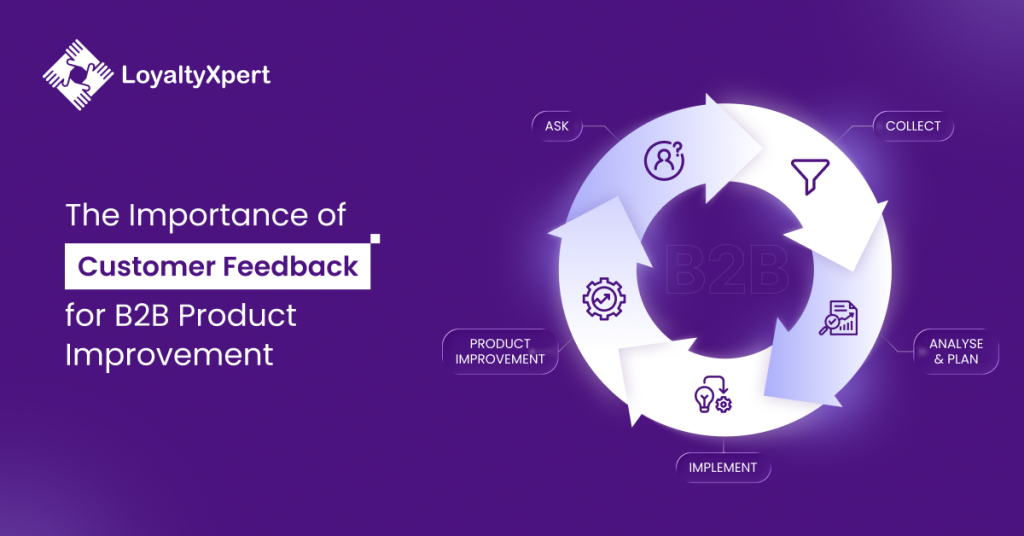
“Can customers’ feedback help in B2B product improvement?” If you are a business-to-business (B2B) brand, then this question must definitely have come to your mind.
That’s because B2B companies don’t deal directly with customers but different types of channel partners such as dealers, distributors, wholesalers, value added resellers, influencers, etc.
So how can customers’ feedback help them improve their products? We’ll, in this blog post, discuss just that.
This blog post covers the importance of product improvement for B2B organizations, challenges B2B companies face in improving their products, and how to take customer feedback for B2B product improvement.
Why Is B2B Product Improvement Indispensable?
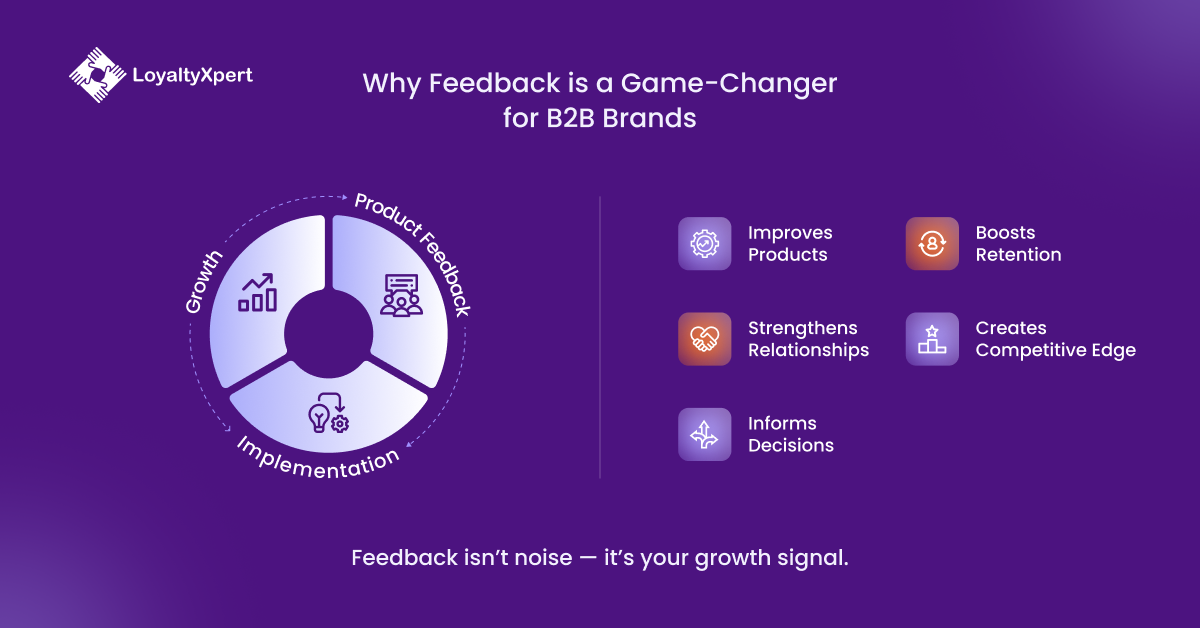
No matter how great a product might be, there are always areas for improvements. Most companies figure out the areas where they can improve their products and implement them. Those that don’t, are left behind. In today’s time, B2B product improvement is not optional. It’s compulsory. Let’s discuss some key reasons why B2B product improvement is indispensable.
1. To remain competitive
At a time when continuous evolution and incremental improvements are the name of the game, not improving products puts a business in a massive disadvantageous position. B2B brands must take customer feedback and improve their products to remain competitive in today’s time.
2. To survive in the market
“Improve or perish.” That’s the hard reality for contemporary manufacturers. The sooner they acknowledge it, the better it would be for their business. It’s not difficult to find countless examples of products that once were extremely popular but were phased out because they didn’t change with time.
Did you know?
Of the total products manufactured, just 40 percent of them tend to survive in the market, recent stats reveal.
3. To retain customers
“New, next, better.” That’s what a majority of customers look for. B2B organizations that improve their products based on customer feedback are more likely to retain a majority of their customers. Product improvement directly supports an organization’s retention strategies. On the other hand, if an organization ignores the minor flaws in its products, no matter how subtle they may be, it is more likely to lose some of its customers. As noted economist W. Edwards Deming rightly said, “No one knows the cost of a defective product. Don’t tell me you do. You know the cost of replacing it, but not the cost of a dissatisfied customer.”
4. To eliminate imperfections in new products
As we have already discussed, no matter how great a product is, there is always room for improvements. However, in many newly-innovated products, the scope for improvement is more. And it shouldn’t be surprising. The initial version of any product is not the best one and it improves by leaps and bounds in subsequent versions.
Did you know?
When it comes to product innovation, 95 percent of new products miss the mark, finds a research by Massachusetts Institute of Technology.
5. To benefit from incremental gains
Legendary author Mark Twain famously said, “Continuous improvement is better than delayed perfection.” The quote resonates even more in the present time. The bestselling book ‘Atomic Habits’ has described the power of continuous improvement and incremental growth. It said if someone keeps on improving by just one percent everyday for a year, then they’ll get 37 times better by the end of the year. If an organization keeps on improving its product little by little, they can benefit from massive incremental growth.
6. To optimize supply chain
Would it be surprising to know that improved products can enhance the supply chain? It definitely shouldn’t. In B2B marketing, fast-moving products have a massive edge over the slow-moving ones. Customer feedback can help in finding out which products move fast and which sit idle. A little improvement in product quality can enhance speed, optimize inventory planning, and eliminate wastage.
7. To enhance revenue growth
B2B product improvement pays for itself. Improved products not only retain existing customers but also attract new ones. Every adjustment, every upgrade, every tweak opens up the floodgates to generate additional revenue. When B2B customer feedback fuels product improvement, sales stop being seasonal spikes and become a steady upward climb.
8. To build long-term trust
Trust isn’t built by promises. It’s built by action. When customers see their feedback shaping your roadmap, loyalty strengthens. Every product update signals that you’re listening. Every refinement confirms that you’re invested in their success. This cycle creates more than satisfaction. It creates advocacy. Your clients don’t just buy again; they recommend. And that trust becomes the most powerful growth engine your brand can have.
9. To future-proof business
Markets change. Technology evolves. Customers never stop shifting. Brands that ignore this are left behind. But brands that embed customer feedback into every decision stay ahead. They anticipate demand. They pivot smoothly. They adapt without panic. This constant evolution doesn’t just protect today’s revenue. It safeguards tomorrow’s. Future-proofing isn’t about predicting every change. It’s about building the reflex to change continuously.
Challenges in Getting Customer Feedback for B2B Product Improvement
When it comes to improving their product range, business-to-customer (B2C) organizations, as well as companies that follow a direct-to-customer (D2C) model, have it a bit easier compared to their B2B counterparts. That’s because they deal with customers directly. But B2B organizations don’t directly deal with end customers. That’s why they face multiple challenges. Here are some of those.
1. Level of intermediaries between manufacturers and end customers
The biggest challenge manufacturers face in understanding what the end customers want, as far as product improvement is concerned, is the layers of intermediaries between them and the end customers. Many levels come in between them and the end customers. That takes us to the next point.
2. Limited direct interaction with end-users
Many B2B brands sell through distributors, dealers, or channel partners. This adds layers between the manufacturer and the actual user. The result? Feedback is diluted or lost entirely, creating blind spots in B2B customer feedback collection.
3. Multiple stakeholders in decision-making
In B2B, buying decisions rarely rest with one person. A product may be evaluated by procurement, finance, and technical teams simultaneously. This makes customer feedback fragmented and harder to consolidate, delaying meaningful B2B product improvement.
4. Difficulty in measuring real product usage
Surveys and meetings can only capture opinions. But in reality, usage data often tells a different story. Without advanced analytics, brands may miss key behavioral patterns that could fuel B2B product improvement.
5. Feedback fatigue among customers
When customers are overloaded with surveys, forms, and interviews, they tune out. This “customer feedback fatigue” reduces response quality and leaves brands with shallow insights. Not the depth needed for meaningful B2B product improvement.
How to Take Customer Feedback for B2B Product Improvement?
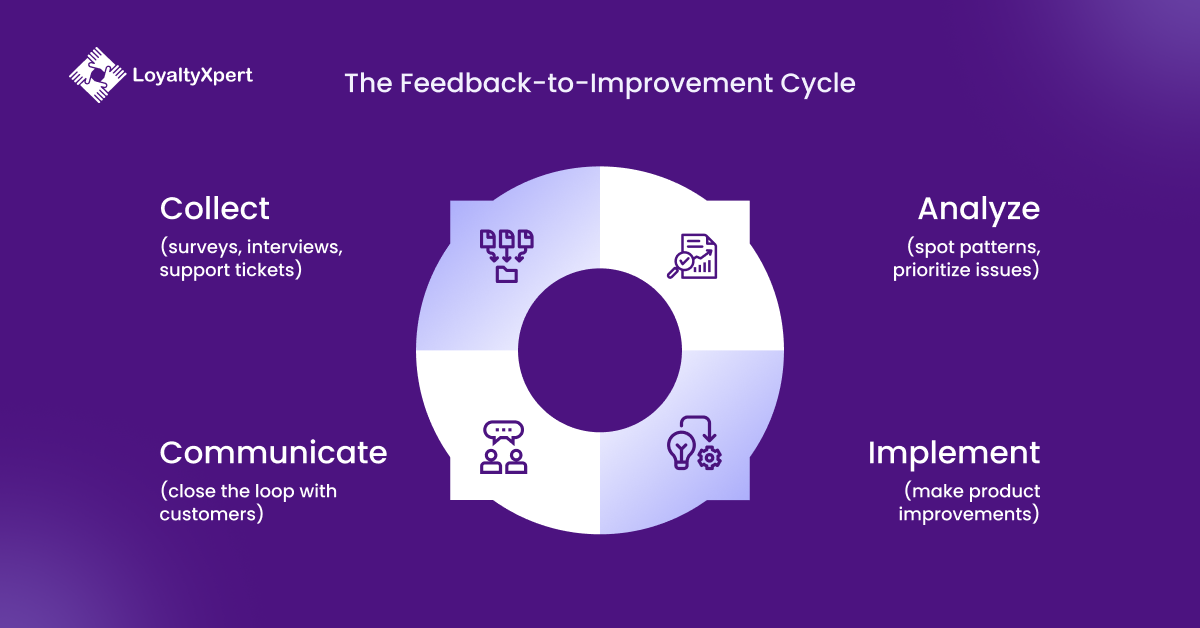
Obtaining B2B customer feedback is a child’s play for B2B organizations. They don’t face any problem in that aspect for obvious reasons. But when it comes to taking the feedback of end customers, they face a lot of problems and challenges. We have already discussed some of those above. But notwithstanding the problems and challenges, there’s still a way to take customer feedback from the end users. Let’s discuss how.
1. Surveys and feedback forms
Surveys and feedback forms are the oldest methods to take customer feedback. Surveys aren’t just about ticking boxes. They’re your direct line into the customer’s mind. A well-crafted survey uncovers pain points, feature requests, and satisfaction levels that raw sales data never reveals. When structured correctly, surveys don’t just collect opinions. They map out a roadmap for B2B product improvement.
2. Use loyalty programs and platforms to seek customer feedback
As revealed by several studies, nearly nine out of ten businesses use some form of loyalty program. So why not use that to take customer feedback? Are you wondering how manufacturers can use their loyalty programs and loyalty platforms to seek customer feedback? The answer is simple. Even though manufacturers design B2B loyalty program for their channel partners and various other intermediaries, it can still act as a bridge between them and end customers. They can leverage sophisticated loyalty software to seek customer feedback.
3. Gauge CSAT scores
Just as SAT scores are important for meritorious students, CSAT (customer satisfaction) scores are important for businesses. As noted speaker and trainer Kevin Stirtz rightly said, “Know what your customers want most and what your company does best. Focus on where those two meet.” Many B2B organizations measure channel partner satisfaction to assess how satisfied their channel partners are with their brands. They can consider asking their channel partners to share the CSAT scores of end customers.
4. Net Promoter Score (NPS)
The Net Promoter Score (NPS) is a market research metric that asks customers questions such as “On a scale of one to 10 how likely are you to recommend us?” Or a simple one such as, “Would you recommend us to a friend or colleague?” Based on the ratings, respondents could be divided under three categories. Promoters are those who give a rating of nine to ten. Passives are those who give a score of seven to eight. Detractors are those who give a score of six or less. This feedback method cuts through the noise and it can tell B2B organizations who their supporters are and who are their detractors.
5. Focus groups
It’s one thing to ask customers for their feedback after they use it. But it’s altogether a different thing to involve them directly in product planning through different focus groups. As the name suggests, focus groups are group interviews that include a limited number of participants (usually up to 12 people). Over the years, many organizations have started using it to collect data, understand customer behaviour, and, of course, seek customer feedback.
No CTA found.
Now, the question comes “Can manufacturing organizations and B2B brands run focus groups to enhance their products?” The answer to the question is a resounding yes. By conducting focus groups, manufacturers and B2B organizations can gain sharper insights and build stronger customer retention strategies at the same time.
6. Use social media, AI tools, and online forums to find out your end customers’ pain points or common problems
This one is a bit unconventional but is highly effective to understand the common pain points or problems of your end customers. Many people share specific pain points and problems (mainly related to business and products) on various social media platforms such as Twitter as well as online forums such as Reddit and Quora. Manufacturers can leverage artificial intelligence (AI) tools such as ChatGPT, Grok, and Perplexity to find out the specific pain points and problems end customers face related to their product or industry by enabling the deep research feature. The AI tools can compile an exhaustive list of tweets, questions, and threads related to that in less than a minute.
7. Track end users’ usage data and insights
The question may come to mind “How can B2B organizations track usage data and insights of end customers when they don’t deal with them directly?” They can get various key data through various ways such as data from their loyalty platforms, point-of-sale (PoS) devices, dashboards, and more. Manufacturers and B2B brands can gain valuable insights on what features end customers love, what they ignore, and what could be better. This feedback fuels both innovation and supply chain optimization.
Taking Everything Into Consideration,
The work of manufacturers doesn’t end after they’ve created a product. On the contrary, it just started. They must figure out ways to take the product to the market and put it in the hands of the end customers. The work doesn’t end there. They need to improve the product consistently. Only then they can remain in the business for a long haul.
To enhance their products, manufacturers need the inputs of end customers. But as most of them don’t deal with end users directly, they need to find out ways to understand what their end customers think about their products and how they can improve their products.
That’s where manufacturers need to think out of the box and come up with effective strategies to take the feedback of end users. At LoyaltyXpert, we have helped many manufacturing organizations and B2B brands in taking customer feedback for B2B product improvement.
Our B2B loyalty platform and sophisticated loyalty software have helped manufacturers and B2B organizations of various sizes to get valuable customer feedback and data insights. If you are curious to know about how our solutions can help you gain customer feedback for B2B product improvement, contact us today and book a free demo.