 Max 6min read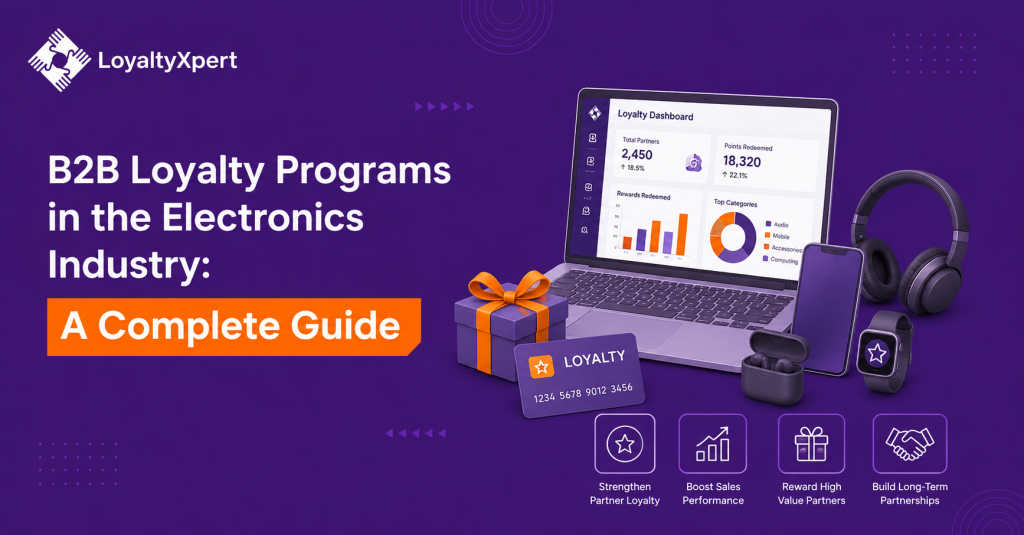
The electronics industry operates through complex networks of distributors, dealers, retailers, installers, and channel partners. With intense competition, frequent product launches, and evolving customer expectations, electronics brands face constant pressure to strengthen channel relationships and maintain market share.
This is where B2B loyalty programs play a critical role. By rewarding dealers, distributors, retailers, and channel partners for purchases, sales performance, product promotion, and brand advocacy, electronics companies can increase engagement, encourage repeat business, and reduce partner switching.
Modern B2B loyalty programs go beyond traditional incentive schemes by leveraging digital platforms, automated rewards, real-time tracking, and performance analytics to create measurable business outcomes.
In this guide, we’ll explore how B2B loyalty programs help electronics brands improve partner loyalty, drive sales growth, and strengthen their distribution ecosystem.
Benefits of loyalty programs in the electronic industry
1. Customer retention:
In the electronic business, loyalty programs play a crucial role in client retention. Take Best Buy’s “My Best Buy” initiative, for example. Customers who participate in this program receive points for every dollar spent, which they can then exchange for savings on additional purchases. With its member-only pricing and point-accumulating incentives, Best Buy gradually builds up its client base by promoting repeat business.
2. Brand loyalty:
Loyalty programs are a common tool used by electronic firms to cultivate strong client brand loyalty. Consider Apple’s “Apple Rewards” initiative. Apple provides several advantages with this program, including exclusive event access, unique financing choices, and point accumulation for purchases. By offering these benefits, Apple fosters a sense of loyalty and attachment among its clients, resulting in ongoing support and advocacy.
3. Data utilization:
Loyalty programs offer important information about the tastes and behavior of customers. Samsung, for example, uses user interactions and purchases to tailor recommendations and prizes through its “Samsung Rewards” program. Samsung improved the overall customer experience by customizing its product offerings and marketing strategies to better match the demands and preferences of its target market by studying this data.
4. Word-of-mouth marketing:
Satisfied members of loyalty programs often become brand advocates and expand their market share through word-of-mouth referrals. The Starbucks Rewards program for instance offered members birthday prizes, personalized offers, and free drinks. These customers would then tell their friends, family, and coworkers about their positive experiences. Through genuine, customer-driven advertising, their enthusiastic recommendations encourage others to sign up for the Starbucks Rewards program, fostering organic development and strengthening the brand presence of Starbucks.
5. Competitive advantage:
Loyalty programs can make a big difference in a cutthroat market like the electronics sector. Consider Amazon Prime, which provides a host of advantages such as free shipping, access to streaming services, and special discounts. By offering these advantages, Amazon differentiates itself from rivals and draws in and keeps consumers who like the extra features of membership.
Ways B2B loyalty programs contribute to achieving remarkable results
1. Increasing Sales for Channel Partners
B2B customer loyalty programs provide incentives such as bonuses, commissions, and awards to electronics dealers, distributors, and retailers, encouraging them to surpass sales goals. This promotes wider product distribution and higher sales volumes, which boost the expansion of the company as a whole.
2. Promoting Cross-Selling and Upselling
Channel partners are encouraged to cross-sell and upsell comparable electronic products through B2B loyalty programs. Manufacturers can promote more purchases and product bundles and boost revenue by offering bonuses or rewards for meeting sales targets.
3. Assisting with after-sale support
Benefits and awards for superior after-sales care given by channel partners may be included in B2B reward programs. This motivates partners to provide priority to warranty services, product upkeep, and customer assistance, which raises customer satisfaction and encourages repeat business.
4. Motivating market growth
B2B loyalty programs encourage channel partners to investigate new markets and grow their clientele. Electronics manufacturers can incentivize partners to enter undeveloped markets by offering unique pricing or territorial exclusivity. This can expand brand awareness and stimulate business growth.
4. Assisting in the launch of products
A key factor in the successful launch of new electrical devices is B2B loyalty programs. Manufacturers can encourage their channel partners to actively market and sell their new products by providing early access, unique promotions, and alluring incentives. This will help drive initial sales momentum and market adoption.
Types of B2B loyalty programs in the electronic industry
1. Volume based discounts
Volume-based loyalty programs offer tiered discounts or awards based on the amount of orders which encourages dealers to buy large quantities in a single order. For instance, Dell’s “Dell Advantage Rewards” program offers any small business making a purchase of INR 35,000 and above a discount on the next purchase. The higher the purchase value more is the discount offered.
2. Tiered loyalty programs
B2B clients are divided into various tiers by tiered rewards programs according to the volume or frequency of their purchases. Lenovo’s “LenovoPRO” program, for instance, provides three membership tiers: Silver, Gold, and Platinum. With each tier unlocked, you can get increasingly valuable benefits like personal account managers, first dibs on goods and services, and first-rate technical assistance. This encourages companies to invest more to advance and gain access to more perks.
3. Co-branded credit programs
B2B customers can use co-branded credit cards to make purchases and receive rewards or cashback through co-branded credit programs. The “Office Depot Business Credit Card” that Office Depot offers is one such. Every dollar spent by businesses earns them rewards points that can be exchanged for gift cards, account credits, or travel benefits.
4. Referral programs
Referral programs encourage existing clients to recommend new clients to your program. Cisco’s “Cisco Referral Program” pays partners to introduce new clients who complete eligible purchases. Partners receive rewards in the form of credits for training and certification courses, rebates, or discounts on further purchases. This improves the relationship between the business and its current partners in addition to helping them attract new clients.
5. Partner programs
Partner programs entail company partnerships to provide packaged product offerings, co-marketing opportunities, or joint promotions. For example, companies can work with Samsung to develop and market integrated solutions for their consumers through the “Samsung Partners” program. Through strategic collaborations, Samsung broadens its market reach while partners can strengthen their services and draw in new customers by utilizing Samsung’s technologies and strong brand.
Final words
B2B loyalty programs have become a powerful tool for electronics brands looking to improve dealer engagement, strengthen distributor relationships, and drive long-term sales growth. By rewarding channel partners for purchases, performance, and brand advocacy, businesses can create stronger loyalty and reduce competitive switching.
As distribution networks become more complex, electronics companies are increasingly adopting digital loyalty platforms to automate rewards, improve visibility, and measure program effectiveness. The right loyalty strategy can help brands build stronger partner ecosystems and achieve sustainable growth.
Looking to launch a B2B loyalty program for dealers, distributors, retailers, or channel partners in the electronics industry? Contact Us to discuss your requirements or Request a Demo to see how LoyaltyXpert helps electronics brands improve engagement and loyalty.