Loyalty Program Software Cost in 2025: Pricing, Factors & ROI

One of the first questions businesses ask before launching a loyalty initiative is: How much does loyalty program software cost? The answer depends on several factors, including program complexity, number of participants, reward structures, integrations, customization requirements, and deployment model.

Whether you’re planning a customer loyalty program, dealer rewards platform, channel partner loyalty solution, or influencer engagement program, understanding the full cost of implementation is essential for budgeting and long-term success.
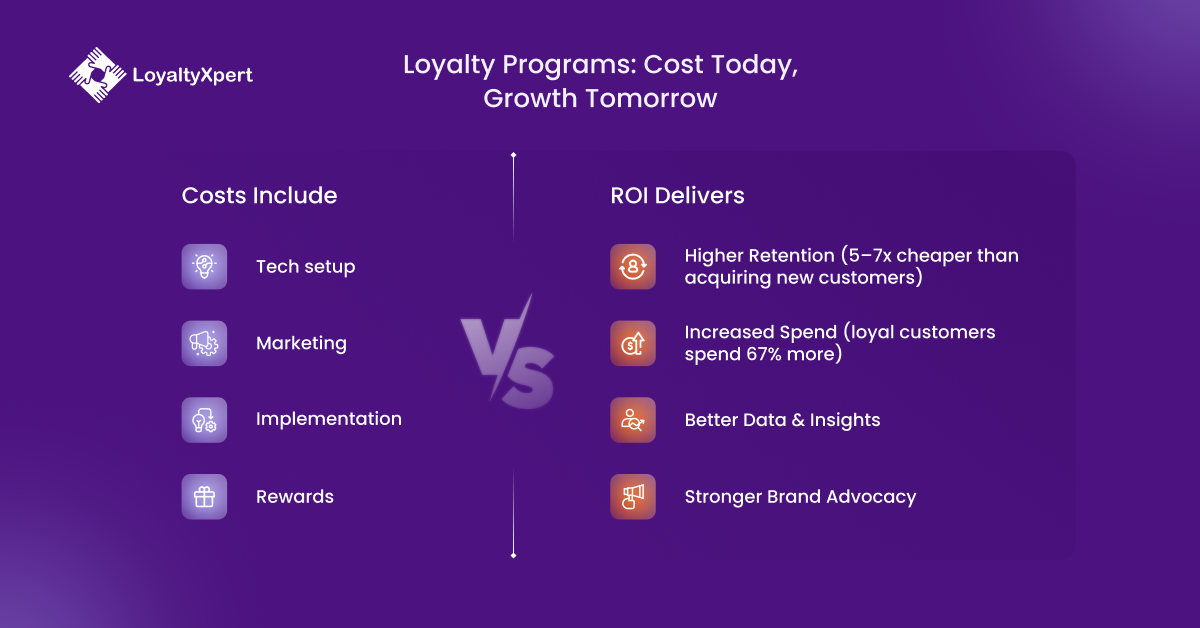
What Makes Up the Cost of a Loyalty Program

As per responses summarized in a new report, loyalty programs accounted for 31% of the total marketing budget, up from 22.8% in 2022. The report also revealed that 83% of loyalty program owners reported a positive ROI, with a strong average of 5.2x.

While loyalty program software requires an upfront investment, many businesses see significant returns through increased retention, higher repeat purchases, stronger engagement, and improved customer lifetime value.

In this guide, we’ll break down loyalty program software pricing, hidden costs, implementation considerations, ROI expectations, and how to choose the right solution for your business.

Loyalty Program Software Cost vs Traditional Loyalty Program Software Cost

At present, many successful businesses are not just looking for ways to optimize their loyalty programs but also reduce the costs associated with running them. In such a scenario, leveraging technology and having a digital-first mindset is extremely beneficial.

Just imagine; if you choose to design and create traditional (or Excel sheet-based) loyalty programs, then it will require you to create everything from scratch. Besides, you will have to spend a lot of time and effort tracking and managing all your loyalty activities manually.

But you can cut your costs by leveraging technology and investing in high-quality loyalty software for business. The loyalty program software cost is far less than the costs incurred in running and managing traditional loyalty programs. That’s why the global loyalty market size is expected to grow at a double-digit figure.

💡 Did you know?

The global loyalty management market size is projected to grow at a compound annual growth rate of 15.3% from $15.19 billion in 2024 to $41.21 billion by 2032, as per a report released by Fortune Business Insights. 

Factors Affecting the Costs of Loyalty Programs

The price that you are going to pay for your loyalty programs is going to be determined by a wide range of factors. Several factors influence costs in different ways. Here are some of those:
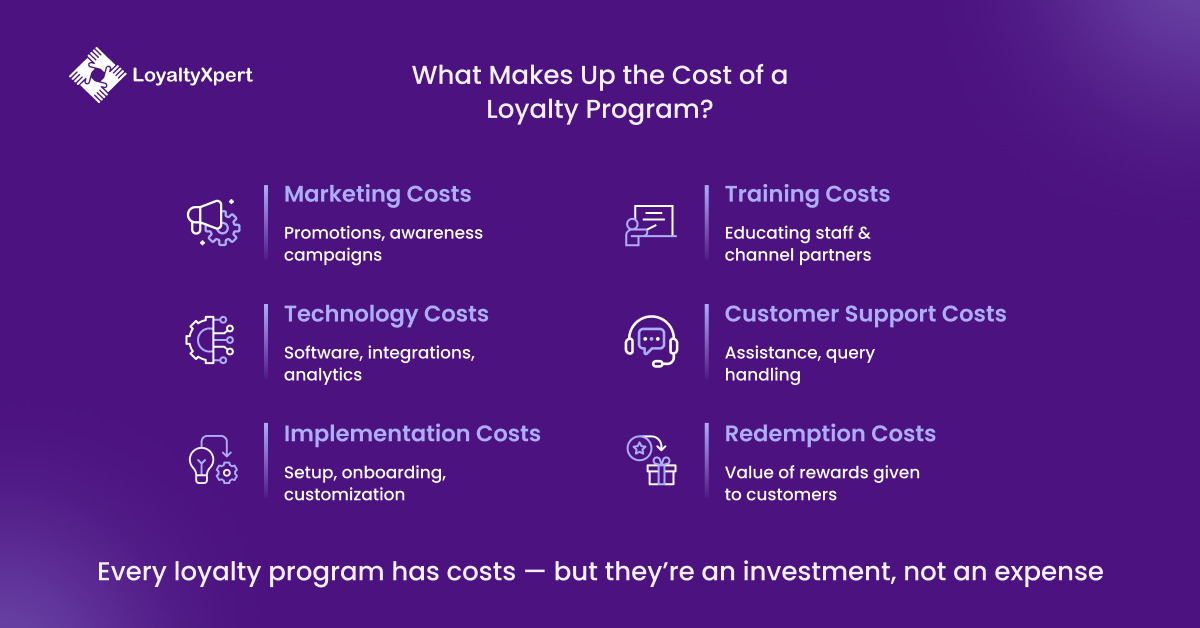
What Makes Up the Cost of a Loyalty Program

1. Types of loyalty programs

Different types of loyalty programs involve different costs. The cost of creating, running, and managing a stamp-based loyalty program can start from USD 100 and the recurring maintenance costs for a customized loyalty app can go up to several thousand (even million) dollars.

Let’s take some examples of leading companies that command strong loyalty from their business partners and clients. For instance, let’s look at Lenovo’s Leap Program, which is considered one of the best B2B loyalty programs in the world. To design, create, run, and manage the loyalty program the personal computer behemoth invested in a bespoke loyalty solution. It also leveraged high-end technology and app-based loyalty programs to provide excellent brand experience and build robust engagement.

But small and medium enterprises cannot afford to invest in such programs. They, however, can invest in small and medium-scale technology to create and run their loyalty programs.

2. Technology costs

How could we not have technology costs on the second slot when we have discussed technology in the above point? This, however, doesn’t apply to businesses that don’t use any type of technology tool to design, create, and run loyalty programs.

But if a business uses any type of technology then it has to incur some types of technology costs. As discussed in the above point, Large and enterprise-sized businesses invest a lot in technology and their expenses (read investments) are quite considerable compared to their smaller counterparts.

This is where small and medium-sized businesses should look for the right technology partner to run and create loyalty programs. Many loyalty solution providers offer free trial periods, which can help in making informed buying decisions.

The setup costs of digital loyalty programs are usually low. After paying the nominal setup fee, you can start your program with just a click of a few buttons. If you are planning to run an app-based loyalty program, then you will need to invest in the right software that can work for your business. That’s why you must consider the loyalty program software cost.

3. Implementation costs

After investing in the right loyalty software for business, you also need to implement the loyalty program and the costs associated with that known as the implementation cost. The cost of implementing a loyalty program increases with its size, scope, and complexity.

It is critical to consider implementation costs as they can have a huge impact on the total budget. The technology costs also considerably affect the implementation cost. The bigger the tech stack, the more will be the implementation costs.

This is where SaaS loyalty software is highly beneficial. As per the 2025 Global Customer Loyalty Report, 28.8% of respondents chose the “ease of managing the loyalty program” as the most valuable aspect of third-party loyalty technology.

4. Marketing costs

Marketing a loyalty program is as important as creating and running it, if not more. This type of cost involves designing and creating marketing strategies for loyalty programs, paying for the creation and printing of marketing materials, and incurring the costs of promotional and advertising campaigns.

As per responses summarized in Global Customer Loyalty Report 2025, on average, companies with a loyalty program allocate 31% of their total marketing budget to customer loyalty program management and Customer Relationship Management. The number has risen 5.4% from 22.8% in 2022.

5. Customer support cost

Creating and implementing loyalty programs is one thing but providing the right customer support is an altogether different ball game. From onboarding clients to assisting them in collecting and redeeming loyalty points, customer support is a huge part of loyalty programs.

When you create a loyalty program, you need to figure out the types and levels of support you intend to provide to your clients and set aside the right budget for that. If you create and run your loyalty programs in-house, it will require you to hire dedicated customer support representatives to provide customer support. But if you partner with a loyalty solution provider, then the provider will bear the customer support cost.

6. Location

Location plays a huge role in determining the costs of a loyalty program. For instance, a company that’s based in New York will have different costs to create and run a loyalty program than a Mumbai-headquartered firm. Let’s take a look at the cost of loyalty programs in different countries:

  • As per several reliable sources, the average annual cost per device for small and mid-sized loyalty programs ranges between USD 100 and USD 500 in the United States and Canada.
  • Likewise, in the UK, the average yearly cost per user for small and medium-sized loyalty programs ranges between GBP 75 and GBP 400.
  • In Australia and New Zealand, the average annual cost for small and medium-sized loyalty programs ranges between AUD 150 (or NZD 160) and AUD 750 (or NZD 810).

In India, the cost of loyalty programs is the most cost-effective. Many loyalty companies in India can design the same quality loyalty software and app-based loyalty programs just for a fraction of costs.

7. Add-on or update costs

Add-on costs are the expenses incurred by businesses when they add new features or functionalities to their existing loyalty programs. Update costs are the expenses that keep existing loyalty programs up to date. Both these costs apply to the companies that have existing loyalty programs and they just pay for the addition of more features or update costs.

8. Knowledge costs

As the name suggests, knowledge costs include the costs of skilled technical experts, such as frontend and backend developers, UX/UI designers, project managers, and more such professionals.

In the US, market rates for these professionals range from $104,000 to $180,000 per year.

In India, the market rates are much lower. If you contact some reputable and trustworthy loyalty program companies in India and ask about their pricing plans, you will be surprised to learn how cost effective they are compared to their counterparts not only in North America, Western Europe, or Oceania, but also in other parts of the world such as the Middle East, South Africa, and many Southeast Asian countries.

9. Platform costs

The cost of integrating a loyalty platform into the existing systems is something businesses must keep in mind. 

Based on an organization’s internal processes, the platform implementation costs can range between $4,000 to $8,500 per month.

After the development of the loyalty program’s core functionalities, the real work begins. The platform needs to be integrated into Customer Relationship Management (CRM), billing, and sales systems.

Best Practices to Optimize Loyalty Program Software Cost

Creating and implementing loyalty programs is going to cost money. But it’s easy to optimize the costs and pay the right price for your loyalty campaigns. Let’s find out what are those:

1. Determine the features you need

An average loyalty software solution comes with several features, some of which may not be as useful as others. Before looking for any loyalty solution provider, list out the features you want and need in your software. This will help you ensure that you do not pay for features that you won’t ever need.

2. Set aside a reasonable budget

After determining the features you need, setting aside a reasonable budget will help you in a lot of ways. First, it will guard you from overinvesting in the software. It will create a maximum upper ceiling beyond which you mustn’t go. Second, it will also prevent you from the temptations of ‘offers’ and ‘discounts’ on loyalty solutions and save you from low-quality products.

3. Select the right loyalty solution provider

This is the most critical step of all. In a highly-crowded market, you won’t find it difficult to find loyalty solution providers. But it would be extremely challenging to find the right one. Selecting anything less than that will be costly and wasteful in the long run. Nowadays, many loyalty software providers are providing free demos. You can search the internet and find some promising companies that provide free trials, which will help you in making an informed decision.

4. Create coupons with a minimum spend limit

To make sure that loyalty discounts don’t hamper your margins, create coupons with a minimum spend limit. The value should depend on your product’s margin and pricing. Also, start stringently and adjust your rewards as you go. But don’t make rewards, benefits, and points hard to obtain as it can be detrimental to your loyalty program.

5. Provide tailored and relevant rewards to your customers

The type of loyalty rewards you provide to your customers plays a huge role in determining your costs. If you choose transactional and financial incentives over experiential and non-transactional rewards, then it’s going to pinch your pocket more. But when you know your customers well and determine how many of them value non-financial rewards, then creating tailored and relevant rewards for them can prove to be cost-effective.

Industry-Specific Loyalty Program Software Costs

Would you be surprised to know that loyalty program software costs in one industry varies from another? You shouldn’t. That’s because when it comes to retaining customers, some sectors have it easier than others. The ones that face more difficulties in retaining a majority of their customers are more likely to spend more and exert more effort into making their loyalty programs successful. Here are loyalty program software costs as per different industries.

No CTA found.

1. Retail industry

As per a latest study the cost of running a loyalty program in the supermarket industry is between 1-1.5% of revenue. As per the report the cost of running a loyalty program in other retail sectors can range from 2-5%.

2. Quick service restaurants (QSR)

According to a PayiQ report, the cost of a loyalty program in the QSR space averages approximately 10% of total company budget due to high transaction frequency and low average order values.

3. Hospitality and travel sector

As per a release by Lodging Magazine says that hotel loyalty programs cost an average of 1.5% of total operating revenue. As per the report airlines invest even more substantially.

4. E-commerce sector

According to a recent study, the initial setup costs of loyalty programs in the e-commerce industry could range between $10,000-60,000 and the monthly software fees can be about $50-$500.

5. BFSI sector

In the banking, financial services, and insurance (BFSI) sector, the cost of retaining customers is a bit higher and takes more effort. Apart from that, many lenders and financial institutions are known to offer attractive cashback, fee waivers, partner discounts, travel miles, interest rate boosts, and more. The average cost of implementing a loyalty program in the BFSI sector is relatively higher compared to other sectors.

Conclusion

Loyalty program software costs can vary significantly depending on business requirements, program complexity, integrations, and customization needs. However, the right platform can deliver measurable value through improved retention, stronger engagement, higher repeat purchases, and increased customer lifetime value.

Rather than focusing solely on upfront pricing, businesses should evaluate the long-term ROI, scalability, and operational benefits a loyalty platform can provide. Choosing a solution that aligns with your goals and growth plans can help maximize the return on your loyalty investment.

Choosing a loyalty software provider can make a huge difference when it comes to cost optimization. At LoyaltyXpert, we have a proven track record of designing, creating, and implementing the right types of loyalty programs for the best price. To book a free demo, contact us today!
Bank Loyalty Programs: 5 Successful Examples (2025)

Why are bank loyalty programs necessary? Well, the banking industry has witnessed a lot of change in the last few years due to the global pandemic, a series of lockdowns, the resulting supply chain crisis and economic slowdown, the Russia-Ukraine war, as well as the rise of automation and AI.

The events not only affected the way banks and financial institutions operated but also changed consumer behaviour to a great extent. As per data released by Customer Gauge, the median customer attrition rate in the industry is between 20 and 30%. Banks and financial institutions need to do whatever it takes to reduce their customer churn rate.

This is where well-designed bank loyalty programs can be extremely useful in retaining customers and minimizing customer attrition rates. Some loyalty programs that are suitable for other sectors may not be appropriate for banks and financial institutions due to regulatory, ethical, or practical reasons.

Every company that operates in the dynamic and rapidly growing industry, whether it’s a public or a privately-owned bank, non-banking financial corporation (NBFC), or a fintech company, must leverage effective bank loyalty programs to their advantage.

This blog post discusses bank loyalty programs in brief details, benefits of bank loyalty programs, and it lists five successful examples of loyalty programs in banking industry. 

If you work in the dynamic and fast-paced banking and finance industry, this blog post is just for you. So, without further ado, let’s dive right into the blog post. Read on and you would be delighted to do so.

What Is a Bank Loyalty Program?

A bank loyalty program is a marketing strategy to encourage customer loyalty. It Offers rewards to valued customers as a way to acknowledge their ongoing business and interaction with the bank

Loyalty programs can help banks to improve customer relationships, understand customer needs, and offer personalized products and services.

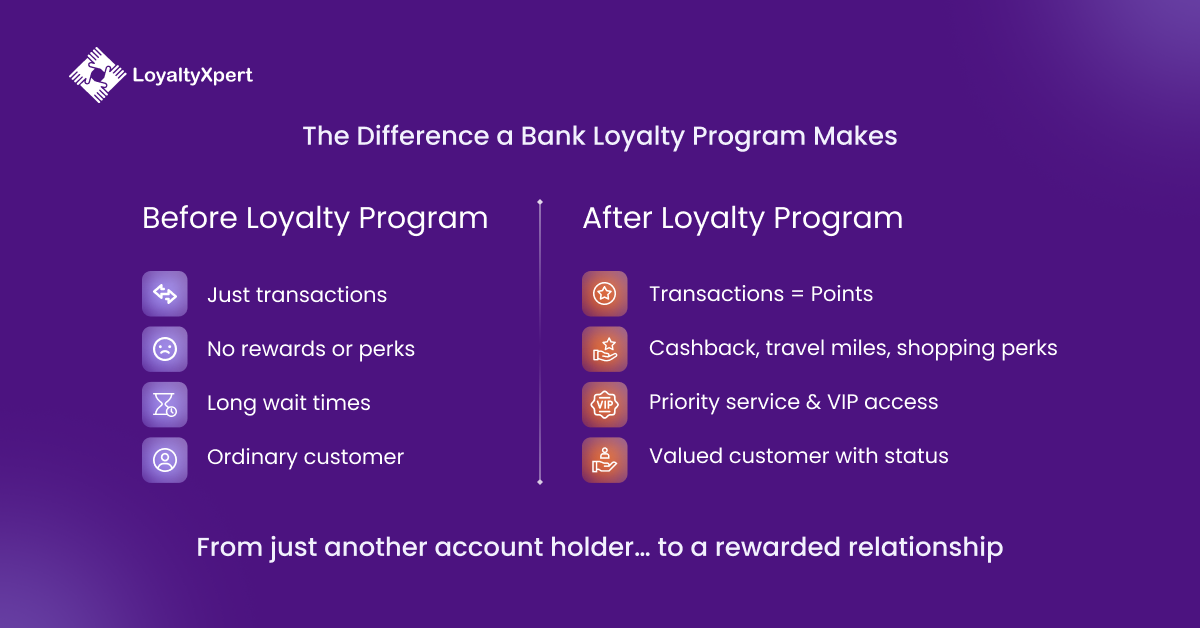
The difference Bank Loyalty Program makes

Based on the information above, the rise of financial technology is putting pressure on traditional banks to innovate and improve their customer service in order to retain customers.

? Did you know?

Nearly 61% of respondents strongly believe that banks and financial institutions should find innovative ways to reward loyal customers, revealed a KPMG study.

Benefits of Bank Loyalty Programs

Loyalty programs in banking industry provide a wide range of long-term benefits. Here are some of those.

1. Better customer engagement

This is one of the biggest benefits of bank rewards programs. A well designed bank loyalty program enables banks and financial institutions to stay connected with their customers. The gamified elements and tiers keep users active and engaged on digital platforms.

2. Higher customer retention

When customers are rewarded for using credit cards, debit cards, or mobile banking apps, they’re less likely to switch to competitors. Bank rewards programs create stickiness by giving clients tangible reasons to stay.

3. Increased cross-selling opportunities

Loyalty platforms give banks insights into customer preferences and behaviors. These insights make it easier to recommend relevant products like personal loans, home loans, or investment options, boosting revenue per customer.

? Did you know?

Nearly 58% of respondents report spending more with brands that offer loyalty programs, a study‘s findings revealed.

4. Enhanced brand differentiation

With multiple banks offering similar products, loyalty programs help stand out. A creative app-based loyalty program or exclusive reward system can make customers feel special and more connected to the bank’s brand.

5. Higher transaction volumes

Customers who know they’ll earn points or rewards for transactions are more likely to use their cards or apps frequently. This directly translates to higher transaction volumes and fee-based income for the bank.

6. Data-driven insights

Loyalty software for business helps banks track customer activity in real time. This data can be used to improve service delivery, personalize offers, and even detect unusual behavior for risk management.

7. Competitive advantage in the market

In a crowded industry, loyalty programs provide a competitive edge. Leading banks worldwide are already leveraging app-based loyalty programs and relevant rewards to grow.

Top 5 Examples of Bank Loyalty Programs

When it comes to loyalty programs in banking industry, here are top 5 example of bank loyalty programs that  innovative rewards keep banks ahead of the curve.

1. Bank of America’s ‘Preferred Rewards program

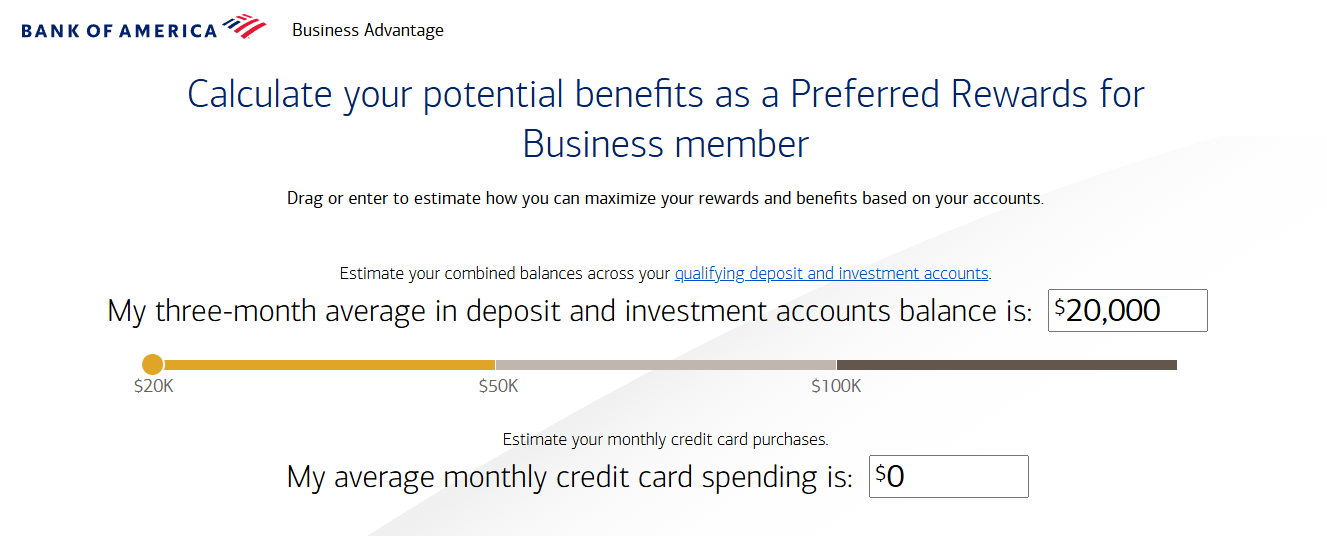
Founded in San Francisco in 1998, Bank of America serves more than 66 million customers in over 4,300 branches across the U.S. The lender has a loyalty program christened ‘Preferred Rewards,’ which has three levels and members get attractive rewards as they climb their way up through the tiers.

Bank Of America Rewards

The base tier is the ‘Gold level,’ which requires customers to maintain a minimum three-month combined average daily balance of $20,000 across their Bank of America and Merrill accounts. Members of this tier get a 5% interest rate booster, a 25% bonus on eligible priority credit services, and many more rewards and valuable benefits that enhance their banking experience.

The second tier, ‘Platinum level,’ unlocks even more benefits for customers who maintain a minimum three-month combined average daily balance of $50,000. Members of this tier enjoy a significantly increased value in all benefits available at the Gold level. They get higher credit service bonuses and interest rate boosts.

The third tier, ‘Platinum Honors level,’ provides the most exceptional rewards and benefits to customers who maintain a minimum three-month combined average daily balance of over $100,000. Members of this tier receive all the benefits of the Gold and Platinum levels but with even more attractive deals.

Bank of America’s Premium Rewards provides its members with enhanced rewards and travel benefits in exchange for an annual fee of $95. The minimum credit limit for the loyalty program is $5,000 and some members have received higher credit limits to the tune of $50,000. The program offers a sign-up bonus of 60,000 online points (worth $600) after a member spends a minimum of $4,000 in the first 90 days of account opening.

2. Citibank’s Citi ThankYou Rewards

Citibank, which was founded as the City Bank of New York in 1812 and later renamed as First National City Bank of Europe, is one of the largest international financial services companies in the world. The bank has more than 100 million customers and 2,649 branches in 98 countries. In 2019, the bank registered revenue of USD 74 billion.

Citibanks Citi ThankYou

The financial firm has an extremely popular points-based loyalty program named ‘Citi Thank You Rewards,’ which enables members to earn points through a wide range of ways. Members can earn points for banking with Citi using an enrolled checking account, using a Citi credit card, and adding qualifying services and products to an existing Citi checking account. Examples include Home Equity Line/Loan, Mortgage, Auto Save, or Personal Loan.

The value of a Citi Thank You point can vary significantly depending on how you redeem it. Members can redeem ThankYou points for travel, cash back, gift cards, charity, payment towards a mortgage or student loan, or shopping.

The best thing about Citi ThankYou Rewards is the level of flexibility and freedom it offers customers in choosing how to use their points. The points can also be shared with other members of the loyalty program.

3. JP Morgan’s One Card

When it comes to banking loyalty programs, how can the largest American bank by assets be left behind? New York-headquartered JP Morgan also has a points-based bank loyalty rewards program named ‘One Card.’

JP Morgan’s “One Card”

In the program, every reward point is equal to a dollar spent. The program requires customers to use a JP Morgan card to collect points and use it in a wide range of ways such as gift cards, travel cards, cash credit, and merchandise.

The loyalty program also provides big businesses with the option to reward their employees with points as well as reinvest the points into the business. Members can earn unlimited points and the points are extremely easy to manage and don’t expire.

The best part is, that members get 25,000 bonus points if they spend at least $50,000 within three months of account opening. The loyalty program is designed to minimize the risk of misuse of points and fraud. Real-time reporting makes it extremely easy to keep track of the points.

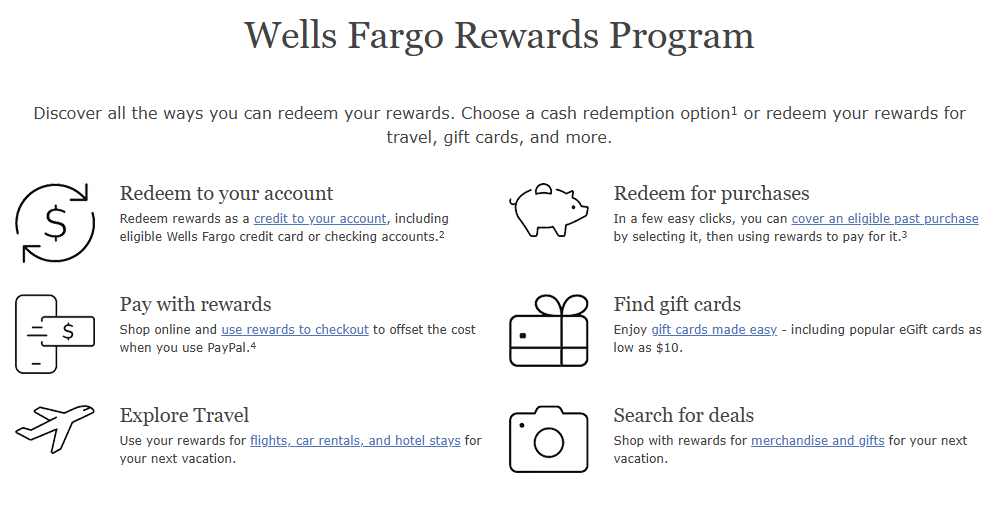
4. Wells Fargo Rewards

San Francisco-based Wells Fargo is one of the leading banks in the U.S. with a customer base of 70 million, a market share of USD 97 billion, and a total asset of USD 1.97 trillion. The bank’s loyalty program is named ‘Wells Fargo Rewards,’ which is available to all eligible rewards-based credit card holders.

Wells Fargo

The financial service company offers three eligible credit cards—the Wells Fargo Active Cash Card, the Wells Fargo Reflect Card, and the Hotels.com Rewards Visa Credit Card.

Customers who have enrolled in one of these special credit cards get a chance to win a wide range of rewards such as:

  • redeeming for purchases and gift cards
  • redeeming rewards back to their accounts
  • using the rewards towards airline and holiday expenditures

Customers can share the rewards with a fellow Wells Fargo account holder or donate the points to the American Red Cross. The reward program is easy to manage. Customers can keep track of their rewards through the Wells Fargo website.

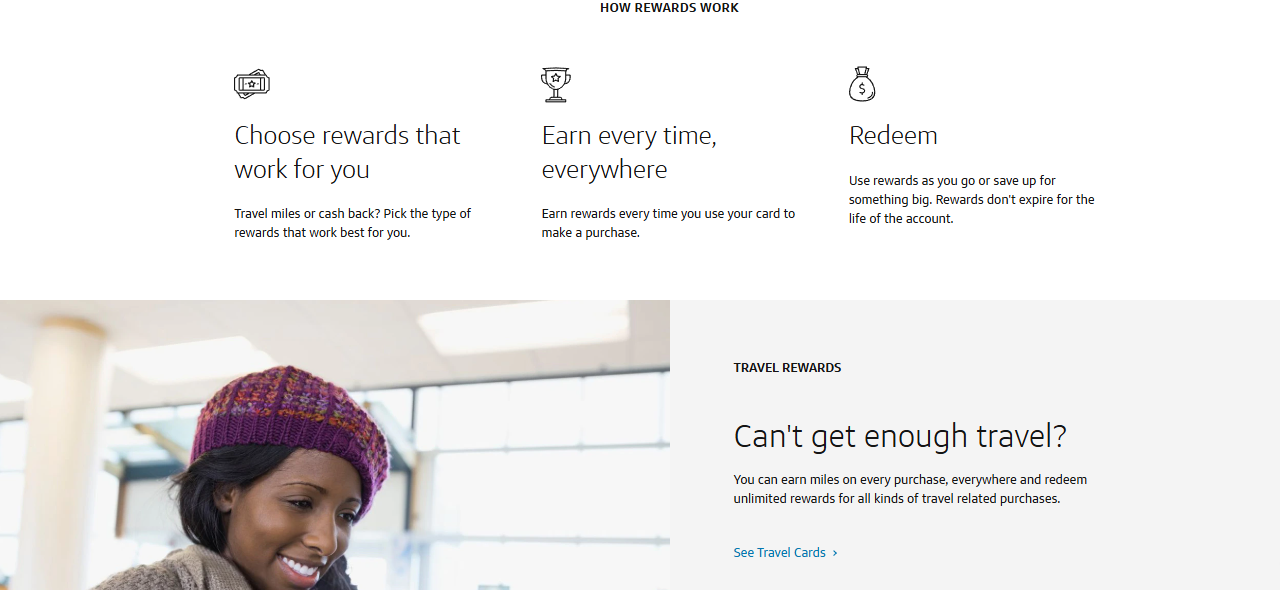
5. Capital One Venture Rewards

Capital One, which was founded in 1994 in Richmond, Virginia, is a bank that’s known for specializing in savings accounts, credit cards, and car financing options. The bank offers accounts for individuals and businesses and it enables parents to open savings accounts for their children with no minimum balance requirements or monthly fees.

Capital One Rewards

The bank offers an exciting loyalty program named ‘Capital One Venture Rewards,’ which is a three-tiered loyalty program that offers a wide array of benefits and perks for its credit card users. The tiers are:

General rewards: Customers with a credit card and an account are eligible for this tier. Rewards in this tier include cash back on entertainment, dining, grocery stores, and other purchases.

Travel rewards: Customers who have the Capital One Venture/Venture One travel rewards card are eligible for this tier. The tier offers excellent miles rewards to customers with strong credit for an annual fee of $95. By using the loyalty card, members can earn two miles on every dollar they spend on all purchases. They get a sign-up bonus of 75,000 miles when they spend at least $4,000 in the first three months of account opening.

No CTA found.

Cash back rewards: Customers who have the Quicksilver credit card are eligible for this tier. Rewards for this category include cash back on every purchase, which can be redeemed in any way the customer likes.

To sum it all up,

As the name indicates, bank loyalty programs are specially designed for banks and financial institutions. That makes the loyalty programs extremely suitable in all aspects. These four types of bank loyalty programs will not only help banks and financial institutions retain customers for a long time but also build trust and strengthen customer relationships.

At LoyaltyXpert, we have a solid track record and years of experience when it comes to creating effective loyalty software for business. If you are looking for the right loyalty program companies in India that will not just help you design and run effective bank loyalty programs but stand firmly by your side throughout each stage, then look no further. Contact us today to book a free demo and experience how we can help you realize your dreams.

Trade Promotions vs. Discounts: What Works Best for Manufacturers?

If you are a manufacturer or you work in the manufacturing industry in some capacity you must have wondered (at least at some point in time) whether to use trade promotions or discounts.

Manufacturers have used several trade promotions strategies for various intermediaries (such as dealers, distributors, wholesalers, retailers, etc.) involved in the distribution process.

They have used discounts for some specific reasons. But today, many manufacturers stand at a crossroads. Some are more inclined to choose trade promotions and various trade promotion strategies. Some are tempted to choose the seemingly lucrative discounts.

But both have their unique strengths and uses. It isn’t a question of “Between trade promotions and discounts, which one is the best?” But, the right question to ask is “When to use trade promotions and when to use discounts?”

In this blog post we will discuss trade promotions and discounts in detail, the key differences between both, when manufacturers should use trade promotions, and when they should use discounts.

If you are curious to know more about trade promotions and discounts, this blog post is just for you. So, without further ado let’s dive right into it and know about the two effective promotion and retention strategies. Read on and you would be delighted to do so.

What Are Trade Promotions?

Trade promotions are tactics that are designed to encourage intermediaries to stock more of the product, allocate more to shelf space, or promote it more vigorously to customers.

The carefully planned tactics drive sales, strengthen partnerships, and preserve brand value through offers such as:

  • Volume-based incentives (buy X, get Y free)
  • In-store visibility investments (end-cap displays, signage)
  • Loyalty rewards for consistent partners
  • Bundled offers that increase overall product adoption
  • Incentives such as free point of sale displays
  • Bulk buying rebates

? Did you know?

Consumer packaged goods (CPG) companies around the globe invest almost 20% of their revenue annually on trade promotions, reveals a McKinsey study.

To put things in perspective, that’s approximately $500 billion annually on trade promotions!

What Are Discounts?

The reduction in the normal or marked price of a product or service. These are unarguably the most common form of promotional strategy that almost everyone, even a small child, knows about it.

The main objective of discount strategies for manufacturers is to attract customers, increase sales, or clear inventory. There are at least five types of discounts:

Percentage discount: As the name suggests, this cuts a certain percentage off from the original price. 

Fixed-amount discount: Quite self explanatory. This deducts a specific monetary amount from the original price.

Quantity discount: This discount is applicable only when someone purchases a certain quantity of items.

Promotional discount: This discount is offered as part of a special promotion or sale.

Cash discount: This is an immediate price reduction for paying with cash or using specific coupons.

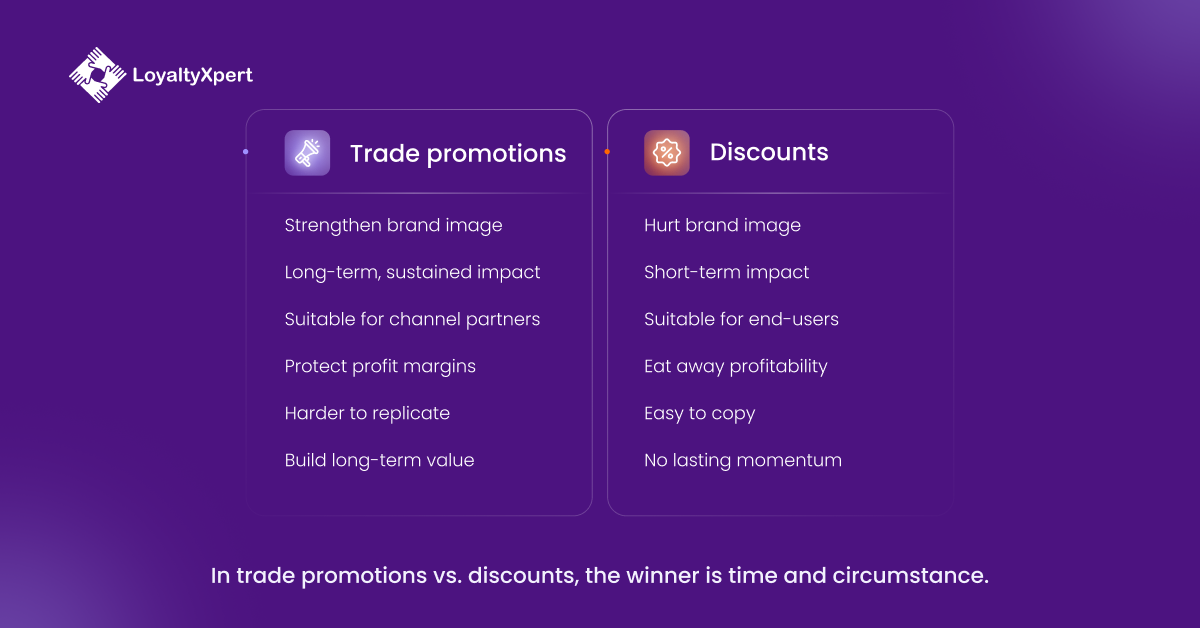
Key Differences Between Trade Promotions and Discounts

As we have already discussed above, trade promotions and discounts have their unique advantages and disadvantages. In the contest of trade promotions vs discounts, here are some key differences to know.

Key DIfferences between Trade Promotions and Discounts

1. Impact on brand

Discounts: While they generate quick interest, discounts can harm brand perception over time. Customers begin to associate the brand with “cheap deals” instead of quality or uniqueness. This erodes value.

Trade promotions: Instead of lowering the price, trade promotions add value for distributors, retailers, and even the end customer. They position the manufacturer as a partner that supports growth, rather than one that constantly cuts prices. Over time, this strengthens the brand’s reputation in the marketplace.

2. Timeframe

Discounts: Their effect is immediate but short-lived. Once the promotional period ends, sales often drop back to normal levels. Sometimes, even lower because buyers wait for the next discount.

Trade promotions: These are designed for sustained impact. Whether it’s a loyalty program for distributors or shelf-space investments, the benefits build over weeks or months. They create a foundation for repeat business and long-term sales momentum.

3. Target audience

Discounts: These are primarily focused on the end customer. The idea is simply to lower the price, attract more buyers. But this ignores the vital role of distributors and retailers in selling the products.

Trade promotions: Focused on the intermediaries (such as distributors, wholesalers, and retailers). By incentivizing them with rewards, rebates, or exclusive schemes, manufacturers secure better relationships and ensure their products are actively promoted to consumers.

4. Sustainability

Discounts: Easy to implement but dangerous to sustain. The more discounts a manufacturer offers, the less effective they become. Competitors can quickly copy them, leading to a “race to the bottom” where no brand truly wins.

Trade promotions: More versatile and repeatable. A manufacturer can design new campaigns, rotate incentives, or adjust mechanics without harming price perception. Because they don’t rely on cutting the product’s sticker price, trade promotions are inherently more sustainable over the long term.

5. Profit Margins

Discounts: These directly affect profitability. A 10% discount may look small. But across thousands of units, it eats away the profit margins. Worse, once customers get used to lower prices, raising them back feels like punishment.

Trade promotions: Instead of cutting prices, promotions encourage higher volumes and stronger sell-through. Margins stay intact, and the incremental lift comes from increased orders.

6. Customer behavior

Discounts: They condition shoppers to wait. Customers who see frequent discounts begin to delay purchases, expecting the “next sale.” This creates inconsistent demand.

Trade promotions: By incentivizing retailers and distributors, manufacturers drive consistent shelf presence. This leads to more stable sales patterns and repeat consumer purchases driven by better visibility.

7. Competitive edge

Discounts: These are easy to copy. The moment a manufacturer slashes prices, competitors can match or undercut. What looked like a win turns into a zero-sum race to the bottom.

Trade promotions: These are harder to replicate. Retailer partnerships, loyalty rewards, and exclusive visibility deals create barriers that competitors can’t break overnight.

8. Long-term value creation

Discounts: These are quick to spur demand but they leave little behind. Once the campaign ends, so does the momentum. The brand equity takes a hit after that.

Trade promotions: They build ecosystems. Over time, they foster loyal distributors, stronger retailer partnerships, and a brand that commands respect.

When Manufacturers Should Use Trade Promotions?

We have already discussed some of the basic differences between trade promotions and discounts. Now, let’s discuss the key instances when manufacturers should use trade promotions to derive the maximum benefits. Here are some scenarios in which best trade promotion tactics work like magic.

1. When launching a new product line

When manufacturers come up with a new product line, they may have to face a little (or a lot of) hesitation from intermediaries due to the risk involved. It’s a bet, after all. If the product line clicks, it will be a roaring success. If it doesn’t, then it would phase out from the market. This is where manufacturers can offer trade promotions to motivate channel partners to stock, display, and sell the new products to end customers.

2. While entering a new market or region

Well, this is the extension of the first point. Just as manufacturers launching new products are better off using trade promotions, the same goes for those entering new markets and regions. When manufacturers foray into a new territory, trade promotions can help them lure channel partners, secure shelf space, and grab eyeballs faster than discounts ever could. 

3. To boost the sales of slow-moving products

Not all slow-moving products carry a negative connotation. Some are slow-moving by default, while some are by design. Sometimes, the more premium a product is compared to its counterparts, the more slow-moving it is. Slashing prices and offering discounts will only dilute its brand value. But trade promotions will enhance its sales.

4. To achieve more prominent and premium placement

“What trade promotions have got to do with the way a manufacturer’s product(s) get placed by channel partners?” The question may come to your mind. The answer is, “a lot.” Even though discounted products may look very attractive to the eyes, it can be repelling on a psychological level. It may raise a lot of questions on quality and other aspects. But trade promotions, on the contrary, commands a premium tag and enjoys a prominent placement.

5. To strengthen channel loyalty

We have already discussed this in the beginning and we will talk about it in detail now. Trade promotions are great to strengthen channel loyalty. That’s because the different aspects of trade promotions keep partners engaged and committed to a brand.

When Manufacturers Should Use Discounts?

Now that we have already discussed when manufacturers should use trade promotions, let’s now discuss when they should use discounts. Here are some instances where discounts can prove to be both tactical and strategic measures.

1. To clear excess or obsolete inventory

Before manufacturers must introduce their new stock to the market, they must clear the excess and older ones. Discounts are the easiest and fastest way to clear the stock that’s nearing expiry, outdated, or clogging warehouses.

No CTA found.

2. To clear seasonal stock

A lot of manufacturers make certain products for specific occasions or seasons. Think of an apparel brand launching its range of summer collections. A toy maker trying to clear its holiday-specific stock as quick as possible. Likewise, there are a lot of examples. When manufacturers face difficulties, discounts can help them in clearing the stock before it’s too late.

3. For introductory trial of new products

If we take a walk down the memory lane, a handful of our favorite daily-use products carried a massive discount when they were newly introduced in the market. Can you remember? Indeed, discounts can be extremely effective to drive trials for new products in highly competitive categories.

4. Stimulating sales in off-seasons and low-demand periods

Many sectors witness off-seasons or slow months during specific times of the year. During those times, discounts can generate a temporary lift and keep sales flowing. However, a word of caution though, the discounts in the lean period shouldn’t be so low that it eats up the profit margins.

5. Countering competitor pricing attacks

We have already discussed how discounts could be a zero-sum race to the bottom. But it could be the only recourse in a time when all or a majority of competitors resort to aggressive price cuts. In such cases, controlled discounts can help manufacturers in defending market share without losing loyal buyers.

Final Thoughts,

In the battle of trade promotions vs. discounts, the real winner is time and circumstance. Trade promotion strategies are best in certain instances. Discount strategies for manufacturers are suitable in specific situations.

The onus lies on manufacturers to know which strategy to use, when to use, how to use either in different circumstances.

This blog post elucidates when and how manufacturers can use trade promotions and discounts both strategically and tactically.

At LoyaltyXpert, we have helped many manufacturers strike the right balance between trade promotions and discounts through our sophisticated loyalty software.

If you are curious to know more about how choosing the right loyalty platform can help contact us today and book a free demo.

How to Develop a Painter Loyalty Program for Long-Term Brand Loyalty?

Let’s begin the blog post with a question. Who are the main influencers in the paint and coatings industry? Yes, influencers! 

Who influence the buying decisions of homeowners, contractors, builders, and anyone and everyone who intends to get residential, commercial, or public spaces painted?

That’s right! The answer is painters. Professional painters who paint houses, buildings, walls, public spaces, iron works, woodworks, and everything in between for individuals, businesses, or government agencies.

They are not just paid for their painting skills, the magic they create with their hands, but also for their judgement that comes with years of hard work and experience.

If you belong to the paint and coatings industry, you must run a painter rewards program and loyalty program for painters. In this blog post we will discuss the problems paint and coatings manufacturers face while dealing with painters and how the right loyalty program for painters can help them overcome the challenges.

In addition to that we will also discuss the key components of a contemporary paints and coatings industry loyalty program as well as the best strategies to run effective paints and coatings industry loyalty programs. Read on and you would be delighted to do so.

Challenges Manufacturers in Paints and Coatings Industry Face while Dealing with Painters

Manufacturers in the paint and coatings industry don’t deal with painters directly. But they liaise with painters through their intermediaries such as dealers, distributors, wholesalers, retailers, etc. While doing that they face a wide array of problems such as:

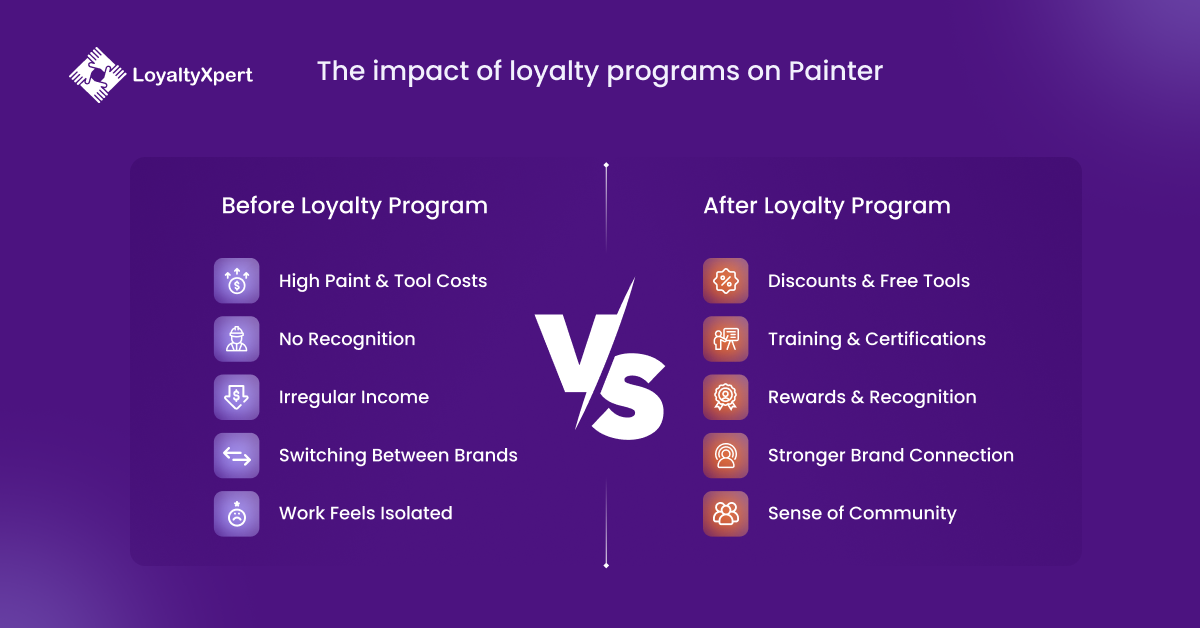
The impact of loyalty programs on Painter and painter loyalty program

1. Communication gaps

As paints and coatings manufacturers don’t deal with painters directly it can lead to massive communication gaps between both the parties. The inability to maintain consistent communication with painters can also cause several issues such as not knowing what painters want, no information about the level of engagement, the level of satisfaction with products and support, among others. The painters also face several issues such as lack of clarity about incentive structures, the goals and objectives of manufacturers, just to name a few. Over a period, this communication gap can prove to be detrimental for both manufacturers and painters.

2. Supply chain disruptions

In the paint and coatings industry, supply chain disruptions are one of the biggest challenges in recent times. This can lead to project delays, loss of clients, and many more ramifications. Even though this aspect is beyond the control of paint and coatings manufacturers, they still can do something about it and streamline their supply chain for minimum disruptions.

Did you know?

Between 2021 and 2022, up to 85 percent of critical components such as monomers, solvents, epoxy resins, and others were in limited supply. This led to a 40-50 percent increase in raw material costs, a study revealed.

3. Reward frauds

In many instances it’s been found that paint and coatings manufacturers create a variety of rewards programs for painters, which don’t reach them. A lot of rewards are lost to frauds and unauthorized access. Reward fraud is a huge challenge in the paint and coatings industry.

Did you know?

The losses due to rewards fraud is estimated to be in the range of USD 1-3 billion every year globally, reveals a recent Reuters report.

4. Lack of product knowledge and training

Apart from rewards and points, painters need hands-on training, demos, and educational content. No matter how great a paint is, it’s of no use if the training isn’t right. If they lack the product knowledge, then it creates a huge gap between them and manufacturers. But in reality, many manufacturers struggle when it comes to imparting the right product knowledge and training to painters. They shouldn’t view painters solely as the artists and the masters of their craft they are. They also need to have in-depth product knowledge so that they can inspire confidence among end customers.

5. Limited personalization of rewards

They say just like every finger on one palm isn’t similar to the other, a person isn’t similar to another. The same holds true for painters. Just think. Can a painter who’s based in a tier one city’s modern residential and commercial buildings and public spaces be similar to a painter in a small town or a village? Likewise, can a painter with years of experience be similar to one new to the trade? No. That’s why manufacturers must personalize rewards for different segments of painters.

6. Over-reliance on traditional methods

In the paint and coatings industry, one thing that hasn’t changed over the centuries is that painters still use their paint brushes to paint (although a lot of them have started using modern paint rollers). But when it comes to adopting technology, they aren’t behind the curve. Whether in villages or cities, many own smartphones. They use the internet to learn, compare products and prices, even make purchases. They’re well equipped to redeem their rewards through smart devices instead of the age-old ways. Manufacturers in the paint and coatings industry must keep this in mind and change traditional ways of engaging with painters and rewarding them.

How the Right Painters Program Can Help Manufacturers in Paint and Coatings Industry Overcome the Challenges?

The right painters program can work wonders for manufacturers in the paint and coatings industry. It can mean the difference between success and failure. Here’s how the right painters program can help in overcoming the above-mentioned challenges:

1. Bridge communication gaps

A well-designed painter rewards program ensures manufacturers in the paint and coatings industry not only bridge communication gaps with their Influencers but keep them engaged. Apart from closing the communication gap instantly, the right influencer loyalty program can help manufacturers nurture brand loyalty at scale.

2. Imparting right training

We have already discussed how the lack of product knowledge could be a major challenge for both manufacturers and painters. The right paint industry loyalty program can help in enhancing painters’ product knowledge. A well crafted digital loyalty program for painters can help manufacturers in the paint and coatings industry impart a wide array of training such by embedding tutorials, guides, and product videos inside loyalty software for business.

3. Tailoring different rewards for different painters

As no two painters are the same, how can the rewards be? A one-size-fits-all, generic reward is a bad idea in the paint and coatings industry. So what’s the solution? That’s right, a tailored and customized painter incentive program that’s specifically engineered for different painter segments. A successful painter rewards program offers flexibility based on painter preferences. The rewards, both monetary or non-monetary, must be designed in such a manner to inspire trust, loyalty, and advocacy from painters.

4. Preventing reward frauds

Can the right loyalty program prevent reward frauds? Yes, of course. An app-based loyalty program backed by advanced loyalty software for business introduces QR-code validations, invoice uploads, and real-time tracking. These features ensure transparency and eliminate loopholes. Partnering with expert loyalty program companies in India helps manufacturers secure their systems. By doing so, they would ensure that fraud prevention isn’t an afterthought but a built-in strength.

5. Encouraging digital adoption

In the paint and coatings industry, many painters still resist digital tools. They trust paper receipts, word-of-mouth, and dealer-led processes. However, the right painter rewards program changes everything. By leveraging the right app-based loyalty program, manufacturers in the paint and coatings industry can spur digital adoption among painters who don’t use the digital technologies as much as they should.

Key Components of a Contemporary Paints and Coatings Industry Loyalty Program

The foundation of a modern painter loyalty program is laid by its components. If the components are right, then the paint industry loyalty program will be strong. If the components are wrong, the loyalty program would be weak. Here are some key components of contemporary loyalty program for painters.

1. Seamless enrollment and onboarding

In the paint and coatings industry, the first hurdle is getting painters on board. That’s because of the complexity in enrollment and onboarding. Complexity kills participation. That’s why the enrollment and onboarding painter loyalty programs must be seamless and frictionless.

2. App-based platform

Paper cards and manual records are things of the past. Contemporary painter rewards programs need to be app-based. An intuitive app-based loyalty program powered by advanced loyalty software for business allows invoice uploads, point tracking, reward catalogs, and even training access.

3. Tiered rewards and recognition

A strong paint industry loyalty program must use different tiers (such as Silver, Gold, and Platinum) to create aspiration and pride. As painters climb levels, they unlock bigger benefits. These painter incentive programs go beyond money. They create status. And when status is tied to your brand, loyalty becomes instinctive, not optional.

4. Personalized and localized rewards

A painter in a metro city (tier one city) has different aspirations, goals, and needs than a painter in a village. That’s why rewards need to be personalized and localized based on different painter segments and regions. That would ensure every loyalty program for painters speaks directly to their needs and motivation.

5. QR code and invoice generator

Not long ago, some leading paint and coatings companies placed loyalty tokens in the form of coins in their paint cans. Whenever painters finished the paint, they would find the coins and redeem those. If some of them failed to notice the coin, they would be deprived of the points and rewards. But the introduction of QR code in every product and invoice proved to be a game changer.

6. Data-driven analytics

Without the right data, loyalty is guesswork. With loyalty software for business, paint and coatings manufacturers gain real-time visibility into painter engagement, regional sales, and product demand. An app-based loyalty program becomes a window into market intelligence.

Read Blog: Reasons Paint Manufacturers Should Invest in Influencer Loyalty Program

Strategies to Run Effective Paints and Coatings Industry Loyalty Program

Now that we have discussed the key components, let’s discuss some effective strategies to run effective painter loyalty programs. Here are some of those.

1. Define your objectives

First thing first; paint and coatings manufacturers must determine what they want from the painter rewards program. Do they want to build stronger relationships with carpenters? Are they looking to increase sales? Do they want the painter loyalty programs to boost product recommendations? Asking such questions can help them get the right answers and determine the objectives they want to achieve.

2. Leverage the right tech stack

After determining the objectives, manufacturers in the paint and coatings industry must leverage the right tech stack. One such way is to use an app-based loyalty program powered by advanced loyalty software for business. It digitizes invoices, tracks redemptions, and provides real-time insights. Manufacturers need to go through the websites of leading loyalty program companies in India and abroad and partner with the right one.

3. Choose the right loyalty model

A winning painter rewards program uses layered models such as points for purchases, tiers for growth, and exclusive perks for loyalty. A well-designed painter incentive program doesn’t just bribe painters with money. It inspires them with pride, belonging, and aspiration. That’s how a paint industry loyalty program transforms fleeting transactions into lasting relationships.

4. Build tiered rewards and recognition

Tiered rewards and recognition make loyalty programs feel like a hard-earned achievement. In such cases, painters aren’t just some random influencers chasing points, monetary incentives, and nonfinancial rewards. But they feel like professionals who are valued and recognized for their contributions.

5. Make sure your loyalty programs are simple and transparent

Even though you leverage sophisticated technology and app-based loyalty software, make sure your painter loyalty programs are simple, transparent, and easy to use. That’s a non-negotiable.

Everything Said and Done,

In today’s fiercely competitive paint and coatings industry, painters stand as the ultimate influencers. They guide homeowners, contractors, and businesses toward their final purchase decisions. 

No CTA found.

A thoughtfully designed painter rewards program not only honors their contribution but also fuels brand advocacy, repeat product usage, and measurable sales growth.

With the right loyalty software for business, manufacturers can launch intuitive app-based loyalty programs that simplify participation, prevent fraud, and deepen engagement.

At LoyaltyXpert, we’ve successfully crafted and executed loyalty programs for painters for top manufacturers in the paint & coatings industry. If you’re ready to strengthen painter relationships and boost market share, connect with us today and book your free demo.

The Importance of Customer Feedback for B2B Product Improvement

“Can customers’ feedback help in B2B product improvement?” If you are a business-to-business (B2B) brand, then this question must definitely have come to your mind.

That’s because B2B companies don’t deal directly with customers but different types of channel partners such as dealers, distributors, wholesalers, value added resellers, influencers, etc.

So how can customers’ feedback help them improve their products? We’ll, in this blog post, discuss just that.

This blog post covers the importance of product improvement for B2B organizations, challenges B2B companies face in improving their products, and how to take customer feedback for B2B product improvement.

Why Is B2B Product Improvement Indispensable?

No matter how great a product might be, there are always areas for improvements. Most companies figure out the areas where they can improve their products and implement them. Those that don’t, are left behind. In today’s time, B2B product improvement is not optional. It’s compulsory. Let’s discuss some key reasons why B2B product improvement is indispensable.

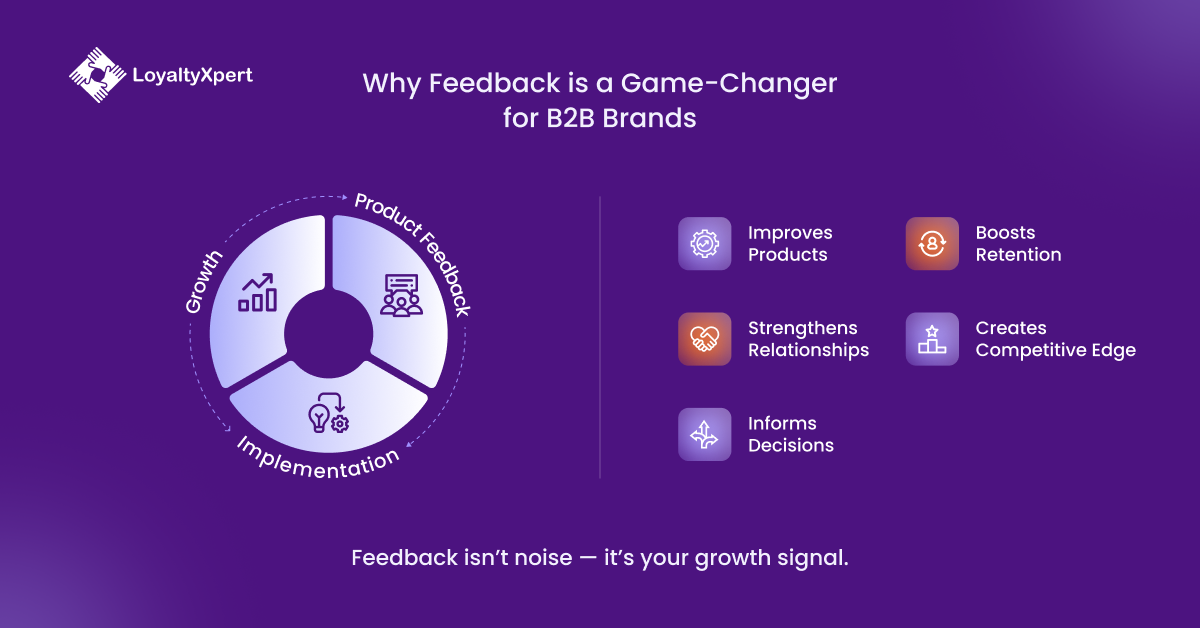
Why Feedback is a Game-Changer for B2B Product Improvement

1. To remain competitive

At a time when continuous evolution and incremental improvements are the name of the game, not improving products puts a business in a massive disadvantageous position. B2B brands must take customer feedback and improve their products to remain competitive in today’s time.

2. To survive in the market

“Improve or perish.” That’s the hard reality for contemporary manufacturers. The sooner they acknowledge it, the better it would be for their business. It’s not difficult to find countless examples of products that once were extremely popular but were phased out because they didn’t change with time.

Did you know?

Of the total products manufactured, just 40 percent of them tend to survive in the market, recent stats reveal.

3. To retain customers

“New, next, better.” That’s what a majority of customers look for. B2B organizations that improve their products based on customer feedback are more likely to retain a majority of their customers. Product improvement directly supports an organization’s retention strategies. On the other hand, if an organization ignores the minor flaws in its products, no matter how subtle they may be, it is more likely to lose some of its customers. As noted economist W. Edwards Deming rightly said, “No one knows the cost of a defective product. Don’t tell me you do. You know the cost of replacing it, but not the cost of a dissatisfied customer.”

4. To eliminate imperfections in new products

As we have already discussed, no matter how great a product is, there is always room for improvements. However, in many newly-innovated products, the scope for improvement is more. And it shouldn’t be surprising. The initial version of any product is not the best one and it improves by leaps and bounds in subsequent versions.

Did you know?

When it comes to product innovation, 95 percent of new products miss the mark, finds a research by Massachusetts Institute of Technology.

5. To benefit from incremental gains

Legendary author Mark Twain famously said, “Continuous improvement is better than delayed perfection.” The quote resonates even more in the present time. The bestselling book ‘Atomic Habits’ has described the power of continuous improvement and incremental growth. It said if someone keeps on improving by just one percent everyday for a year, then they’ll get 37 times better by the end of the year. If an organization keeps on improving its product little by little, they can benefit from massive incremental growth.

6. To optimize supply chain

Would it be surprising to know that improved products can enhance the supply chain? It definitely shouldn’t. In B2B marketing, fast-moving products have a massive edge over the slow-moving ones. Customer feedback can help in finding out which products move fast and which sit idle. A little improvement in product quality can enhance speed, optimize inventory planning, and eliminate wastage.

7. To enhance revenue growth

B2B product improvement pays for itself. Improved products not only retain existing customers but also attract new ones. Every adjustment, every upgrade, every tweak opens up the floodgates to generate additional revenue. When B2B customer feedback fuels product improvement, sales stop being seasonal spikes and become a steady upward climb.

8. To build long-term trust

Trust isn’t built by promises. It’s built by action. When customers see their feedback shaping your roadmap, loyalty strengthens. Every product update signals that you’re listening. Every refinement confirms that you’re invested in their success. This cycle creates more than satisfaction. It creates advocacy. Your clients don’t just buy again; they recommend. And that trust becomes the most powerful growth engine your brand can have.

9. To future-proof business

Markets change. Technology evolves. Customers never stop shifting. Brands that ignore this are left behind. But brands that embed customer feedback into every decision stay ahead. They anticipate demand. They pivot smoothly. They adapt without panic. This constant evolution doesn’t just protect today’s revenue. It safeguards tomorrow’s. Future-proofing isn’t about predicting every change. It’s about building the reflex to change continuously.

Challenges in Getting Customer Feedback for B2B Product Improvement

When it comes to improving their product range, business-to-customer (B2C) organizations, as well as companies that follow a direct-to-customer (D2C) model,  have it a bit easier compared to their B2B counterparts. That’s because they deal with customers directly. But B2B organizations don’t directly deal with end customers. That’s why they face multiple challenges. Here are some of those.

1. Level of intermediaries between manufacturers and end customers

The biggest challenge manufacturers face in understanding what the end customers want, as far as product improvement is concerned, is the layers of intermediaries between them and the end customers. Many levels come in between them and the end customers. That takes us to the next point.

2. Limited direct interaction with end-users

Many B2B brands sell through distributors, dealers, or channel partners. This adds layers between the manufacturer and the actual user. The result? Feedback is diluted or lost entirely, creating blind spots in B2B customer feedback collection.

3. Multiple stakeholders in decision-making

In B2B, buying decisions rarely rest with one person. A product may be evaluated by procurement, finance, and technical teams simultaneously. This makes customer feedback fragmented and harder to consolidate, delaying meaningful B2B product improvement.

4. Difficulty in measuring real product usage

Surveys and meetings can only capture opinions. But in reality, usage data often tells a different story. Without advanced analytics, brands may miss key behavioral patterns that could fuel B2B product improvement.

5. Feedback fatigue among customers

When customers are overloaded with surveys, forms, and interviews, they tune out. This “customer feedback fatigue” reduces response quality and leaves brands with shallow insights. Not the depth needed for meaningful B2B product improvement.

How to Take Customer Feedback for B2B Product Improvement?

Obtaining B2B customer feedback is a child’s play for B2B organizations. They don’t face any problem in that aspect for obvious reasons. But when it comes to taking the feedback of end customers, they face a lot of problems and challenges. We have already discussed some of those above. But notwithstanding the problems and challenges, there’s still a way to take customer feedback from the end users. Let’s discuss how.

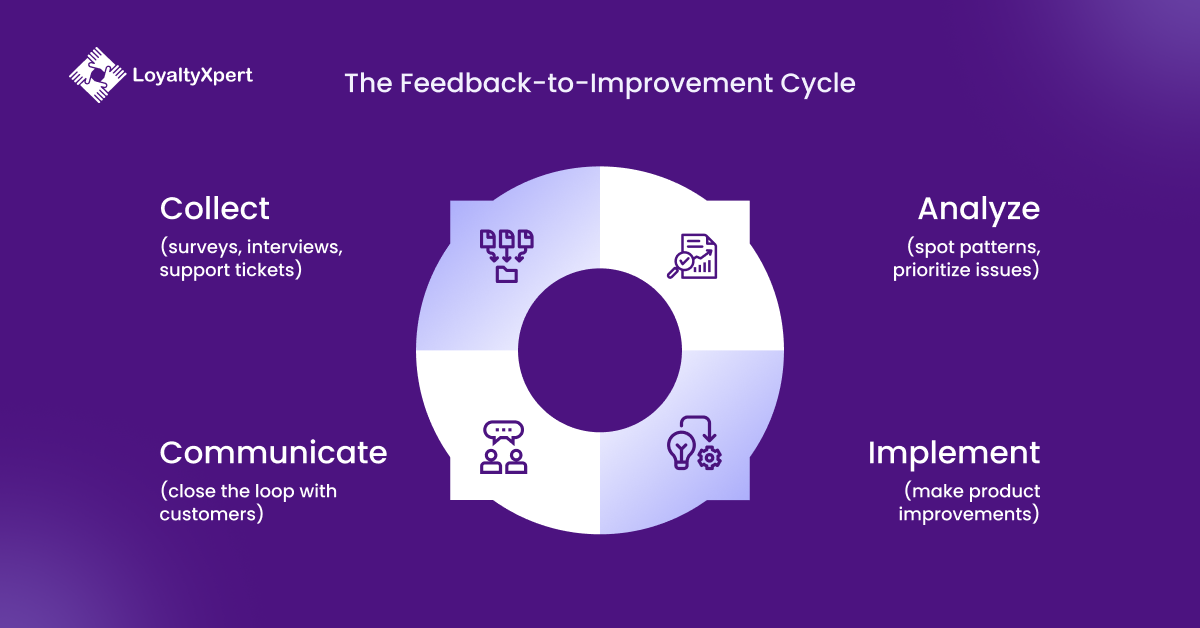
Feedback to Improvement Cycle in B2B Product Improvement

1. Surveys and feedback forms

Surveys and feedback forms are the oldest methods to take customer feedback. Surveys aren’t just about ticking boxes. They’re your direct line into the customer’s mind. A well-crafted survey uncovers pain points, feature requests, and satisfaction levels that raw sales data never reveals. When structured correctly, surveys don’t just collect opinions. They map out a roadmap for B2B product improvement.

2. Use loyalty programs and platforms to seek customer feedback

As revealed by several studies, nearly nine out of ten businesses use some form of loyalty program. So why not use that to take customer feedback? Are you wondering how manufacturers can use their loyalty programs and loyalty platforms to seek customer feedback? The answer is simple. Even though manufacturers design B2B loyalty program for their channel partners and various other intermediaries, it can still act as a bridge between them and end customers. They can leverage sophisticated loyalty software to seek customer feedback.

3. Gauge CSAT scores

Just as SAT scores are important for meritorious students, CSAT (customer satisfaction) scores are important for businesses. As noted speaker and trainer Kevin Stirtz rightly said, “Know what your customers want most and what your company does best. Focus on where those two meet.” Many B2B organizations measure channel partner satisfaction to assess how satisfied their channel partners are with their brands. They can consider asking their channel partners to share the CSAT scores of end customers.

4. Net Promoter Score (NPS)

The Net Promoter Score (NPS) is a market research metric that asks customers questions such as “On a scale of one to 10 how likely are you to recommend us?” Or a simple one such as, “Would you recommend us to a friend or colleague?” Based on the ratings, respondents could be divided under three categories. Promoters are those who give a rating of nine to ten. Passives are those who give a score of seven to eight. Detractors are those who give a score of six or less. This feedback method cuts through the noise and it can tell B2B organizations who their supporters are and who are their detractors. 

5. Focus groups

It’s one thing to ask customers for their feedback after they use it. But it’s altogether a different thing to involve them directly in product planning through different focus groups. As the name suggests, focus groups are group interviews that include a limited number of participants (usually up to 12 people). Over the years, many organizations have started using it to collect data, understand customer behaviour, and, of course, seek customer feedback.

No CTA found.

Now, the question comes “Can manufacturing organizations and B2B brands run focus groups to enhance their products?” The answer to the question is a resounding yes. By conducting focus groups, manufacturers and B2B organizations can gain sharper insights and build stronger customer retention strategies at the same time.

6. Use social media, AI tools, and online forums to find out your end customers’ pain points or common problems

This one is a bit unconventional but is highly effective to understand the common pain points or problems of your end customers. Many people share specific pain points and problems (mainly related to business and products) on various social media platforms such as Twitter as well as online forums such as Reddit and Quora. Manufacturers can leverage artificial intelligence (AI) tools such as ChatGPT, Grok, and Perplexity to find out the specific pain points and problems end customers face related to their product or industry by enabling the deep research feature. The AI tools can compile an exhaustive list of tweets, questions, and threads related to that in less than a minute.

7. Track end users’ usage data and insights

The question may come to mind “How can  B2B organizations track usage data and insights of end customers when they don’t deal with them directly?” They can get various key data through various ways such as data from their loyalty platforms, point-of-sale (PoS) devices, dashboards, and more. Manufacturers and B2B brands can gain valuable insights on what features end customers love, what they ignore, and what could be better. This feedback fuels both innovation and supply chain optimization.

Taking Everything Into Consideration,

The work of manufacturers doesn’t end after they’ve created a product. On the contrary, it just started. They must figure out ways to take the product to the market and put it in the hands of the end customers. The work doesn’t end there. They need to improve the product consistently. Only then they can remain in the business for a long haul.

To enhance their products, manufacturers need the inputs of end customers. But as most of them don’t deal with end users directly, they need to find out ways to understand what their end customers think about their products and how they can improve their products.

That’s where manufacturers need to think out of the box and come up with effective strategies to take the feedback of end users. At LoyaltyXpert, we have helped many manufacturing organizations and B2B brands in taking customer feedback for B2B product improvement.

Our B2B loyalty platform and sophisticated loyalty software have helped manufacturers and B2B organizations of various sizes to get valuable customer feedback and data insights. If you are curious to know about how our solutions can help you gain customer feedback for B2B product improvement, contact us today and book a free demo.

How to Run a Carpenter Loyalty Program for the Furniture and Hardware Industry?

If you own a furniture or hardware business, you must consider running the right carpenter loyalty program (if you aren’t running one already). That’s because carpenters are the unsung heroes in the furniture and hardware industry.

They are the main influencers in the furniture and hardware industry. Surprised? Now, every carpenter worth its salt may not be the type of influencer as listed in this article. But a majority of them (if not all) influence the purchasing decisions of end customers.

They work directly with commercial builders, real estate developers, and homeowners. They don’t just craft woodwork or install products, but more often than not, they purchase the raw materials and hardware’s themselves.

In this blog post, we will discuss why furniture and hardware brands need carpenter loyalty programs in today’s time, what are the problems they face as they deal with carpenters, and how the right carpenter loyalty program can benefit them. Apart from that we will also discuss the key components of a carpenter loyalty program and how furniture and hardware brands can design and run effective carpenter loyalty programs.

What Are Some Key Problems Furniture and Hardware Brands Face While Dealing with Carpenters?

Furniture and hardware brands (the manufacturers of plywood, laminates, medium density fiberboards, and other types of hardware such as hinges, bearings, and other architectural fittings) don’t deal with carpenters directly. However, they deal with the carpenters through some of their key channel partners such as dealers and distributors. When it comes to problems, some of them face the following common problems:

1. Supply chain disruptions and delivery delays

In the present time, supply chain disruption is one of the biggest problems for manufacturers across industries. Even though many external factors are responsible for it, it has been affecting carpenters adversely. Due to supply chain disruptions, the project timelines have been delayed and it caused massive downtime.

2. Lack of adequate product knowledge

A majority of carpenters are the masters of their craft. No doubt about it. But some may not have the adequate product knowledge. Even though this may not be true for all, it’s a common problem for the ones who are relatively new in the trade and have low exposure to different brands and products. Several carpenters aren’t formally trained. That makes it difficult for them to understand installation techniques. If they install the hardware improperly, it can harm a plywood or hardware brand’s reputation.

3. Low brand loyalty

Some carpenters prioritize short-term gains over long-term relationships with a brand. Such carpenters are highly price-conscious, and more often than not, they choose hardware or furniture fittings based on discounts, commissions, or freebies. They won’t hesitate to switch brands easily if a competitor offers slightly better margins or immediate rewards. Instead of recommending one trusted brand, they are more likely to suggest multiple brands based on the immediate benefits they receive.

4. Rewards fraud

Just imagine yourself in the shoes of a carpenter. You are expecting to be rewarded for driving up sales volume for a particular brand. But you realized that the rewards you’re supposed to get have been usurped by someone else. What would be your reaction? Disbelief? Angry? Confused? Anxious? Chances are, you will feel these emotions all at once. This is not just a hypothetical scenario. It’s a reality in all sectors, including the furniture and hardware industry. Rewards fraud (also called loyalty fraud) is prevalent in the furniture industry and hardware industry and has risen by leaps and bounds in the last decade.

Did you know?

The losses due to rewards fraud is estimated to be in the range of USD 1-3 billion every year globally, reveals a recent Reuters report.

5. Resistance to new technologies and processes

Some carpenters (in this case, the older ones in the trade) are more likely to resist new technologies and processes due to several factors. Some of it could be the fear of installation errors, the hesitation to unlearn the old things and learn new things, fear of higher costs, and more.

6. Lack of recognition and trust

In a competitive furniture industry and hardware industry, recognition isn’t optional. It’s a must. Carpenters are not machines. They’re the masters of their craft. They’re influencers and decision-makers. Yet some furniture brands and hardware brands treat them as faceless order-takers. This neglect builds resentment. Carpenters shift to rivals who give them recognition.

How the Right Carpenter Loyalty Program Helps Furniture and Hardware Brands Address the Problems?

The right carpenter loyalty program can help furniture and hardware brands address the above-mentioned problems faced by carpenters in multiple ways. Here are some of those.

1. Driving consistent engagement

A dedicated carpenter loyalty program motivates carpenters to stay connected with a furniture brand or hardware brand by rewarding repeat purchases and referrals. Unlike one-time discounts, a structured B2B loyalty program creates consistent engagement through reward points, recognition tiers, and milestone benefits.

2. Enhancing product knowledge

The latest fittings and accessories in the furniture industry and hardware industry require proper training. With an app-based loyalty program, brands can integrate learning modules, video tutorials, and certifications. Carpenters earn rewards not only for purchases but also for improving their technical skills.

3. Balancing dealer influence

Carpenters often rely on local dealers when choosing products. A smart furniture loyalty program or hardware loyalty program aligns both dealer and carpenter incentives. This dual approach encourages dealers to recommend the same brand that carpenters are rewarded for buying or installing (or both).

4. Reducing price sensitivity

Instead of chasing short-term discounts, carpenters benefit from structured rewards such as tools, branded merchandise, or vouchers through loyalty software for business. This system helps brands reduce overdependence on price cuts and build long-term loyalty.

5. Strengthening brand relationships

Carpenters value recognition as much as monetary rewards. By partnering with experienced loyalty program companies in India, brands can design personalized rewards for special occasions and milestones such as birthdays, anniversaries, years of association, numbers of projects completed. Such recognition builds deeper emotional bonds with carpenters.

6. Encouraging digital adoption

Many carpenters still operate offline. A simple app-based loyalty program makes it easy to scan invoices, earn points via SMS/WhatsApp, and redeem rewards. Over time, brands can leverage this digital platform to introduce e-catalogues, online ordering, and real-time support.

7. Treating recognition as currency

Recognition is the most powerful reward. A well-crafted B2B loyalty program turns it into a currency. Every reward, every badge, every milestone says “You matter.” In the furniture and hardware industry, where carpenters are often overlooked, this changes the game. By leveraging loyalty software for business, furniture brands and hardware brands turn carpenters into partners.

Key Components of a Carpenter Loyalty Program

Done right, a carpenter loyalty program can become the spine of a furniture or hardware brand’s growth. For that, it needs to get its component right. Here are some key components every winning furniture loyalty program or hardware loyalty program must have.

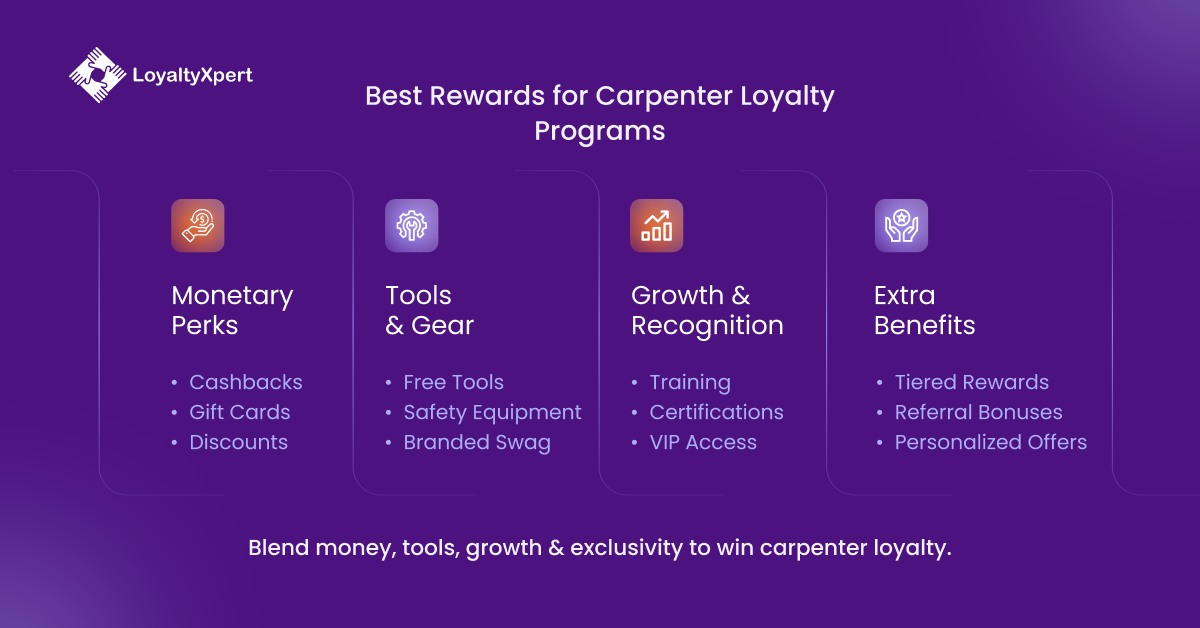
Best Rewards for Carpenter Loyalty Programs

1. Seamless enrollment and onboarding

The way a furniture or hardware brand enrolls and onboards its influencers can determine the success or failure of its carpenter loyalty program. Many carpenters aren’t tech savvy. So, brands have to make the enrollment and onboarding process as simple as possible. They must leverage sophisticated app-based loyalty programs to ensure seamless enrollment and onboarding.

2. Effective reward structures

Points. Tiers. Exclusive access. Aspirational prizes. These are not gimmicks. They are rewards that motivate. They are rewards that drive carpenters to climb up the ladder, achieve the desired objectives, and carve a place for themselves in the brand’s growth story. The right furniture loyalty program and hardware loyalty program offers structured rewards that tap into this drive.

3. Personalized and localized rewards

A carpenter who is young and new in the industry won’t be motivated with the same rewards as a carpenter who has spent years or decades in the industry. The same goes for a carpenter in a tier-one city (or a metro city) versus a carpenter in a small town or a village. Their needs are different and brands need to keep this in mind. They must personalize and localize the rewards.

4. Training and education modules

New hinges. New modular fittings. New tools. The furniture industry and hardware industry never stand still. If carpenters don’t evolve, a brand’s reputation suffers. That aside, when carpenters learn, they earn. And when they earn, they influence with confidence.

5. Data-driven analytics

As the saying goes, “If you can’t measure it, you can’t control it.” Modern loyalty software for business is equipped with sophisticated data-driven analytics and reporting tools to track key performance indicators. It gives brands the power to predict sales, fine-tune promotions, and maximize return on their investments.

6. QR code generator and scanner

Here’s the weapon that changes everything. The QR code. Every invoice, every product, every reward can carry a QR code. By providing QR codes, furniture and hardware brands can accelerate the way they reward their influencers. No waiting. No paperwork. No manual processes. The entire process happens in just a few seconds.

7. Digital infrastructure and professional program management

In today’s market, a carpenter loyalty program cannot run on paper slips or manual tallies. A robust app-based loyalty program is a basic requirement. That’s why furniture and hardware brands must invest in sophisticated digital infrastructure and a company that can handle the tech aspect of the carpenter loyalty programs.

How Furniture and Hardware Brands Can Design and Run Effective Carpenter Loyalty Programs

A strategically designed carpenter loyalty program can help furniture and hardware brands in a wide range of ways. That’s why they must leave no stone unturned in designing and running effective carpenter loyalty programs. Here are some ways to do that.

1. Set clear objectives

First thing first; a furniture or hardware brand must define and set clear objectives. What are the things they want from the carpenter loyalty programs? Do they want to increase carpenter retention? Boost sales? Enhance product recommendations? Speed up adoption of new fittings? Or simply improve engagement? Getting the answers to these questions can provide clarity and help them set their prime objectives.

2. Handpick the right app-based loyalty software

Manual loyalty programs are things of the past. In today’s digital age, furniture and hardware brands must leverage the right app-based loyalty software. The right software for business can ensure transparency, instant updates, fraud prevention, and more. When looking for loyalty program companies in India or abroad, furniture and hardware brands must look at the track record, case studies, and success stories to handpick the right loyalty solutions partner for their business.

3. Choose the right loyalty model

Furniture and hardware brands need to pick the right loyalty model and structure for different segments of carpenters. They should mix financial rewards with nonfinancial ones.

4. Provide tiered rewards and recognition

Tiered rewards and recognition are extremely important for carpenter loyalty programs. That’s because they appeal to the “status needs” as per Maslow’s need hierarchy theory. For some, money isn’t the be all and end all. They like growth, progress, and achievements. And tiers and recognition are some of the most effective ways to showcase that.

5. Personalize the experience

Now that we have discussed tiers and recognition, there are carpenters that value other forms of rewards such as loyalty points and rebates. Each one has their own preference. That’s why personalization of loyalty programs is a must. It means relevance. It commands loyalty.

6. Simplify participation and ensure transparency

Simplicity is the key to an effective furniture loyalty program and hardware loyalty program. Furniture and hardware brands must see to it that their influencers can easily join the programs. They also need to ensure that the loyalty programs are as transparent as possible. Transparency is the foundation of trust. That’s the most effective way to win carpenters’ loyalty.

7. Continuously evolve

A static B2B loyalty program dies. Carpenters grow bored. Competitors outpace. In the furniture industry and hardware industry, brands must keep programs alive by rotating rewards, gamifying progress, introducing seasonal challenges, and more. A furniture brand or hardware brand that evolves its program stays ahead. Those that don’t? They vanish.

Taking Everything Into Consideration,

In today’s competitive furniture industry and hardware industry, carpenters are the main influencers who shape customer choices and influence their purchase decision.

No CTA found.

A well-designed carpenter loyalty program not only rewards their contribution but also strengthens long-term trust, ensures repeat product usage, and drives measurable sales growth.

By leveraging sophisticated loyalty software for business, furniture and hardware brands can design effective app-based loyalty programs and enhance carpenters’ loyalty.

At LoyaltyXpert, we have engineered effective carpenter loyalty programs for some highly reputable plywood and laminates manufacturers as well as brands in the hardware industry.

If you are curious to know more about our solutions, contact us today to book a free demo.

Loyalty Program Management: 5 Proven Ways to Manage Your Loyalty Program

Would you be surprised to know that poor loyalty program management is one of the major reasons for loyalty programs failure? You shouldn’t.

If you take a look at some of the successful loyalty programs that didn’t do well as expected, you will find that poor loyalty program management is among the biggest causes behind the dismal performance.

In this blog post we will discuss what loyalty program management is, why contemporary organizations need loyalty program management, as well as the seven proven ways for effective loyalty program management.

What Is Loyalty Program Management?

Loyalty program management is all about the use of strategy, tools, and tactics that a company uses to acquire, engage, and keep hold of loyal customers.

It helps in targeting the right audiences and offering them the best possible experiences, benefits, and rewards with the intent to drive long-term engagement.

Apart from a loyalty program, an all-inclusive loyalty management platform includes an array of elements such as:

  • Loyalty program construct
  • Loyalty program optimization
  • Technology enhancements
  • Rewards and benefits
  • Creative services
  • Member acquisition strategy
  • Member communication and marketing
  • Branded customer service
  • Billing engine
  • Client services, etc.

All the above-mentioned elements require working together for a successful loyalty program. However, managing all these elements may take up a lot of time, resources, technology, and expertise. Due to this reason, a large number of retailers prefer outsourcing some of these elements to some experienced and professional loyalty management program organizations.

Did you know?

Nine out of every ten businesses have some form of loyalty programs in place. But just three out of ten manage to get the desired outcomes from their loyalty programs!

Creating a loyalty program may be easy but managing it is very difficult. A lot of surveys reveal that in their findings. The multiple levels and multi-process nature of loyalty programs make management difficult. It takes considerable effort, resources, and commitment to analyze, structure, and manage loyalty programs.

However, with proper planning, strategies, and partnership with the right loyalty partner, managing loyalty programs is easy.

Why Contemporary Organizations Need Effective Loyalty Program Management?

Like it or not, it’s no longer just about discounts. It’s about using the right tools (such as loyalty program management systems and software) and processes to build long-term value. Contemporary organizations must embrace loyalty program management to stay relevant in the present time. Here’s why they need loyalty program management.

Why Loyalty Program Management Matters

1. To retain customers

Retaining customers and making them return should be the goal of every business. That’s because retaining an existing customer is five to seven times less expensive than attracting a new one. Besides, if a business sells to one customer for just one time, it cannot sustain its operations for long. But if it manages to sell its products multiple times to its customers, then it will not just survive but thrive. That’s why effective loyalty program management is extremely important. It helps reduce churn and increase customer lifetime value.

2. To drive engagement

Engagement with customers is extremely important in today’s time. When customers connect with a brand and remain engaged with it, they become brand advocates and drive long-term growth. With effective loyalty program management and by leveraging advanced loyalty program management software, organizations can deliver personalized offers, gamification, and real-time rewards.

3. To differentiate from competitors

Take any industry, the competition has become intense. For every product, customers have at least over a dozen choices. In some cases and sectors, the choices look the same and hard to differentiate from one another. Keeping that in mind, it’s extremely important to differentiate from competitors. It can give a massive edge to organizations. In crowded markets, expert loyalty program management companies help brands stand out with innovative strategies.

4. To strengthen customer relationships

For businesses, customer relationships are everything. Building strong customer relationships is the secret recipe for growth and long-term success. Strong ties fuel growth. A well-structured loyalty program management system creates emotional connections beyond transactions.

5. To unify customers’ data

When customers’ data is scattered, it creates gaps, silos, and missed opportunities. But very few organizations manage to unify data across channels. Without integration of customer data, personalization fails. Modern loyalty program management platforms solve this by connecting data from every touchpoint, delivering a true 360° view of each customer.

7 Proven Ways for Loyalty Program Management

Here are seven proven ways for effective loyalty program management:

7 Rules for Managing Loyalty Programs That Work with loyalty program management

1. Define your goals

Defining goals is the first step that’ll help you turn your wants and desires into reality. Whether acquiring new customers, retaining them for a long time, raking in more sales, and registering more revenue, achieving all these will be easy when you set well-defined goals for your loyalty programs. While setting concrete goals for your loyalty programs, keep these in mind:

Have a long-term and short-term marketing strategy in place: When creating strategies for a loyalty program, focus on long-term endeavors for three to five years. Also, have a one-year marketing strategy for your short-term goals.

Define your Key Performance Indicators (KPIs): To define KPIs for your loyalty program, you should identify specific metrics aligned with team member objectives. The KPIs could include new customer acquisition rate, customer retention rate, sales revenue, customer satisfaction score, and average transaction value. Make sure the KPIs are relevant, measurable, and achievable.

Assign operational activities: After defining KPIs, it’s time to assign operational tasks for the loyalty program team. While doing that, be fair and identify the unique talents of each team member. Assign tasks based on team members’ expertise and strengths. Encourage open communication and collaboration among team members so that they can uninhibitedly contribute their ideas and insights.

Determine the frequency and form of KPI reporting: The last but most important point in the goal-setting stage is to determine the frequency and form of reporting progress on the KPIs. How often are you going to report the progress? Monthly or quarterly? Apart from that, allocate time to reflect and evaluate the results as well as identify areas for improvement.

2. Understand your customers

After defining goals, the next step is to understand your customers so that you can understand what they like and dislike as well as what their preferences and motivations are. The best way to understand your customers is to conduct:

  • Market research
  • Surveys
  • Interviews
  • Social media analysis
  • Purchase history
  • Direct feedback

Now the question comes “Would customers readily give their data to businesses for better loyalty programs?” The answer is a resounding yes. As per a new Accenture study, eight out of every ten respondents are ready to share their data with brands if they get personalized experiences.

Even though these methods of collecting data will need you to invest some of your time, resources, and energy, they will provide considerable benefits in the long run. After you get the data, use it to tailor your loyalty programs, rewards, and experiences to cater to your customer’s needs and preferences. Collect regular customer feedback to make data-driven decisions and make continuous improvements to the program.

3. Keep your loyalty programs simple and user-friendly

There is great power in simplicity. To achieve the ultimate sophistication in your loyalty programs, keep things simple, realistic, and user-friendly. The advent of modern technology has made digital loyalty programs far simpler and easier compared to traditional loyalty programs.

A simple and well-designed loyalty program can mean all the difference between success and failure. While designing a loyalty program, make it easy for customers to enroll, earn rewards, and redeem them. 

To ensure a smooth and intuitive user experience, streamline the program’s features and functionalities. By keeping things simple and user-friendly, you enhance customer satisfaction and increase their engagement with the loyalty program.

When it comes to rewards, keep them simple and transparent. Provide relevant and appealing rewards to your customers and avoid excessive restrictions or complicated mechanisms. Also, enable customers to view available rewards and monitor their progress.

4. Focus on regular communication and engagement with members

Effective communication is the ticket to success. When it comes to ensuring the success of loyalty programs, nothing can beat the power of regular communication and engagement with loyalty program members through various channels.

Engage with them through personalized messages, social media, or loyalty program apps to maintain their interest and participation. Keep them informed about new program updates, exciting new rewards, and exclusive offers. Also, engage with them on a more personal level by sending personalized messages that resonate with their preferences and needs.

Leverage your loyalty program app and social media platforms to connect with loyalty program members. By doing that, you can elicit positive responses and active participation from the members and it will boost their loyalty.

5. Focus on regular evaluation and improvement

After completing all the above steps, identify areas of improvement and make the required adjustments to boost your loyalty program’s user-friendliness and simplicity. If continuous improvement is your game plan, then nothing can stop your loyalty programs from being successful.

Continuously evaluate customer feedback and program performance. While analyzing data, look for new patterns. By doing that, it would be easy for you to pivot your loyalty program to changing customer preferences or trends.

6. Leverage the right technology

Manual processes slow programs down and create errors. Technology is the backbone of modern loyalty program management. Relying on manual processes can slow down operations, create inefficiencies, and even frustrate customers. A well-integrated digital platform ensures that loyalty programs run smoothly, deliver consistent experiences, and generate measurable business value.

To make the most of technology in loyalty management, focus on the following aspects:

Select the right loyalty program management platform: Choose a loyalty program management software that aligns with your program design (points-based, cashback, tiered, or coalition). Make sure that it can integrate with your existing customers relationship management (CRM), point of sale (POS) systems, e-commerce platforms, and mobile apps.

Automate critical tasks: Automation saves time and reduces errors. Use the loyalty program management solutions for member enrollment, point accrual and redemption, tier upgrades, expiry notifications, bonus campaigns, and fraud checks.

Use AI and data analytics: Leverage artificial intelligence to segment customers, personalize offers, predict churn, and trigger real-time actions such as sending re-engagement offers when activity drops.

Ensure omnichannel consistency: Customers should enjoy a seamless experience across touchpoints be it shopping in-store, browsing online, or engaging through WhatsApp, SMS, or a mobile app.

7. Choose the right loyalty partner

Even the best technology or internal strategy will fall short without the right expertise. A reliable loyalty partner can help businesses not only design effective programs but also execute and optimize them for long-term success.

When evaluating loyalty partners, keep these key factors in mind:

Expertise and experience: Look for partners with proven experience in both B2C and B2B loyalty management. Case studies, client references, and vertical-specific expertise are strong indicators of reliability.

No CTA found.

Technology strength: A good loyalty partner should offer an open, scalable platform with strong API support, reliable uptime, and clear data ownership. The platform should enable everything from program design and analytics to campaign management and fraud governance.

End-to-end support: The right partner will assist you across the program lifecycle.

To minimize risk, start small with a pilot project. Test the loyalty program in a limited market, validate its performance, and then expand in phases. A good partner will guide you through phased rollouts, provide training, and support your internal teams and distribution channels.

Ultimately, the right loyalty partner becomes more than just a service provider. They become a strategic ally. They accelerate time-to-market, ensure smooth execution, and keep your loyalty program evolving to meet changing customer expectations.

All in all,

The difference between successful loyalty programs and unsuccessful ones is the way they’re managed. When businesses manage their B2B and B2C loyalty programs in the best possible manner, then nothing can stop them from retaining their existing customers and attracting new ones.

At LoyaltyXpert, we have not only designed and created effective digital loyalty programs for a wide range of businesses but we’ve also helped them manage and run their loyalty programs effectively and efficiently. If you are looking for a reputable and trustworthy loyalty partner not just to develop high-quality loyalty programs but manage them as efficiently as possible, then contact our team for a free demo.

Loyalty Programs for FMCG Companies Tips in 2025

Think of the toothpaste an average person uses after waking up. The tea or coffee they drink. The packaged foods (cereals, bread, cookies, etc.) they have for breakfast. All these are examples of fast-moving consumer goods (FMCG).

Manufacturers in the FMCG industry have a massive advantage over manufacturers in other sectors. They can make customer loyalty a habit, quite literally!

Customers use their products on a more regular basis (if not on a daily basis). That’s why they must optimize their FMCG loyalty programs to build trust and engage customers.

In this blog post, we will briefly discuss FMCG loyalty programs, challenges faced by FMCG companies, benefits of FMCG loyalty programs, and tips to create successful FMCG loyalty programs in 2025 and beyond.

All You Need to Know About FMCG Loyalty Programs

As the name suggests, FMCG loyalty programs are dedicated programs exclusively designed for organizations that manufacture fast moving consumer goods such as packaged food and beverages, cosmetics, toiletries, household cleaning products, and more such goods.

FMCG loyalty programs are designed to maintain a good relationship with customers. If you have more brand-loyal customers, you can increase revenue. Thus you can keep expanding your business.

The primary motive for FMCG loyalty programs is to retain more customers and grow your business. Loyalty programs are helpful for all industries. However, it offers definite benefits for the FMCG industries.

Challenges Faced by FMCG Brands

In the present era, FMCG brands face a lot of challenges especially when it comes to customer retention. Here are some of the top challenges they face.

Why FMCG Brands Struggle With FMCG Loyalty Programs

1. Stiff competition

Would you be surprised to know that FMCG brands face stiff competition? Just a walk into a department store would make you realize that. For every product, you would find at least a dozen brands vying for customers’ attention and preferences.

2. High rate of churn

Barring the most loyal ones, all other customers of FMCG brands tend to switch to competitors once in a while. Not all churn happens due to bad experience with the products. There can be different motives, such as the curiosity to try out different brands, getting better deals and discounts elsewhere, just to name a few. But the churn rate in the FMCG sector is one of the highest.

Did you know?

The average customer churn rate in the consumer packaged goods (CPG) industry is 40%, reveals a study.

3. Limited scope for differentiation

FMCG companies deal with similar looking products that bear almost identical price tags. Being in such a highly competitive industry, the scope for differentiation is limited as such. Even in offers and discounts, FMCG brands cannot differentiate much.

4. Inability to unify customers’ profiles

FMCG companies face challenges in unifying customers’ profiles due to several reasons. Some of those are purchases made from brick-and-mortar stores or third-party e-commerce websites. FMCG companies have a difficult time unifying customer profiles when a majority of customers make purchases and payments using online and offline modes.

5. Inadequate zero-party and first-party customer data

Zero-party data is the data that customers willingly share by themselves. First-party data is the data that businesses collect via customer behavior and interactions. Both the data types are crucial for the FMCG sector. But a lot of FMCG brands face challenges in collecting both due to various reasons.

Benefits of FMCG Loyalty Programs

FMCG loyalty programs offer a wide range of benefits to manufacturers of fast moving consumer goods and companies dealing with such products. Here are some key benefits.

1. Increased ROI

The FMCG loyalty management system is designed to aid you to increase revenue. It helps to manage your customer base and optimizes business functions. By using this program, you can easily boost ROI.

Brand-loyal customers tend to make more purchases. So, once you start getting the brand loyal customers, you can boost profitability. FMCG programs are designed to attract and retain more customers. The programs facilitate retaining existing customers which costs much lesser money and effort in comparison to acquiring new customers.

2. Better communication with customers

It’s easier to communicate with your potential customers through loyalty programs for fast-moving consumer goods. You can announce new products or services directly to the customers.

Moreover, informing them about rebates, contests, best deals, or other promotional activities is simpler with the FMCG loyalty program. The loyalty programs are intended to improve and maintain better communication with your target audience.

3. Drive more new customers

If you want to grow your business, you need to focus on driving more customers. With the FMCG loyalty programs, it’s simpler to offer rewards to new customers. For instance, you can offer discounts or rewards points for signing up. This is how you encourage new customers with loyalty programs.

Besides, if the customers like your offers and offerings, you have the distinct advantage of WOM (word of mouth) publicity for your brand.

4. Sustain market competition

The Loyalty programs for FMCG help you to stay ahead of the market competition. The program helps to add more value to your existing services with a personalized experience for your customers.

No CTA found.

When you reward your customers, you are making an emotional connection with them. And, they give more importance to your brand and services. Having more loyal customers adds benefits to sustaining a marketing competition.

5. Effective data management

FMCG loyalty programs offer effective customer data management to improve customer services. You can get useful analytics about customers’ behaviour, preferences, buying habits, etc. With the FMCG loyalty management system, you can offer the product or services that your customers are looking for.

Further, the analytics report helps in inventory management, pricing, and promotional planning. Also, the data enables marketers to measure the results of promotional activities.

Effective Tips for Creating Successful FMCG Loyalty Programs in 2025

FMCG loyalty programs are more than just offers, discounts, and freebies. Contemporary FMCG brands must be innovative to build effective and customer-friendly loyalty programs. Here are some valuable tips to create successful FMCG loyalty programs in 2025 and beyond.

8 Winning Strategies for FMCG Loyalty Programs in 2025

1. Handpick the right loyalty program software

To succeed in 2025, FMCG companies need to leverage the right technology. The very first thing they must do is to handpick the right loyalty program software. Some loyalty solutions providers such as LoyaltyXpert offer custom-designed FMCG loyalty software, which can enable FMCG brands manage campaigns, track consumer data, and deliver personalized rewards at scale.

2. Personalize FMCG rewards and loyalty programs

When it comes to loyalty programs, the one-size-fits-all approach no longer works in the FMCG industry. FMCG companies must aim to serve a diverse customer base with personalized FMCG loyalty programs. For instance, a loyalty program that’s going to work for Gen Z customers won’t work for millennials. Likewise, the same loyalty programs for the head of a household will not work for bachelors and students.

3. Gamify FMCG loyalty programs and make it more engaging

Given a choice between an engaging and fun FMCG loyalty program and one that’s not, people will select the former. FMCG companies must keep that in mind when they create loyalty programs. The best way to make loyalty programs more engaging and interesting is by gamifying those. In today’s age, adding gamified elements into FMCG rewards is easier than ever before.

4. Make sure the FMCG loyalty programs can be accessed across channels

Today’s customers are everywhere. Whether it’s brick-and-mortar stores, e-commerce websites, quick-commerce apps, and even social media marketplaces, they try out all these forums. FMCG brands must ensure that their FMCG loyalty programs are accessible across all these channels. They must make sure that all customers can avail the FMCG rewards regardless of the channels they’re using.

5. Create FMCG loyalty programs that focuses on sustainability

For the FMCG industry, sustainability is not just a buzzword. It’s a necessity. Contemporary customers, particularly Gen Z and millennials, focus on sustainability. They would want brands to focus on that aspect as well. As per a recent study, 62% of Gen Z shoppers prefer to buy from sustainable brands. That’s not all. A whopping 73% of the respondents are ready to pay more for sustainable products and services.

6. Engineer tiered FMCG rewards structures

Just as it’s important to personalize FMCG rewards for different customers, it’s also important to create different tiers for different segments. There can be multiple segments of customers. The top ones are those who make high value and high volume of transactions. It’s important for FMCG brands to make them feel valued. Tiered FMCG loyalty programs such as Bronze, Silver, and Gold can enable customers to climb levels based on their spending habits. With modern FMCG loyalty software, FMCG companies can easily create and manage different tiers.

7. Leverage partnerships and cross-brand rewards

Customers in the FMCG industries interact with multiple brands daily. Strategic partnerships between FMCG companies and lifestyle, retail, or delivery platforms expand the scope of FMCG loyalty programs. For example, a snack brand could partner with a streaming service to offer bundled rewards, while a beverage company could tie up with grocery delivery apps for double points promotions.

8. Harness consumer feedback and social proof

Today’s customers are vocal and digitally active. Encouraging them to share reviews, ratings, or user-generated content can double up as both advocacy and engagement for FMCG loyalty programs. Brands can design systems where customers earn FMCG rewards for posting testimonials, tagging the brand on social media, or referring friends. This not only drives organic brand promotion but also gives FMCG companies actionable feedback for improving products and services.

Taking Everything Into Consideration,

In 2025, FMCG companies need more than just points and discounts to win loyalty. Success lies in combining technology, personalization, gamification, sustainability, and transparency. 

With the right FMCG loyalty software and innovative strategies, FMCG brands can transform everyday purchases into long-term brand relationships, ensuring that their FMCG loyalty programs remain relevant, rewarding, and future-proof.

So, whether you want to increase ROI or you want to increase your customer base, opt for the FMCG Loyalty Programs and take your business to the next level.

At LoyaltyXpert, we offer customized loyalty management solutions to minimize major challenges hindering the success of your business. Contact us today and book a free demo, to get more details on how the loyalty program helps you to grow your business.

Automation and Technology Tools for Operational Excellence in Manufacturing

Kevin Duggan, a bestselling author and operational excellence expert rightly said, “Operational excellence is the point at which each and every employee can see the flow of value to the customer, and fix that flow before it breaks down.”

In today’s time, operational excellence in manufacturing is the only way to survive and thrive in the highly competitive sector. Manufacturers can achieve operational excellence through various ways.

One of the most effective hacks to achieve operational excellence in manufacturing is by leveraging the right industrial automation systems and sophisticated manufacturing technology solutions in the right manner.

In this blog post, we discuss the importance of using automation and technology tools to achieve operational efficiency, the tools manufacturers must use for operational excellence in manufacturing, and what to look for before investing in them.

Why Must Manufacturers Use Automation and Technology Tools to Achieve Operational Excellence in Manufacturing?

Noted musical artist MC Hammer, who is also a tech investor, famously said, “Technology is important because it creates the future. We’re able to be a part of the ‘next’ and create things that don’t exist.” Manufacturers should definitely use automation and technology tools to take their operations to the next level. Here are some reasons why technology is essential to achieve operational excellence in manufacturing.

How Automation Boosts operational excellence in manufacturing Excellence

1. To enhance efficiency

Microsoft founder Bill Gates rightly said, “The first rule of any technology used in a business is that automation applied to an efficient operation will magnify the efficiency.” When manufacturers leverage industrial automation systems and tech-driven manufacturing solutions, they manage to improve operational efficiency. Use of the right tech stack also enhances manufacturing process optimization.

2. Automate routine and repetitive tasks

Just imagine the wastage and inefficiencies when the employees in a manufacturing organization have to perform one or more repetitive tasks manually. It sounds horrific already. But what would be the scenario when the routine tasks are automated by using industrial automation systems? That would save a lot of time, effort, and resources.

3. Save time

It’s not at all surprising to know that automation in manufacturing is a time saver. But did you know that it can also be a life saver? It’s true for organizations that manufacture essential goods such as lifesaving medicines and equipment that’re used in emergency situations. When manufacturers of such products reduce the turnaround time by leveraging tech-driven manufacturing solutions, they literally save the lives of many people.

4. Save money

Of course, how can we miss this! When manufacturers use automation and sophisticated technology tools to automate a wide array of routine and repetitive tasks, they not only achieve operational excellence but also cost efficacy. They not only save a lot of money but generate a lot of revenue with a lean team.

Did you know? 

Businesses that adopt AI automation can reduce operational costs by 20–30%, finds a McKinsey report. Not only that, they can enhance operational efficiency by more than 40%.

5. Quality control

For manufacturers, quality is everything. A certain level of quality is just similar to hygiene. Its presence may or may not necessarily boost business and financial health. But its absence can be damaging. Digital transformation in manufacturing can help manufacturers keep an eye on quality control, which in turn can help them achieve operational excellence. As W. Edwards Deming, a noted economist, business theorist, industrial engineer, and management consultant, rightly said, “Quality comes not from inspection, but from improvement of the production process.”

6. Error-proof operations

In the manufacturing sector, organizations must do whatever it takes to error-proof their operations. That’s because rectifying errors in the sector is extremely expensive and difficult. In some cases, errors can cost lives. Not sure how? Think of the consequences a minor error can cause for a safety belt manufacturer. Automation in manufacturing and the use of the right technology can eliminate human errors and enhance manufacturing process optimization.

7. Accelerate production cycles

Automation and technology tools can quicken the process of transformation of raw materials into finished goods by leaps and bounds. Let’s say, a product that would take a few hours to be made from scratch manually could be ready in just a few minutes, even seconds, because of automation and use of technology. That’s the magic of manufacturing technology solutions.

8. Scale up operations

Just imagine a scenario, where a manufacturing organization is witnessing a surge in demand but it’s unable to keep pace. The factors responsible are outdated processes and capacity limitations. The company can scale up and achieve operational excellence in manufacturing by leveraging smart manufacturing tools.

What Automation and Tech Tools Manufacturers Must Use to Achieve Operational Excellence in Manufacturing?

To achieve operational excellence in manufacturing, organizations must use a broad range of automated technology tools. Here are some important ones that every manufacturer must use.

Top Tools Every Manufacturer Needs in getting operational excellence in manufacturing

1. Supply chain management tools

For manufacturing companies, efficient management of the supply chain is critical for success. Supply chain expert Hau L. Lee rightly said, “The supply chain is no longer a cost of doing business, it is a driver of competitive advantage.”

Thankfully, there are sophisticated tools specifically engineered to manage supply chains. For obvious reasons, they’re named supply chain management tools. Comprising a wide array of technologies, they’re designed to optimize several aspects of the supply chain whether it’s procurement of raw materials, production of goods, warehousing, as well as logistics and delivery.

By leveraging the right supply chain tools, manufacturers can manage multiple suppliers, warehouses, and distribution channels on a central system.

2. ERP and CRM software

Just the thought of managing production, inventory, customer relationships, and finances on separate systems is daunting enough. Just imagine what would happen when a manufacturer has to do that in real life.  

The lack of integration causes delays, data mismatches, and operational blind spots. Fortunately, there are tools to manage the end-to-end operations of manufacturing enterprises as well as customer relationships. They are called Enterprise Resource Planning (ERP) and Customer Relationship Management (CRM) systems.

The former is a tool that helps in management and integration of core business processes. The tool automates and streamlines various functions and provides a unified view of operations. The latter, as the name suggests, is a tool that manages, tracks, and analyzes customer data and interactions as well as automates processes related to customer service, sales, and marketing.

3. Sales tracking apps

Manufacturers have a dedicated sales team to take the finished goods to the market and convert those into revenue streams. Without that, there’s no point in manufacturing.

Manufacturers must monitor their sales team and ensure that they face no problems while selling. The right sales tracking app can help manufacturers get real-time visibility and live updates about their sales team. 

Sales tracking apps and software are equipped with many sophisticated features such as GPS tracking, real-time location sharing, check-in/check-out logs, last location battery record, task assignment and scheduling, mobile accessibility with offline capability, and more.

4. Warranty management systems

Manufacturers in some specific sectors such as electricals, plywood, industrial equipment and machinery provide warranty for their products. A strong warranty is a manufacturer’s promise that their products will stand the test of time. In case of specific issues, the manufacturer repairs for free of cost or replaces the product with a new one.

Managing warranty claims manually can be extremely difficult and inefficient. Apart from being time-consuming and prone to errors, it can delay resolution. That’s why manufacturers need a sophisticated tool to automate warranty claims management.

The name of the solution is warranty management software. By selecting the right warranty management software, manufacturers can streamline the way they manage warranty claims.

5. In-person meet management systems

In the digital age, the popularity of virtual meet-ups and tools facilitating that such as Zoom, Google Meet, FaceTime, and more have increased. But nothing can replace the effectiveness of in-person meets, especially in the manufacturing sector.

Manufacturers need to organize in-person meetings with their channel partners, influencers, and buyers to create awareness and drive better business outcomes. According to the 2025 State of Events Report, 78 percent of respondents said they believe in-person events are more effective in marketing strategies as well as achieving desired business outcomes.

In-person meet management systems such as nukkad meet management software and apps can enable manufacturers to create meetings instantly, track attendance in real-time, prevent proxies, create post-meet promotions, and more.

6. Digital loyalty platforms

In a time when nine out of every ten businesses run loyalty programs, manufacturers that don’t run one risk a significant competitive disadvantage. In the digital age, traditional loyalty programs won’t be effective. That’s why manufacturers need to invest in digital loyalty platforms.

Digital loyalty platforms can automate the way manufacturers reward their buyers, engage with their stakeholders, as well as build relationships with their channel partners and influencers. Fitted with a wide array of advanced features, digital loyalty platforms are highly cost effective in the long run.

No CTA found.

By integrating digital loyalty platforms (such as that of LoyaltyXpert’s) with tech-driven manufacturing solutions, manufacturers can improve operational efficiency. Not just that, they can turn their loyalty programs into a driver of operational excellence in manufacturing.

What Manufacturers Should Look for Before Investing in Automation and Tech Tools to Achieve Operational Excellence in Manufacturing?

We have already discussed the automation and technology tools manufacturing organizations must use for digital transformation in manufacturing. But what should they look for to make sure that they find the right manufacturing technology solutions? Here are some things they need to keep in mind.

1. Reputation and track record of solution providers

When manufacturing organizations look for manufacturing technology solutions and smart manufacturing tools, they must consider the reputation, expertise, and track record of the solution providers they have shortlisted.

2. Integration with their existing systems

When trying various tech-driven manufacturing solutions, manufacturers should see how seamlessly the tools integrate with their existing systems and tech stack. If the integration is seamless, then manufacturers can use the tools and solutions with their existing systems without having to buy new systems.

3. Ease of use

When availing the free demo of different manufacturing technology solutions and tools, manufacturers should focus on the ease of use and user-friendliness. If the tools can be easily used by a majority of team members, whether they’re technically savvy or not, then it’s a good idea to invest in them.

4. Features and benefits to manufacturing operations

Not all smart manufacturing tools and tech-driven manufacturing solutions come equipped with the same features. Some have more sophisticated features than others. While trying out the solutions, find out the unique features and selling points in each of them. Also, see what benefits the features offer for specific use cases and operations.

5. Pricing models and potential ROI

Different manufacturing tools have different pricing plans. Manufacturers must consider not only the pricing plans but also different expenses for installation, maintenance, and upgrades. They should also calculate the potential return on their investments for every manufacturing technology solution.

All In All,

Operational excellence expert Joris Wijpkema said, “What operational excellence looks like is really a consistent way of working. So it’s really a set of culture, behaviors, mindsets, and daily practices that is intimately tied to the organization’s reason for being.”

To achieve operational excellence in manufacturing, the question for manufacturers is no longer “Whether or not to use automation and technology tools?” Instead, it’s “What automation and technology tools to use? And what to consider while selecting the tools?”

At LoyaltyXpert, we understand how important it is to select the right tech stack for manufacturing process optimization. We are proud to design some extremely highly specialized and sophisticated automated and tech-driven manufacturing solutions.

Whether it’s our digital loyalty platforms, on-field sales tracking software, nukkad meet management app, or warranty management system, each solution is engineered to help manufacturers improve operational efficiency.

If you are curious to know how our solutions can streamline your manufacturing operations and help you achieve operational excellence, contact us today and book a free demo.

Why Aren’t More Manufacturers Using Digital Loyalty Platforms Yet?

You may know that a lot of manufacturing companies and B2B brands run loyalty programs. However, you may not be aware that a majority of them don’t use digital loyalty platforms. Sounds ironic, isn’t it?

But that’s true. Not using digital loyalty platforms in today’s time is just similar to travelling on horse-drawn carriages in the age of electric vehicles.

There are many reasons behind manufacturers not running digital loyalty programs. In this blog post we will discuss the key reasons that prevent manufacturers from adopting digital loyalty platforms as well as what can be done to enhance adoption of digital loyalty software by manufacturers and B2B brands.

If you are an owner of a manufacturing organization or you work as a senior professional in a B2B company, this blog post is just for you. Read on and thank us later.

Key Reasons Preventing Adoption of Loyalty Programs for Manufacturers

When it comes to adopting digital loyalty platforms, there are many reasons behind manufacturers and B2B brands not adopting those. Here are some of the major reasons.

Why Many Manufacturers Still Avoid Digital Loyalty Platforms

1. Perceived complexity 

Some manufacturers don’t use digital loyalty platforms because they perceive those to be extremely complex and difficult. More often than not, when the term ‘digital’ is combined with something, it can create a perception that the thing is more technical and one needs to be technically savvy to operate that. But the truth is far from that. As noted writer and columnist Douglas Rushkoff said, “Our fear of technology is really a fear of empowerment. We now have the ability to design the reality we live in, and we have to step up to the occasion.”

2. Perceived expenses

Just as many manufacturers perceive digital loyalty platforms to be highly complex, they also perceive those to be extremely expensive. Digital loyalty programs and digital loyalty management software may sound fancy but it isn’t. On the contrary, digital loyalty platforms are mostly more cost effective compared to traditional loyalty programs in the long run.

3. Uncertainty about ROI

Some manufacturers may not fear the costs associated with digital loyalty platforms but they haven’t adopted those due to uncertainty about the return on their investments. Fear of costs is, “Buying a digital loyalty platform is going to cost us some hundred of dollars? We can’t afford that!” Uncertainty about return on investment is, “If we get a digital loyalty platform by paying some hundreds of dollars, how soon can we get the return on our investment? If it’s hard to determine, let’s not think about that now.”

4. Organizational resistance

In some organizations, resistance from employees can prevent them from adopting digital loyalty platforms. Noted author Daniel H. Wilson rightly said, “Change creates fear, and technology creates change. Sadly, most people don’t behave very well when they are afraid.”

5. Personalizing offers and experiences based on behavior

Digital loyalty programs will need organizations to personalize their offers and experiences based on behavior. But many organizations face challenges in doing that. 

Did you know?

40% of respondents said that personalizing offers and experiences based on behavior is a top challenge.

The same study revealed measuring the ROI of loyalty initiatives is the top challenge for 30% of respondents.

6. Data privacy, security, and compliance concerns

Going digital may sound like the loss of privacy and security to some manufacturers and B2B brands. They may feel that they will be giving away money on one hand and their proprietary business data and sensitive customer information on the other. Some also feel that digital loyalty platforms can cause a lot of other complications. However, adopting digital loyalty platforms doesn’t mean that a business has to sacrifice data privacy and security.

7. Lack of awareness

Last but not least, many manufacturing organizations and B2B brands haven’t yet adopted digital loyalty platforms due to lack of awareness. This may raise the question, “In the digital age, is this even possible?” The answer is yes. It’s possible. Many traditional manufacturers and B2B brands aren’t aware of the rapid changes in technology. They still rely on outdated methods. It makes them miss lost opportunities for stronger customer relationships and engagement.

What Needs to Change for Greater Adoption of Digital Loyalty Platforms?

For manufacturing companies and B2B brands to readily adopt digital loyalty platforms, a lot of things need to change.

How Digital Loyalty Platforms Can Be More Popular

1. Simplify loyalty programs 

Noted engineer and entrepreneur Anousheh Ansari famously said, “Technology doesn’t have to be difficult to use or complicated. I feel technology is something that’s there to make your life easier, not more difficult.” That’s so true in the context of digital loyalty platforms for manufacturers. They should be easy to set up and manage.

2. Cutting costs

Cutting corners isn’t an option for creating effective digital loyalty programs. But cutting unnecessary costs is always a great idea. And truth be told, manufacturing organizations and B2B companies can always cut unnecessary costs by using SaaS-based digital loyalty apps and digital loyalty schemes with pay-as-you-go models. The right digital loyalty platforms and digital loyalty software eliminates unnecessary spending.

3. Robust security and privacy

This one is quite self-explanatory. Digital loyalty platforms are usually safe and secure. But in some cases, if manufacturers and B2B brands don’t focus on data privacy and security as they should, then it can lead to disastrous consequences. That’s why digital loyalty programs and loyalty management software must tick all the boxes when it comes to security.

4. Enhance personalization

Personalization makes digital loyalty rewards more meaningful. Digital loyalty programs should offer tailored discounts, targeted promotions, and segment-specific rewards based on purchase history and buying patterns. Be it B2B loyalty programs, channel loyalty programs, or direct retail, personalization in loyalty management software is a must.

5. Better integration capabilities

Manufacturers benefit most from digital loyalty platforms that connect easily with existing systems such as Customer Relationship Management (CRM), Enterprise Resource Planning (ERP), and Point of Sale (POS) systems. Seamless integration means loyalty programs for manufacturers can run without disrupting daily operations. With API-enabled digital loyalty software, you can sync customer data, track transactions, and automate rewards in real-time.

6. Advanced analytics and insights

Data-driven decision-making is the key to maximizing ROI. Digital loyalty platforms must come equipped with robust analytics tools to measure engagement, redemption rates, and sales impact. The right loyalty management software turns raw data into actionable strategies for growth. Manufacturers can use these insights to improve digital loyalty schemes, refine digital loyalty rewards, and optimize channel loyalty programs.

7. Support scalability for growth

Digital loyalty platforms should grow with a manufacturing business. From small manufacturer customer loyalty initiatives to global B2B loyalty programs, the platform must handle more users, rewards, and integrations over time. Scalable digital loyalty software ensures you won’t need to start over as your customer base expands, saving both time and cost in the long run.

What Are the Pros of LoyaltyXpert’s Digital Loyalty Platform?

Now that we have discussed the reasons behind manufacturers not adopting digital loyalty programs and what can be done to make digital loyalty programs more viable for manufacturers, let’s take a look at the strengths of LoyaltyXpert’s digital loyalty platform. 

No CTA found.

1. Extremely simple

LoyaltyXpert’s digital loyalty platform is designed for simplicity. Businesses can launch digital loyalty schemes quickly without complex technical steps. Whether you’re running B2B loyalty programs, manufacturer customer loyalty initiatives, or channel loyalty programs, LoyaltyXpert’s digital loyalty platform setup process is straightforward and user-friendly.

2. Cost-effective and high ROI

LoyaltyXpert’s digital loyalty platform offers great value with affordable pricing plans to fit businesses of all sizes. You can start small and scale your digital loyalty rewards program as your needs grow. There are no hidden costs. The platform’s sophisticated features reduce overhead. The best part is, a majority of LoyaltyXpert’s clients can vouch for the return on investments the platform offers.

3. Secure and fully compliant

Security is at the core of LoyaltyXpert’s digital loyalty platform. Fortified with industry-standard encryption and compliant with all relevant data protection laws, the platform ensures your digital loyalty programs are impenetrable, fraud-proof, and non-questionable. Whether you’re using LoyaltyXpert’s digital loyalty app or loyalty management software, you can rest assured that your manufacturer customer loyalty initiative is safe, secure, and meets all compliance requirements. 

4. Flexible and scalable

LoyaltyXpert’s digital loyalty platform is engineered to adapt to business growth. Whether you manage small-scale digital loyalty schemes or large-scale B2B loyalty programs, the platform can scale effortlessly. By using the loyalty management software, you can expand features, reward options, and customer segments without rebuilding your program from scratch.

5. Seamless integration

LoyaltyXpert’s digital loyalty platform connects easily with all existing tools such as Customer Relationship Management (CRM), Enterprise Resource Planning (ERP), Point of Sale (POS) and marketing systems. This makes it simple to integrate digital loyalty software into daily operations without disruption. 

6. Automation-driven efficiency

Automation is built into LoyaltyXpert’s digital loyalty platform to make program management effortless. From point tracking to issuing digital loyalty rewards, most tasks run automatically in the background. This means you can focus on growing your business instead of managing the day-to-day details of your loyalty programs for manufacturers, B2B loyalty programs, or channel loyalty programs.

7. Powerful data and insights

LoyaltyXpert’s digital loyalty platform includes robust analytics to track customer behavior, reward redemptions, and overall program performance. With clear reports, you can see what’s working, refine your digital loyalty programs, and maximize the return from your loyalty management software.

Final Words,

While many manufacturers are yet to adopt digital loyalty platforms, those who do have a massive advantage. In today’s time, leveraging digital loyalty platforms is indispensable.

No CTA found.

Contemporary loyalty management software and sophisticated digital loyalty platforms are engineered to be simple, cost-effective, secure, and adaptable.

By handpicking the right digital loyalty platforms, manufacturers can strengthen relationships with distributors, retailers, and various other channel partners.

At LoyaltyXpert, our digital loyalty platforms are user-friendly, safe, secure, compliant with various data privacy regulations, and offer seamless integration with all your existing systems.

If you want to know more about our digital loyalty platforms, contact our team of experts and book a free demo today.